

1.4 - Comparative Advantage and Trade
The goal is to tell apart absolute and comparative advantage, calculate opportunity cost for both output and input problems, and figure out mutually beneficial trade terms that let everyone consume beyond what they could produce on their own.
Absolute vs. comparative advantage
- Absolute advantage: being able to produce more of a good with the same resources, or the same amount with fewer resources. This just tells you who’s “better” at making something.
- Comparative advantage: being able to produce a good at a lower opportunity cost. This is the concept that actually matters for figuring out the best use of resources, and it’s the basis for trade.
Calculating opportunity cost
The method depends on whether you’re given outputs (finished goods) or inputs (resources like time).
Output problems, the “other over” trick: put the other good’s number over the good you’re solving for.
Example: if Big Country can make 80 tons of grain or 40 tons of meat, the opportunity cost of 1 ton of grain is , or half a ton of meat.
Input problems, the “it over” trick: put the same good’s number over the other good’s number.
Example: if Ashley takes 6 minutes to mop and 3 minutes to vacuum, the opportunity cost of one mopping is , or 2 vacuumings.
Specializing and trading
Once you know who has the comparative advantage in what, everyone should specialize in the good where their opportunity cost is lower, and then negotiate mutually beneficial terms of trade.
For a trade to work for both sides, the agreed “price” has to sit between the two parties’ opportunity costs. If Country A’s cost for grain is 1/2 meat and Country B’s is 1 meat, a fair trade might land at 1 grain for 3/4 meat.
While it’s impossible to produce outside your own PPC, specialization and trade let you consume outside it.
Worked example: Big Country and Small Country
Here’s what each country can make in a year if it puts all of its resources into one good:
Country | Grain (tons) | Meat (tons) |
Big Country | 80 | 40 |
Small Country | 30 | 30 |
Use the “other over” trick to find each opportunity cost:
Country | Opportunity cost of 1 ton of grain | Opportunity cost of 1 ton of meat |
Big Country | ton of meat | tons of grain |
Small Country | ton of meat | ton of grain |
- Absolute advantage: Big Country can make more of both goods (80 vs. 30 tons of grain, 40 vs. 30 tons of meat), so it has the absolute advantage in both.
- Comparative advantage: Big Country gives up less meat for each ton of grain (1/2 vs. 1), so it has the comparative advantage in grain. Small Country gives up less grain for each ton of meat (1 vs. 2), so it has the comparative advantage in meat.
- Specialize: Big Country makes only grain (80 tons) and Small Country makes only meat (30 tons).
- Set the terms of trade: the price of 1 ton of grain has to land between the two opportunity costs, 1/2 and 1 ton of meat. Say they agree on 1 ton of grain for 3/4 ton of meat, and Big Country ships 20 tons of grain to Small Country for 15 tons of meat.
- Check that both sides gain: before trade, say Big Country made 50 grain and 15 meat, and Small Country made 15 grain and 15 meat (both points on their own PPCs). After trading, Big Country has 60 grain and 15 meat, and Small Country has 20 grain and 15 meat. Each country has the same meat and more grain than before, a point outside its own PPC.
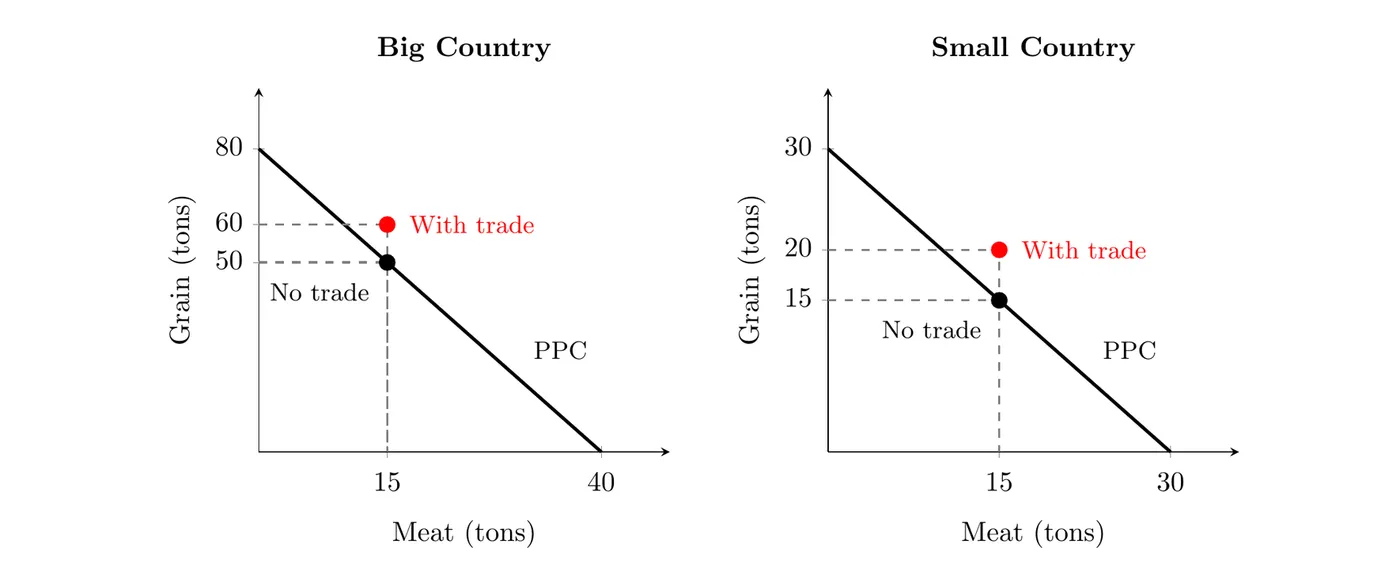
Why 3/4 works for both: Big Country gets 3/4 ton of meat for each ton of grain it gives up, while making that meat at home would have cost it 1.5 tons of grain. Small Country pays only 3/4 ton of meat for each ton of grain, while making grain at home would cost it a full ton of meat. If the price fell outside the range (say, 1 grain for 1.2 meat), Small Country would rather make its own grain, and the trade wouldn’t happen.
If you’re given PPCs instead of a table, the intercepts are the same numbers the table would show, and the slope of a straight-line PPC (ignoring the minus sign) is the opportunity cost of the good on the horizontal axis.
In an input problem (hours or workers needed per unit), absolute advantage goes to whoever needs fewer hours, and you use the “it over” trick for opportunity cost. Every other step is the same.
Takeaway
A country or person can have an absolute advantage in literally everything, being faster or more productive across the board, but it’s mathematically impossible to have a comparative advantage in everything. By sticking to what you can produce at the lowest relative cost and trading for the rest, everyone ends up able to consume more than they could alone.