

2.2 - Defining the Derivative of a Function and Using Derivative Notation
What is a Derivative?
A derivative is an expression that calculates the instantaneous rate of change of a function. In other words, it gives you the slope of the tangent line to a function at any given -value.
Visual Understanding
Consider the function , whose derivative is .
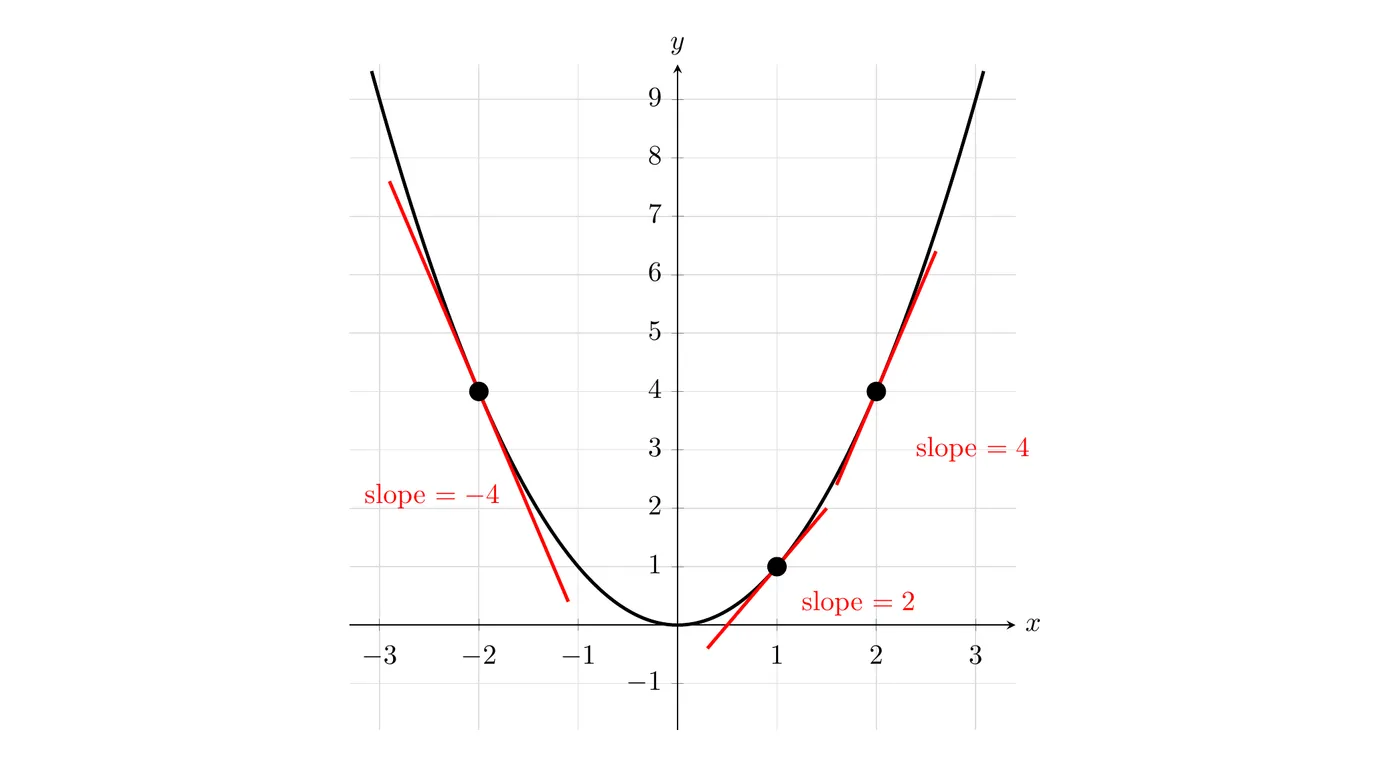
At : , so the tangent line has slope 2.
At : , so the tangent line has slope 4.
At : , so the tangent line has slope -4.
Key insight: The derivative function tells you the slope of the original function at any point you choose.
Interpreting Derivatives
Example 1: Function Values vs. Derivative Values
Given only the derivative , find .
Interpretation: The slope of the tangent line to at is .
Notice we never needed to know what actually is. The derivative gives us the slope directly.
Example 2: Real-World Context
Let represent the distance in meters you have run, where is time in minutes.
Interpret :
After 8 minutes, I have run 1200 meters. This is a function value, so it tells us position at a specific time.
Interpret :
At the 5-minute mark, I was running at a rate of 180 meters per minute. This is a derivative value, so it tells us the rate of change (speed) at a specific instant.
Critical distinction:
- gives position
- gives the rate of change of position (velocity)
The derivative always represents a rate, so the units should include “per”: meters per minute, miles per hour, and so on.
Derivative Notation
There are several ways to write derivatives, and you should recognize all of them.
Notation | Name | Read as |
Lagrange notation | “f prime of x” | |
Prime notation | “y prime” | |
Leibniz notation | “dee y dee x” or “the derivative of y with respect to x” |
When to Use Each
Lagrange notation : when your function is written as
Prime notation : when your function is written as
Leibniz notation : emphasizes that you’re finding how changes with respect to . Later you’ll see variations like , which is how the radius changes with respect to time.
All three mean the same thing: the derivative.
At a specific point: to write the derivative at one -value, plug that value in, like . In Leibniz notation you’ll see , read “dy/dx at .” Both mean the slope of the tangent line at .
The symbol: by itself means “take the derivative, with respect to , of whatever comes next.” So just says the derivative of is . You’ll see this a lot starting with the power rule in Topic 2.5.
The Definition of the Derivative
The derivative of a function at any point is defined as:
What it’s saying:
- Start at the point
- Move a tiny distance to the right, to
- Calculate the slope between those two points
- Let approach zero, making the points infinitely close
This works provided the limit exists. That’s the difference from Topic 2.1: there, was one fixed number, so the limit gave one slope, . Here, stays a variable, so the limit gives a whole new function, , that outputs the slope of at every where the limit exists. Those -values make up the domain of , which can be smaller than the domain of (more on that in Topic 2.4).
From Secant Line to Tangent Line
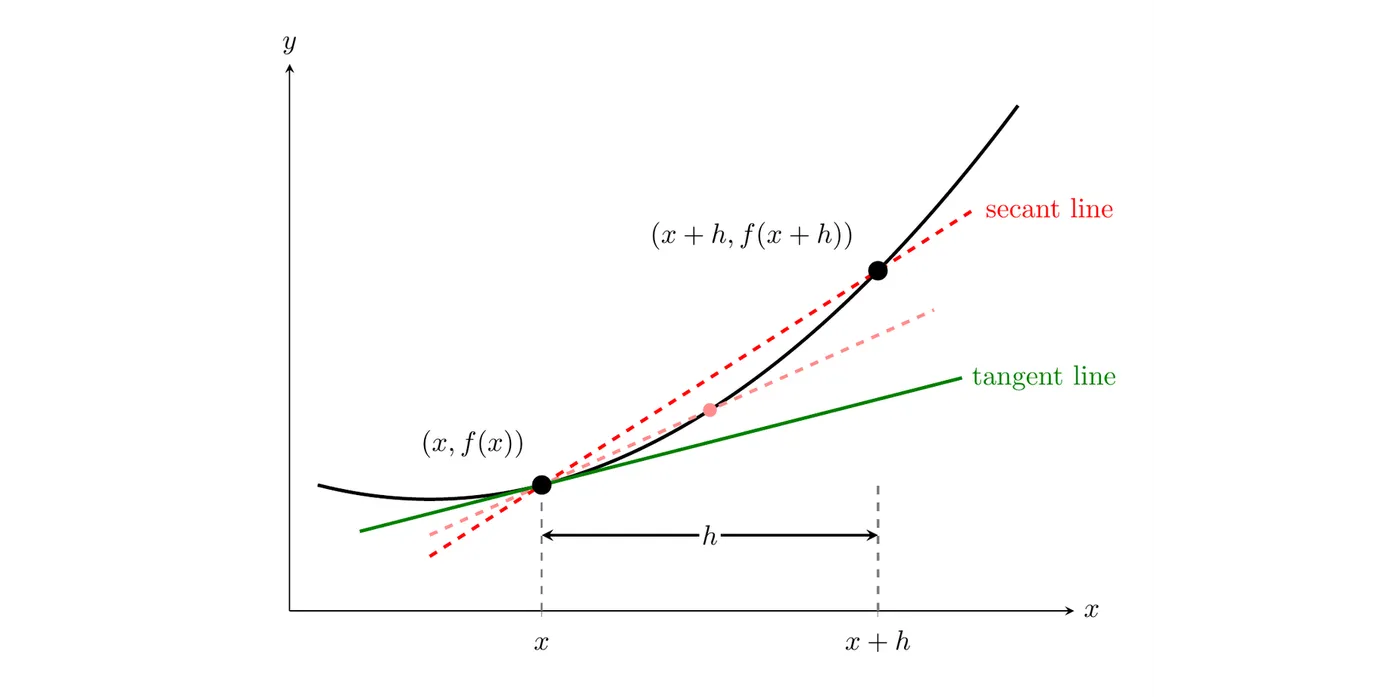
Secant line (red): connects two points, slope
Tangent line (green): touches at one point, slope
As , the secant line approaches the tangent line.
Finding Derivatives Using the Definition
Example 3: Polynomial Function
Find the derivative of using the definition.
Step 1: Write the definition
Step 2: Find
Step 3: Set up the difference quotient
Step 4: Simplify the numerator
Step 5: Factor out
Step 6: Cancel
Step 7: Evaluate the limit
Answer:
This derivative gives the slope of at any -value.
Example 4: Rational Function
Find the derivative of using the definition.
Step 1: Set up the definition
Step 2: Substitute
Step 3: Find a common denominator in the numerator
Step 4: Expand
Step 5: Multiply by the reciprocal of
Step 6: Factor from the numerator
Step 7: Cancel
Step 8: Evaluate the limit
Answer:
Good News: Shortcuts Are Coming
The process above is algebraically brutal. The good news is that you’ll learn shortcut rules soon that make finding derivatives way faster.
So why learn the long way first?
- Understanding the limit definition helps you recognize derivative expressions on exams
- It connects what you learned about limits to the concept of derivatives
- Some AP exam questions ask you to identify the original function from a limit expression
For the rest of the year: you’ll use shortcut rules, not this lengthy limit process.
Equation of a Tangent Line
Finding the equation of a tangent line is one of the most common applications of derivatives.
Point-Slope Form
where is a point on the line and is the slope.
For Tangent Lines
where:
- is the -value where you want the tangent line
- is the -coordinate of the point on the curve
- is the slope of the tangent line, from the derivative
Three things you need:
1. The -value:
2. The -value:
3. The slope:
Example 5: Writing a Tangent Line Equation
The point lies on the curve , and . Write the equation of the tangent line at .
What we have:
- , the -value
- , the -value
- , the slope
Apply point-slope form:
Answer:
Note: Unless you’re specifically asked to solve for (slope-intercept form), you can leave your answer in point-slope form.
Example 6: The Complete Process
Given and , find the equation of the tangent line at .
Step 1: Find the -coordinate
Step 2: Find the slope
Step 3: Write the equation
Answer:
Reading Derivative Graphs
Sometimes you’re given the graph of the derivative instead of the original function .
Key Understanding
If you’re looking at the graph of :
- The -values on that graph tell you slopes of
- To find , look at the point where on the derivative graph
Example 7: Using a Derivative Graph
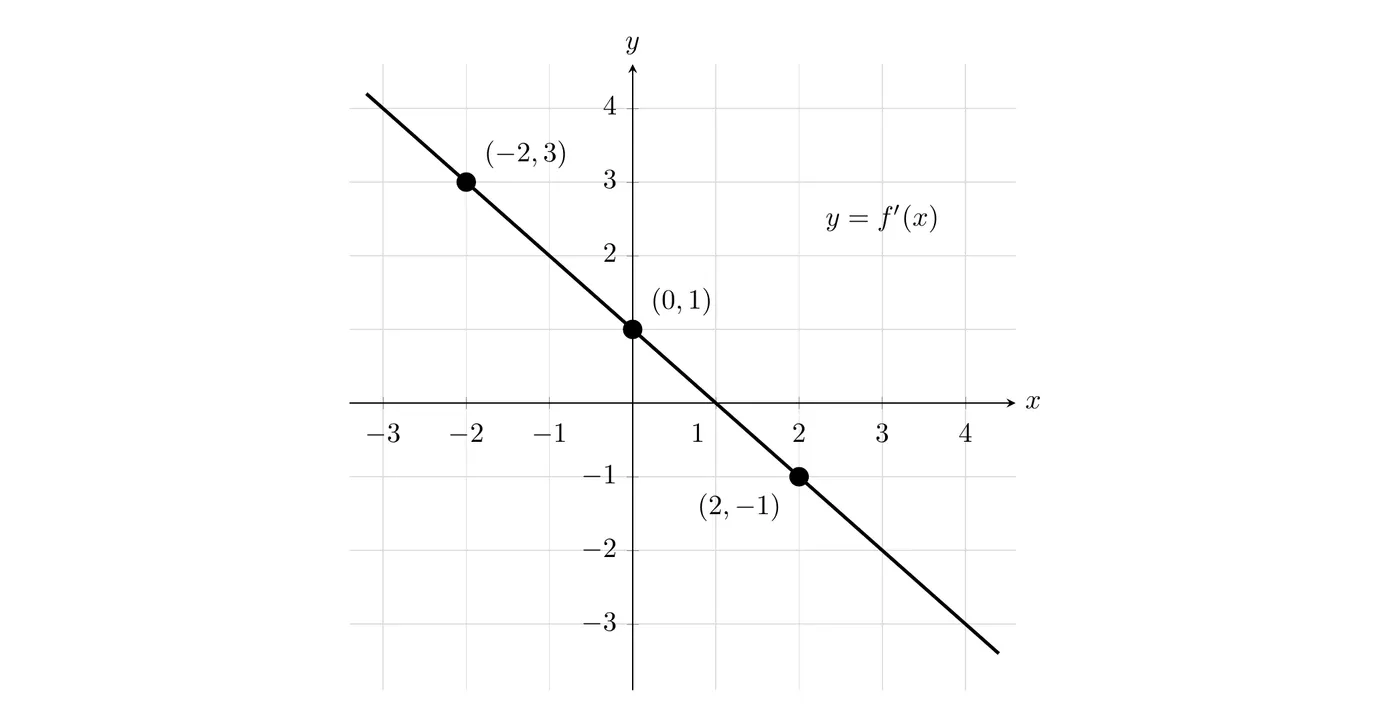
The graph above shows , the derivative. Given that , write the equation of the tangent line to at .
Step 1: We already know , since it’s given.
Step 2: Find the slope from the derivative graph. Look at on the graph. The -value there is , so .
Step 3: Write the tangent line equation
Answer:
Important: When you’re reading from a derivative graph, remember you’re reading slope values, not function values.
Four Ways to Represent a Derivative
A derivative can show up in four forms, and AP questions switch between them all the time. They all describe the same thing: how fast the function is changing.
Representation | What it looks like | Example |
Graphical | The slope of the tangent line on a graph of , or the -value on a graph of | Example 7: , read from the graph of |
Numerical | A table of values, where you estimate the slope from nearby points | Topic 2.3: estimates |
Analytical | A formula, from the definition or the derivative rules | Example 3: |
Verbal | A sentence with units that describes a rate | Example 2: at the 5-minute mark, you’re running 180 meters per minute |
Practice Problems
Problem 1
Find the derivative of using the definition.
Answer:
After simplification:
Problem 2
If and , write the equation of the tangent line at .
Answer:
Problem 3
A car’s position in miles after hours is given by . Interpret .
Answer: After 2 hours, the car is traveling at 65 miles per hour.
Key Takeaways
- The derivative gives the slope of the tangent line at any point
- Three notations, , , and , all mean the same thing
- Derivative = instantaneous rate of change
- Definition:
- Derivatives represent rates, so include “per” in the units
- Tangent line equation:
- You need three things for a tangent line: the -value, the -value, and the slope
- When reading derivative graphs, -values represent slopes of the original function
- Finding derivatives by definition is algebraically intensive, but shortcuts are coming
- Understanding the definition helps you recognize derivative expressions on exams
- Leave tangent line equations in point-slope form unless told otherwise
- The derivative can be shown four ways: graphically, numerically, analytically, and verbally