

2.5 - Applying the Power Rule
Introduction
The power rule is one of the most famous and useful tools in calculus. It’s a shortcut that lets you find derivatives quickly without using the limit definition.
Previously, to find the derivative of , we had to use:
That process was algebraically intensive. Now we have a shortcut.
Discovering the Pattern
If we used the limit definition to find derivatives of power functions, we’d get:
Original Function | Derivative |
See the pattern? The exponent becomes the coefficient, and the new exponent is one less than the original.
Where the Pattern Comes From
Here’s the limit definition applied to . Expand first:
The same thing happens for any whole-number power . When you expand , the cancels, the next term is always , and every term after that has at least in it. After you divide by , those leftover terms still have an , so they go to . All that’s left is .
The Power Rule Formula
For any function of the form , where is any real number:
In words:
1. Bring the exponent down as a coefficient
2. Subtract 1 from the exponent
Alternative notation: if , then
Basic Examples
Example 1: Large Positive Exponent
Find the derivative of .
Process: the exponent 37 comes down as the coefficient, and the new exponent is .
Example 2: Another Basic Power
Find if .
Negative Exponents
Example 3: Reciprocal Function
Find the derivative of .
Step 1: Rewrite with a negative exponent
Step 2: Apply the power rule
Step 3: Rewrite with a positive exponent
Example 4: Higher Negative Power
Differentiate .
Rewrite:
Apply the power rule:
Final answer:
Fractional Exponents (Radicals)
Example 5: Square Root
Find the derivative of .
Step 1: Rewrite as a fractional exponent
Step 2: Apply the power rule
Step 3: Rewrite as a radical
Example 6: Seventh Root
Differentiate .
Step 1: Rewrite as a fractional exponent
Step 2: Apply the power rule
Step 3: Simplify the exponent
Step 4: Rewrite with a positive exponent
Simplifying Before Differentiating
Sometimes you need to simplify the function before applying the power rule.
Example 7: Quotient of Powers
Find and evaluate for .
Step 1: Rewrite with exponents
Step 2: Simplify using exponent rules
Step 3: Apply the power rule
Step 4: Evaluate at
Interpretation: this is the slope of the tangent line to at .
Example 8: Product Under a Radical
Find for .
Step 1: Rewrite with exponents
Step 2: Add exponents, since the bases are the same
Step 3: Apply the power rule
Step 4: Evaluate at
Step 5: Simplify
Pro tip: when evaluating at specific values, compute roots before powers whenever you can.
- is easy
- is manageable
- That’s way easier than computing first
Parallel Tangent Lines
Two curves have parallel tangent lines at certain -values if their derivatives (their slopes) are equal at those points.
The Concept
Parallel lines have equal slopes. So in calculus, if and have parallel tangent lines at , then:
Example 9: Finding Points of Parallel Tangency
Find all -values where and have parallel tangent lines.
Step 1: Find both derivatives
Step 2: Set the derivatives equal
Step 3: Move everything to one side
Step 4: Factor
Step 5: Solve using the zero product property
Answer: the tangent lines are parallel at and .
Visual Understanding
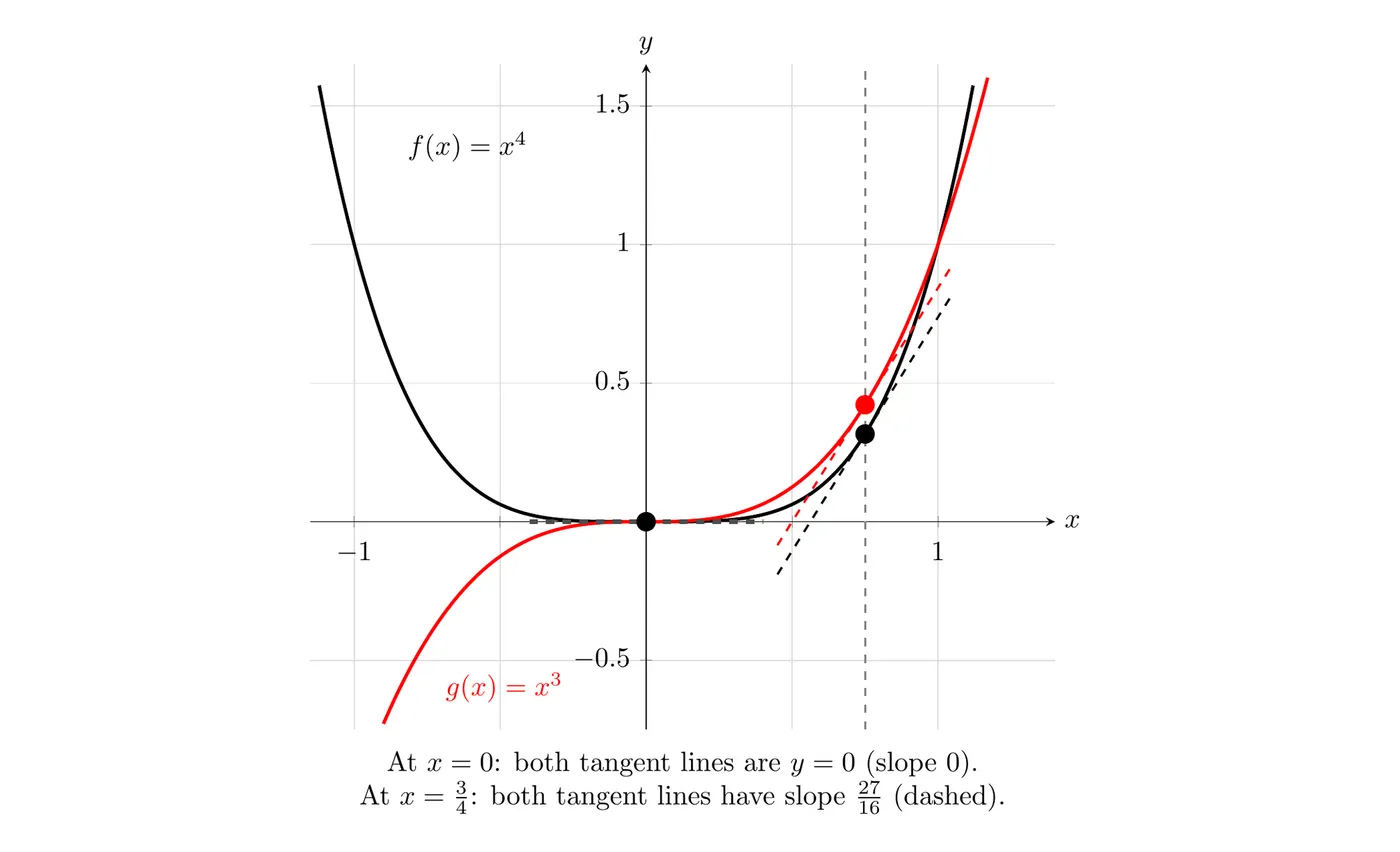
At : both functions have horizontal tangent lines, with slope 0.
At : both functions have tangent lines with the same positive slope.
Important: parallel tangent lines don’t mean the curves intersect at those points. It just means their slopes match.
Practice Problems
Problem 1
Find the derivative of .
Answer:
Problem 2
Differentiate .
Answer:
Problem 3
Find for .
Answer:
Problem 4
Find if .
Answer:
Problem 5
Where do and have parallel tangent lines?
Answer:
Common Mistakes to Avoid
Mistake 1: Forgetting to subtract 1
❌ Wrong:
✓ Correct:
Mistake 2: Subtracting from negative exponents incorrectly
❌ Wrong:
✓ Correct: , because
Mistake 3: Subtracting from fractions incorrectly
❌ Wrong:
✓ Correct: , because
Mistake 4: Computing large powers inefficiently
When evaluating something like :
❌ Wrong approach: compute first, which is over a million
✓ Correct approach: compute first, then
Mistake 5: Using the power rule when the variable is in the exponent
❌ Wrong:
✓ Correct: the power rule only works when the base is the variable and the exponent is a constant, like . In , the variable is in the exponent, so it’s an exponential function. You’ll learn its derivative in Topic 2.7.
Key Takeaways
- Power rule: for any real number
- It works for positive, negative, and fractional exponents
- Process: bring the exponent down, then subtract 1 from the exponent
- Always rewrite radicals and fractions as exponents first
- Simplify expressions before differentiating when you can
- The derivative gives the slope of the tangent line at any point
- Parallel tangent lines occur where the derivatives are equal
- When evaluating at specific values, take roots before powers for easier calculation
- Be careful with negative and fractional exponents when subtracting 1
- The power rule is much faster than the limit definition
- You’ll use this rule constantly throughout calculus