

2.1 - Defining Average and Instantaneous Rates of Change at a Point
Introduction to Rate of Change
Rate of change is something you’ve been working with since middle school. It’s just slope. In this lesson we’ll review average rate of change and introduce instantaneous rate of change, which is the foundation for derivatives.
Important: You’ll need a graphing calculator for this lesson, and make sure it’s set to RADIAN mode, not degrees. This matters any time you use sine, cosine, or tangent.
Average Rate of Change (Review)
Definition: Slope Between Two Points
The average rate of change is the slope of the line connecting two points on a function.
Slope formula:
For a function on the interval :
Alternative form (the order doesn’t matter as long as you’re consistent):
Example 1: Finding Average Rate of Change Algebraically
Find the average rate of change of on the interval .
Step 1: Apply the formula
Step 2: Evaluate each function value
Step 3: Substitute
Step 4: Calculate with a calculator
Answer: (rounded to three decimal places)
Using Calculator Function Notation
For complicated functions, there’s an efficient calculator method that saves you from retyping expressions.
Calculator Steps (TI-84)
Step 1: Enter your function in
Y1. Press Y= and enter the function, like ln(2X).Step 2: Return to the home screen with
2nd → QUIT.Step 3: Use function notation. Press
VARS → scroll right to Y-VARS → select Function → choose Y1.Step 4: Evaluate at specific values. Type
Y1(5) and press ENTER to get , then Y1(2) for .Step 5: Calculate the rate of change. Type
(Y1(5) - Y1(2))/3 and press ENTER.This is especially handy for long, complicated functions.
Critical Warning: Avoid Rounding Errors
The Problem with Early Rounding
Wrong approach:
That gives an incorrect answer because of rounding error.
The Correct Approach: Round Only at the End
Keep full precision the whole way through. Only round (or truncate) to three decimal places at the very final answer.
Rule: Never round intermediate steps. Let your calculator hold onto all the digits until the end.
Example 2: Average Rate of Change from a Table
Given the table below, find the average rate of change of on the interval .
3 | 10 | 25 | 40 | |
8 | 15 | -3 | 12 |
Identify the right values: We only need and , so and .
Calculate:
Answer: , or
Common mistake: Don’t assume the numbers in the first row go in the numerator. The -values (function values) go on top and the -values go on the bottom.
Introduction to Instantaneous Rate of Change
The Secant Line
The average rate of change is the slope of a secant line, which is a line connecting two points on a curve.
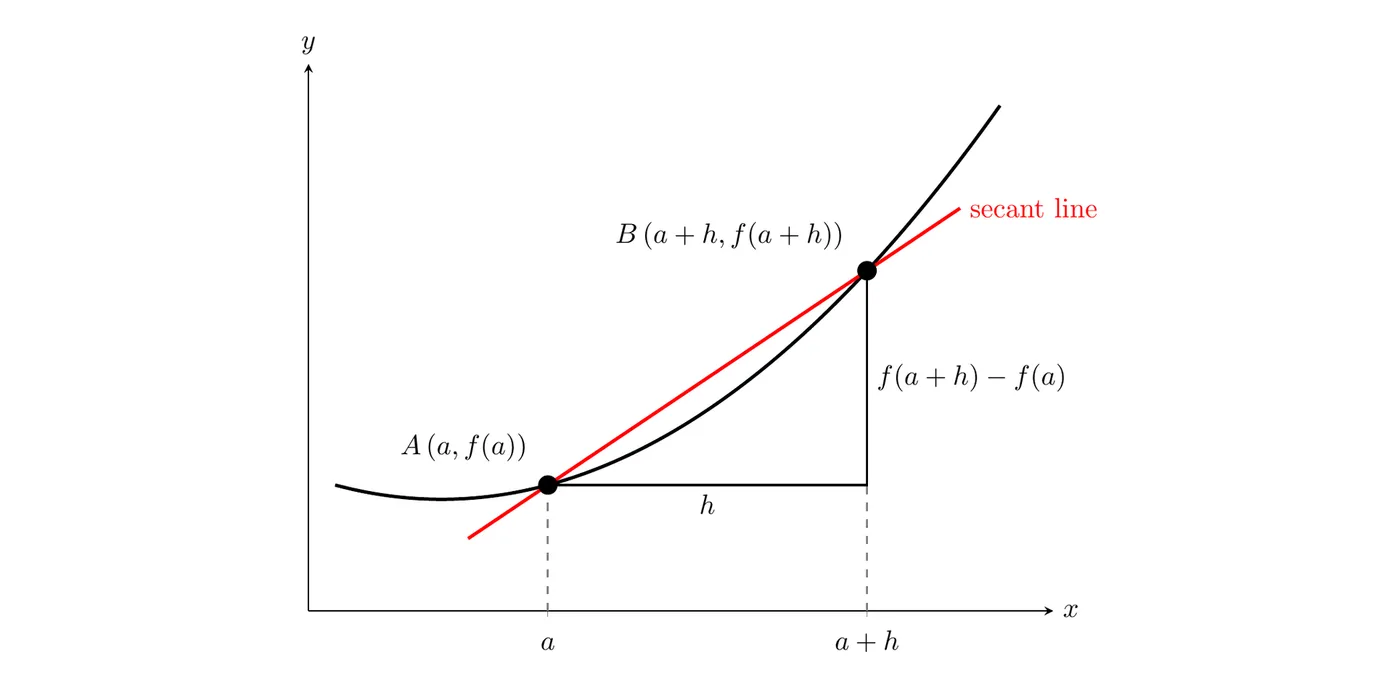
The secant line connects and .
Slope of the secant line:
The Tangent Line (Instantaneous Rate of Change)
So what happens as the two points get closer together? As , the secant line approaches the tangent line.
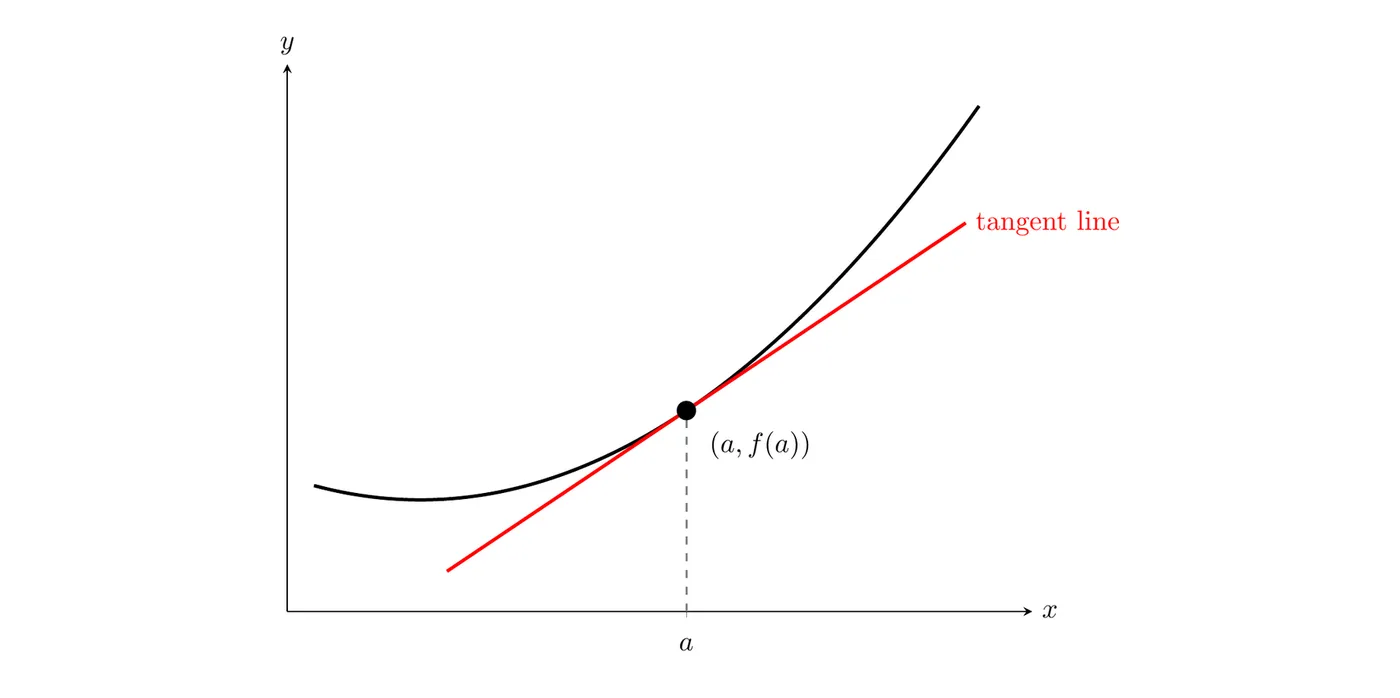
The tangent line touches the curve at the point and represents the instantaneous rate of change at that point. (It can cross the curve again somewhere else. What matters is that it matches the curve’s direction right at that point.)
Instantaneous rate of change at :
This limit gives you the slope of the tangent line at the point .
Watching it happen with numbers. Take at . For any , the secant slope simplifies to . Here’s what happens as shrinks toward from both sides:
Secant slope |
The secant slopes close in on from both sides, so the instantaneous rate of change of at is .
Two Forms of the Definition
There are two equivalent ways to express instantaneous rate of change.
Form 1: Using
What it’s saying:
- Start at the point
- Move units to the right, to
- Find the slope between those points
- Let approach zero
Form 2: Using
What it’s saying:
- Start at the point
- Consider another point
- Find the slope between those points
- Let approach
Both forms give you the same result.
Before you take the limit, both fractions are difference quotients, and each one is an average rate of change. is the average rate of change of on the interval from to , and is the average rate of change on the interval from to . Taking the limit is what turns an average rate into an instantaneous one.
The value of either limit is called the derivative of at , written and read “f prime of a.” This only works provided the limit exists. If the limit doesn’t exist (for example, the left side and the right side approach different values), then doesn’t exist and there’s no instantaneous rate of change at . Topic 2.4 shows when that happens.
Finding Instantaneous Rate of Change
Example 3: Using Form 1 (with )
Find the instantaneous rate of change of at .
Step 1: Identify and . Here and .
Step 2: Set up the limit
Step 3: Evaluate
Step 4: Evaluate
Step 5: Substitute and simplify
Step 6: Cancel
Step 7: Evaluate the limit
Answer: The instantaneous rate of change at is 3. That means the slope of the tangent line to the curve at is .
Example 4: Using Form 2 (with )
Find the instantaneous rate of change of at , this time using the alternate form.
Step 1: Set up the limit
Step 2: Substitute
Step 3: Factor the numerator
Step 4: Cancel
Step 5: Evaluate
Answer: 3, the same as Form 1.
Recognizing Derivative Expressions
On AP Calculus exams, you’ll need to identify the original function and the point from a limit expression.
Example 5: Identify from Form 1
Given:
What’s the original function and the point?
Identify the pattern:
The function: Look at the first term, , so
The point: Where is being added? It’s added to make , so .
Answer: at
Example 6: Identify from Form 2
Given:
What’s the original function and the point?
Identify the pattern:
The function:
The point: , the value approaches.
Answer: at
Practice Problems
Problem 1
Find the average rate of change of on .
Answer:
Problem 2
Find the instantaneous rate of change of at .
Answer:
Problem 3
Identify the function and the point:
Answer: at
Key Takeaways
- Average rate of change is the slope between two points:
- Use calculator function notation for complicated expressions
- Never round early. Only round to three decimals at the final answer
- A secant line connects two points, and its slope is the average rate of change
- A tangent line touches at one point, and its slope is the instantaneous rate of change
- Two forms for instantaneous rate of change:
- Form 1:
- Form 2:
- Both forms give the same answer
- The value of the limit is , the derivative at , provided the limit exists
- Later you’ll learn shortcut rules for finding derivatives, but you have to understand this limit definition first
- On exams, you’ll need to identify the original function and point from limit expressions
- This concept is the foundation for derivatives