

2.6 - Derivative Rules: Constant, Sum, Difference, and Constant Multiple
Three Fundamental Rules
These three rules make taking derivatives way faster. They build on the power rule and let you handle more complicated functions.
Rule 1: Derivative of a Constant
The derivative of any constant is zero.
where is any constant.
Why This Makes Sense
Take the function . That’s just a horizontal line.
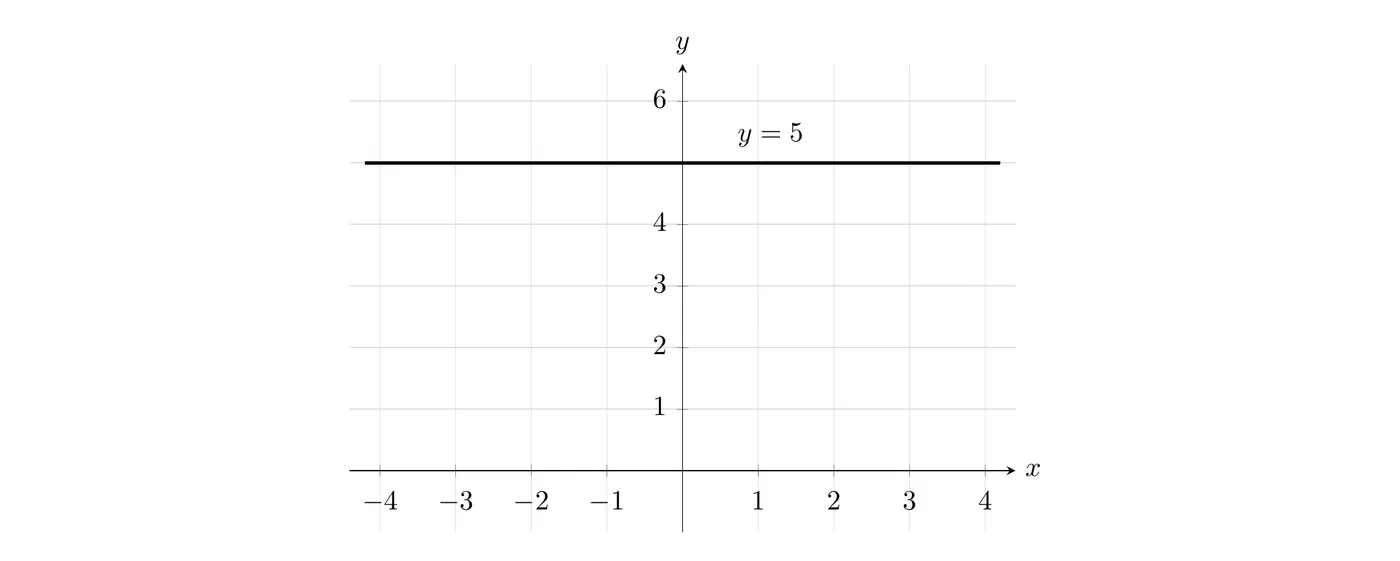
What’s the slope of that line? Zero. And since the derivative is the slope, .
Examples
Example 1:
Example 2:
Example 3:
Common Mistake: Special Constants
Watch out for these:
Even though and are special, they’re still just numbers. Their derivatives are zero. Remember that and are constants, not variables.
Rule 2: Constant Multiple Rule
The derivative of a constant times a function is just the constant times the derivative of the function.
In words: pull the constant out front, then take the derivative.
Example 4: Basic Constant Multiple
Find the derivative of .
The 7 just stays in front while you power-rule the .
Example 5: Negative Constant
Differentiate .
Example 6: Fraction as Constant Multiple
Find the derivative of .
Step 1: Rewrite it as a constant multiple.
Step 2: Apply the rule.
Key idea: dividing by a constant is the same thing as multiplying by its reciprocal.
Rule 3: Sum and Difference Rule
The derivative of a sum or difference is just the sum or difference of the derivatives.
In words: take the derivative of each term separately.
Example 7: Polynomial with Multiple Terms
Find the derivative of .
Go term by term:
Breakdown:
- (power rule with a constant)
- (power rule with a constant)
- (power rule: )
- (constant rule)
Example 8: Mixed Terms with Fractions
Differentiate .
Step 1: Rewrite with negative exponents.
Step 2: Differentiate term by term.
Step 3: Rewrite with positive exponents.
Example 9: Radicals and Constants
Find for .
Step 1: Rewrite.
Step 2: Differentiate.
Step 3: Rewrite.
Note that is a constant (roughly ), so its derivative is zero.
Application: Horizontal Tangent Lines
A horizontal tangent line happens wherever the slope equals zero.
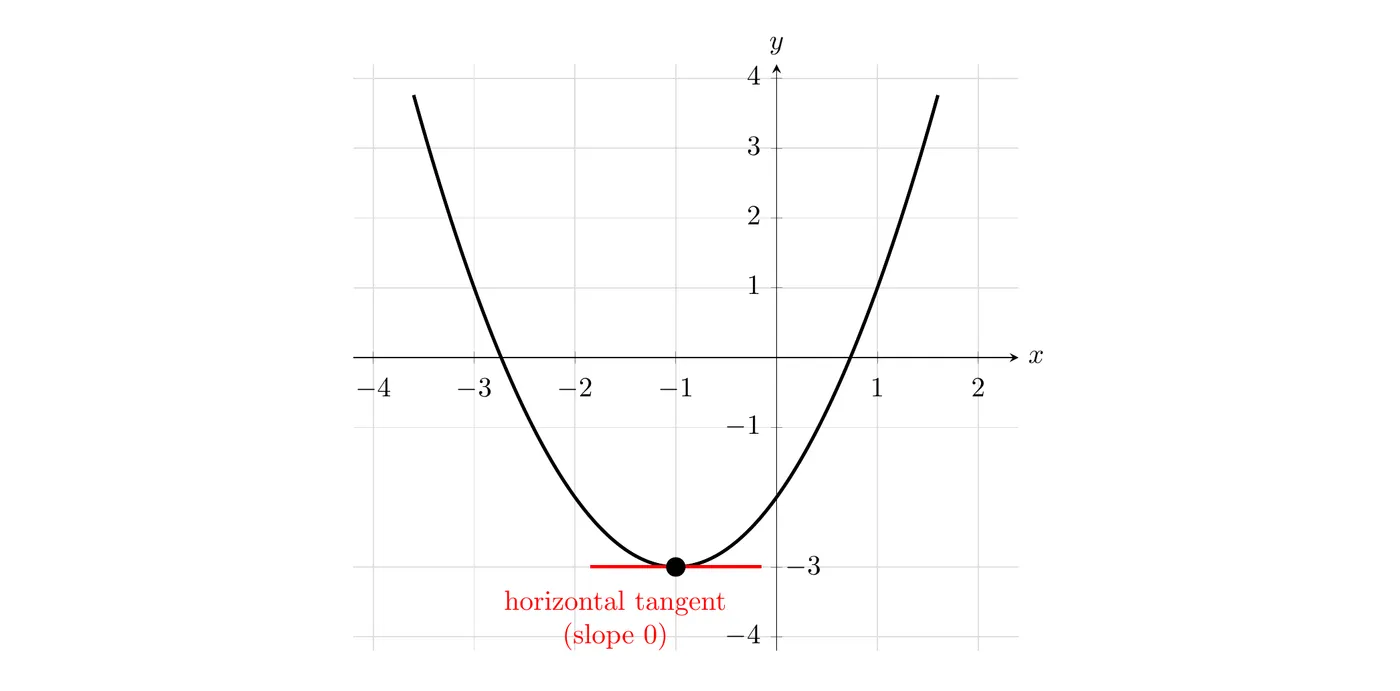
To find them:
- Find the derivative (the slope function)
- Set the derivative equal to zero
- Solve for
Example 10: Finding Horizontal Tangents
Find where has a horizontal tangent line.
Step 1: Find the derivative.
Step 2: Set it equal to zero.
Step 3: Solve.
So there’s a horizontal tangent at , which is the minimum of the parabola.
Application: Normal Lines
A normal line is perpendicular to the tangent line at a given point.
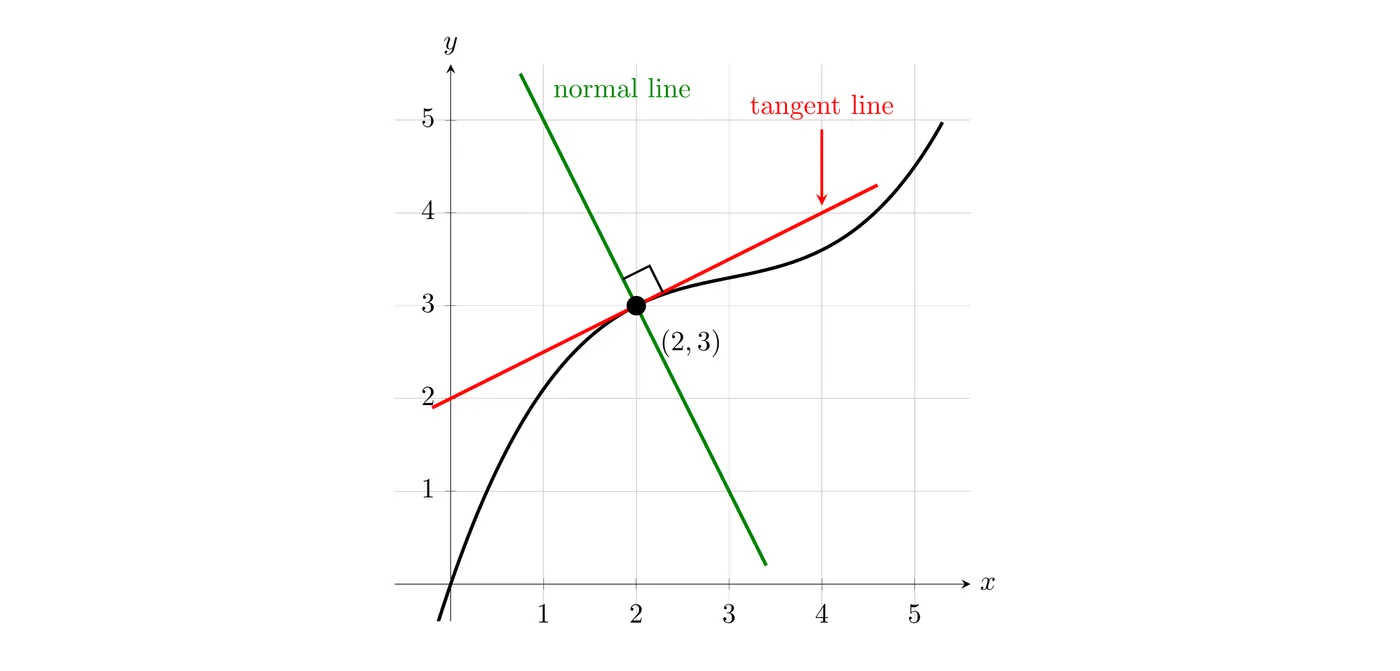
The key concept: perpendicular lines have slopes that are negative reciprocals. If the tangent line has slope , the normal line has slope .
Example 11: Equation of a Normal Line
Find the equation of the normal line to at .
Step 1: Find the point.
Step 2: Find the derivative.
Step 3: Find the tangent slope.
Step 4: Find the normal slope.
Step 5: Write it in point-slope form.
Differentiability of Piecewise Functions
A piecewise function is differentiable at a boundary point if two things are true:
- The function is continuous there (the pieces actually connect)
- The derivatives are equal there (no sharp corner)
Example 12: Testing Differentiability
Is this differentiable at ?
Test 1: Continuity. Check whether the pieces meet at .
Left piece:
Right piece:
Since , it’s not continuous at , so it’s not differentiable there either. You don’t even need the second test.
Example 13: Not Continuous, So Not Differentiable
Is this differentiable at ?
Test 1: Continuity.
Left piece:
Right piece:
Since , not continuous, so not differentiable.
Example 14: Continuous but Not Differentiable
Is this differentiable at ?
Test 1: Continuity.
Left piece:
Right piece:
Since , the function is continuous. Now test the derivatives.
Test 2: Equal derivatives.
Left piece: , and at that’s
Right piece: , and at that’s
Since , the derivatives don’t match. So the function is continuous but not differentiable at . There’s a sharp corner.
What would make it differentiable? If the right piece were instead, it would still give at (continuous), and its slope would be , matching the left piece. Then both tests pass, and the function would be differentiable at .
Finding Unknown Constants
Sometimes you have to find the constants that make a piecewise function differentiable.
Example 15: Finding Two Constants
Find and that make this differentiable everywhere:
Condition 1: Continuity at . Set the pieces equal.
Condition 2: Equal derivatives at .
Left derivative: , which at gives
Right derivative:
Solve: Since , we get .
Answer: and
Practice Problems
Problem 1. Find the derivative:
Problem 2. Where does have a horizontal tangent?
, so
Problem 3. Find the normal line to at .
Point: . , so the normal slope is . Equation:
Key Takeaways
- Derivative of a constant is zero:
- Constant multiple rule:
- Sum/difference rule: differentiate each term separately
- Horizontal tangent happens where
- Normal line is perpendicular to the tangent, so the slopes are negative reciprocals
- Differentiability requires both continuity (pieces connect) and equal derivatives (no corner)
- Not continuous automatically means not differentiable
- Continuous does not guarantee differentiable, since there could be a corner
- To find unknowns, set up two equations: continuity and equal derivatives