These are the derivative rules for sine, cosine, exponential, and logarithmic functions. You’ll use them constantly, so memorizing them isn’t optional.
Derivatives of Trig Functions
dxd[sinx]=cosx
The derivative of sine is cosine.
dxd[cosx]=−sinx
The derivative of cosine is negative sine.
Memory tip: the derivative of cosine picks up a negative sign. Functions that start with “c” (cosine, and later cotangent and cosecant) all have a negative sign in front of their derivatives.
Example 1: Basic Trig Derivatives
Find the derivative of f(x)=3sinx−4cosx.
f′(x)=3cosx−4(−sinx)=3cosx+4sinx
The −4cosx becomes −4(−sinx), and the two negatives cancel into a positive.
Example 2: Mixed Functions
Differentiate g(x)=5cosx+2x3−sinx.
g′(x)=5(−sinx)+6x2−cosx=−5sinx+6x2−cosx
Properties Worth Remembering First
Natural Logarithm Properties
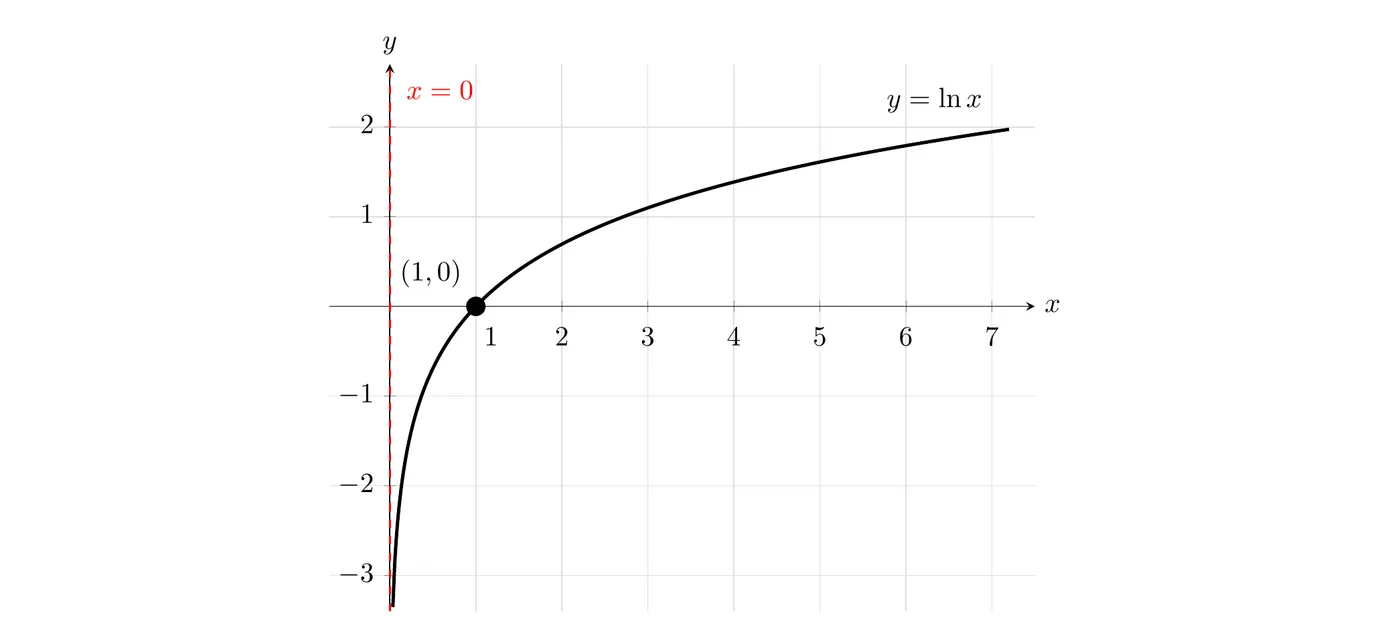
ln(1)=0ln(0)=undefined
Why is ln(0) undefined? Because the graph of y=ln(x) has a vertical asymptote at x=0.
Since the function never actually reaches x=0, ln(0) is undefined.
Exponential Properties
e0=1
(Any nonzero number to the zero power is 1.)
Inverse Properties
eln(a)=aln(ea)=a
The natural exponential and the natural log are inverses, so they undo each other.
Derivatives of Exponential Functions
Rule 1: Derivative of ex
dxd[ex]=ex
The derivative of ex is itself. One of the most elegant results in calculus.
Rule 2: Derivative of ax (general base)
For any positive constant a=1:
dxd[ax]=axln(a)
The pattern: keep the function, then multiply by the natural log of the base.
Why ex is special: when a=e
dxd[ex]=ex⋅ln(e)=ex⋅1=ex
Since ln(e)=1, the extra factor just disappears.
Example 3: Exponential with Base e
Find the derivative of f(x)=7ex+3x2.
f′(x)=7ex+6x
The derivative of ex is just ex, so the 7 stays put.
Example 4: Exponential with Another Base
Differentiate h(x)=5x−2x.
h′(x)=5xln(5)−2
Since the base is 5 and not e, you have to include ln(5).
Example 5: Multiple Exponentials
Find g′(x) for g(x)=4ex+2x.
g′(x)=4ex+2xln(2)
The 4ex term gives 4ex
The 2x term gives 2xln(2)
Derivatives of Logarithmic Functions
Rule 1: Natural Log
dxd[lnx]=x1
Simple and important.
This rule only works for x>0, because that’s the domain of lnx. The formula x1 gives a number for negative x too, but lnx doesn’t exist there, so neither does its derivative. (Remember from Topic 2.4: a point that isn’t in the domain of f isn’t in the domain of f′.)
Rule 2: General Log
For any positive constant a=1:
dxd[logax]=xln(a)1
The pattern: x1 multiplied by ln(base)1.
Why natural log is special: when a=e
dxd[lnx]=xln(e)1=x⋅11=x1
Example 6: Natural Log
Find the derivative of f(x)=3lnx+5x.
f′(x)=3⋅x1+5=x3+5
Example 7: Log Base 10
Differentiate g(x)=log10x+4x2.
g′(x)=xln(10)1+8x
Base 10 isn’t e, so ln(10) goes in the denominator.
Example 8: Log with Another Base
Find h′(x) for h(x)=log3x−2cosx.
h′(x)=xln(3)1−2(−sinx)=xln(3)1+2sinx
Combining Multiple Rules
Example 9: Mixed Exponential and Trig
Find the derivative of f(x)=4sinx+6ex.
f′(x)=4cosx+6ex
Example 10: All Function Types
Differentiate g(x)=3x−5cosx+ex.
g′(x)=3xln(3)−5(−sinx)+ex=3xln(3)+5sinx+ex
Example 11: Log and Trig
Find h′(x) for h(x)=2log5x+3sinx.
Rewrite: h(x)=2log5x+31sinx
h′(x)=xln(5)2+31cosx
Evaluating Derivatives at Specific Points
Example 12: Evaluate at a Point
Given f(x)=2lnx+ex, find f′(3).
Step 1: Find the derivative.
f′(x)=x2+ex
Step 2: Plug in x=3.
f′(3)=32+e3
That’s the exact answer. Don’t try to simplify e3 any further, it’s irrational (about 20.086).
Example 13: Trig Function at a Specific Point
Find g′(π) if g(x)=4cosx+2sinx.
Step 1: Find the derivative.
g′(x)=−4sinx+21cosx
Step 2: Evaluate at x=π.
g′(π)=−4sin(π)+21cos(π)
Step 3: Use unit circle values. sin(π)=0 and cos(π)=−1.
g′(π)=−4(0)+21(−1)=−21
Example 14: Another Trig Evaluation
Find h′(2π) for h(x)=3sinx−2cosx.
h′(x)=3cosx+2sinx
Using the unit circle, cos(2π)=0 and sin(2π)=1:
h′(2π)=3(0)+2(1)=2
Using Derivatives to Evaluate Limits
In Topic 2.1 you learned to spot the function and the point hiding in a limit like limh→0hf(a+h)−f(a). Now that you know these derivative rules, you can go one step further and actually evaluate the limit, because it equals f′(a). Many of these limits give 00 and are hard to do with algebra, but they take one line with a derivative rule.
Steps:
Match the limit to hf(a+h)−f(a) or x−af(x)−f(a).
Name the function f and the point a.
Find f′(x) with a derivative rule.
Plug in a. The limit equals f′(a).
Example 15: A Sine Limit
Evaluate:
h→0limhsin(6π+h)−21
Step 1: Since sin(6π)=21, this is hf(a+h)−f(a) with f(x)=sinx and a=6π.
Step 2: The derivative of sinx is cosx, so the limit is f′(6π).
h→0limhsin(6π+h)−21=cos(6π)=23
Example 16: A Natural Log Limit
Evaluate limx→1x−1lnx.
Plugging in x=1 gives 00. But ln(1)=0, so the numerator is really lnx−ln(1):
x→1limx−1lnx−ln(1)
That’s x−af(x)−f(a) with f(x)=lnx and a=1. Since f′(x)=x1, the limit is f′(1)=11=1.
Example 17: A Cosine Limit
Evaluate limh→0hcosh−1.
Since cos(0)=1, write it as hcos(0+h)−cos(0). That’s hf(a+h)−f(a) with f(x)=cosx and a=0.
h→0limhcosh−1=−sin(0)=0
Key idea: the number being subtracted in the numerator has to equal f(a). Check that before you use the derivative.
Practice Problems
Problem 1. Find the derivative: f(x)=sinx+cosx+x2
f′(x)=cosx−sinx+2x
Problem 2. Differentiate: g(x)=ex+4x
g′(x)=ex+4xln(4)
Problem 3. Find h′(x) for h(x)=lnx+log2x
h′(x)=x1+xln(2)1
Problem 4. Evaluate f′(1) if f(x)=5lnx+3ex
f′(x)=x5+3ex, so f′(1)=5+3e
Problem 5. Find g′(0) for g(x)=sinx+cosx
g′(x)=cosx−sinx, so g′(0)=1−0=1
Problem 6. Evaluate limh→0he3+h−e3
This is the derivative of ex at x=3, so the limit is e3.
Summary of Derivative Rules
Most Common (memorize these)
Function
Derivative
sinx
cosx
cosx
−sinx
ex
ex
lnx
x1
Less Common (still important)
Function
Derivative
ax
axln(a)
logax
xln(a)1
Key Takeaways
Derivative of sine is cosine (positive)
Derivative of cosine is negative sine
Derivative of ex is itself
Derivative of lnx is x1
For other bases (ax or logax), you have to include ln(a)
ex and lnx are both special because ln(e)=1
Remember the inverse properties: eln(a)=a and ln(ea)=a
When evaluating at specific angles, use unit circle values
These rules combine with the power rule, constant multiple, and sum/difference rules
A limit that matches the definition of the derivative equals f′(a), so you can evaluate it with a derivative rule