

2.3 - Estimating Derivatives of a Function at a Point
Introduction
Graphing calculators can compute derivatives at specific points, even for functions you don’t yet know how to differentiate by hand. That’s incredibly useful for calculator-allowed portions of exams and homework.
Important: You need a graphing calculator for this lesson. If you don’t have a TI-84 or TI-83, look up instructions specific to your calculator model.
Calculator: Finding Derivatives at a Point
The nDeriv Function (TI-84)
Your calculator can estimate the derivative at any specific -value.
Steps:
- Press
MATH
- Scroll down to option 8: nDeriv, or just press
8
- The format appears:
nDeriv(function, variable, value)
Syntax:
nDeriv(f(x), X, a)
where
f(x) is your function, X is the variable, and a is the -value where you want the derivative.Result: this gives you , the slope of the tangent line at .
Example 1: Basic Derivative Calculation
Find if .
Calculator steps:
- Press
MATH→8
- Enter
nDeriv(e^(X)cos(X), X, 3)
- Press
ENTER
Result:
Interpretation: The slope of the tangent line to at is about .
Answer:
Example 2: Function with a Square Root
Find the derivative of at .
Calculator steps:
MATH→8
- Enter
nDeriv(√(X² + 4), X, 5)
- Press
ENTER
Result:
Answer: , rounded to three decimal places
Example 3: Logarithmic Function
Find if .
Calculator steps:
MATH→8
- Enter
nDeriv(ln(3/(X + 1)), X, 2)
- Press
ENTER
Result:
Answer:
Using the Calculator for Tangent Line Equations
Recall: Point-Slope Form
For tangent lines:
What you need:
1. The -value:
2. The -value: , from evaluating the function
3. The slope: , from the calculator derivative
Example 4: Complete Tangent Line Problem
Find the equation of the tangent line to at .
Step 1: Find the -value
Step 2: Find the slope (the derivative at )
Calculator:
nDeriv(X*ln(X), X, 2) gives Step 3: Write the equation
Answer:
Note: Unless you’re asked to solve for , leave it in point-slope form.
Example 5: Another Tangent Line
Write the equation of the tangent line to at .
Find :
Find :
Calculator:
nDeriv(e^(X)/X, X, 1) gives Write the equation:
Answer: , a horizontal tangent line.
Estimating Derivatives from Tables
When you have a table of function values but no formula, you can estimate the derivative using nearby points.
Method: Average Rate of Change
To estimate where sits between and :
Key principle: use the two -values closest to and surrounding your target point.
Example 6: Basic Table Estimation
The function is differentiable. Use the table to estimate .
2 | 5 | 8 | 11 | |
10 | 18 | 30 | 46 |
We want , and the closest surrounding values are at and .
Answer:
Example 7: Table with Units
The table shows distance in kilometers after hours. Estimate .
(hours) | 1 | 3 | 5 | 7 |
(km) | 50 | 140 | 250 | 380 |
Use the surrounding values at and :
Units: since is in kilometers and is in hours, is in kilometers per hour.
Answer: km/h
Interpretation: at hours, the speed is about 50 km/h.
Example 8: Rate of a Rate (Second Derivative Concept)
The function gives velocity in m/s at time in seconds. Estimate .
(seconds) | 0 | 4 | 8 |
(m/s) | 20 | 35 | 44 |
Units:
- is in meters per second (m/s)
- is in seconds (s)
- so is in (m/s) per second, which is m/s²
Answer: m/s²
Interpretation: at seconds, the acceleration is about 3 m/s².
Understanding Units with Derivatives
When the Function is Already a Rate
If represents a rate, like gallons per minute, then represents a rate of change of a rate.
Original function | Derivative |
meters | meters/second |
miles/hour | miles/hour² or (miles/hour)/hour |
gallons/second | gallons/second² or (gallons/second)/second |
Shorthand: “per second per second” becomes “per second squared.”
Example 9: Flow Rate
Water flows from a tank at a rate gallons per minute, where is time in minutes.
(min) | 0 | 5 | 10 |
(gal/min) | 40 | 32 | 20 |
Estimate and give the units.
Units:
- is in gallons per minute
- is in minutes
- so is in (gallons/minute) per minute, which is gallons per minute squared
Answer: gal/min²
Interpretation: at minutes, the flow rate is decreasing at 2 gallons per minute squared.
Estimating Derivatives from Graphs
If all you have is a graph of , then is the slope of the tangent line at . You can estimate it by reading two points off that tangent line.
- Draw the tangent line at (or use the one given). It should touch the curve at that point and match its direction there.
- Pick two points on the tangent line that are easy to read, like spots where it crosses grid lines.
- Find rise over run between those two points.
Quick sign check: if the graph is going up at , then is positive. If it’s going down, is negative. At a smooth peak or valley, where the tangent line is horizontal, .
Example 10: Reading a Slope from a Graph
The graph shows and the line tangent to it at . Estimate , and decide whether is positive or negative.
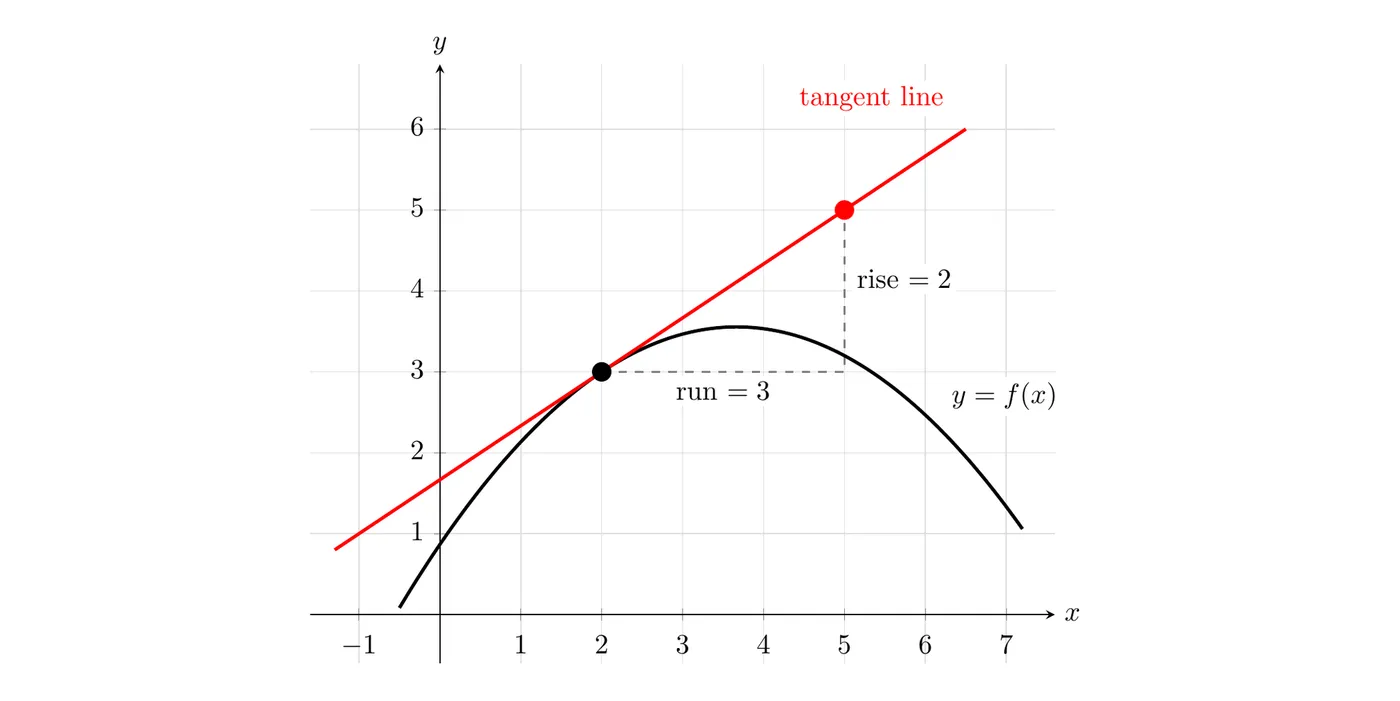
Step 1: Find two easy points on the tangent line. It passes through , the point of tangency, and .
Step 2: Find rise over run.
Step 3: Check the sign. The graph is rising at , so a positive slope makes sense.
For : the graph is falling at (it’s past the peak), so is negative.
Answer: , or about , and .
Important Notes About Calculator Derivatives
Accuracy
The calculator’s
nDeriv function gives you an estimate, not an exact answer. That said, it’s usually accurate to 4 or 5 decimal places, which is way more than enough for our purposes.Watch out:
nDeriv estimates the slope using points on both sides of , so it can give you a number even where the derivative doesn’t exist. For example, nDeriv(abs(X), X, 0) gives , but has a sharp corner at , so doesn’t exist (Topic 2.4). If the graph has a corner, cusp, jump, or vertical tangent at that point, don’t trust the calculator’s answer.When to Use It
- On calculator-allowed portions of exams
- For functions you don’t yet know how to differentiate
- To check your work while you’re learning new derivative rules
When NOT to Use It
- ✗ On no-calculator portions
- ✗ Later in the year, when you’ll be able to do these by hand faster
- ✗ On exam questions that require you to show the process, not just the answer
Practice Problems
Problem 1
Use your calculator to find if .
Answer:
nDeriv(X²sin(X), X, 1) gives about Problem 2
Write the equation of the tangent line to at .
Answer: and , so the equation is
Problem 3
Estimate from the table:
2 | 4 | 6 | |
15 | 23 | 28 |
Answer:
Problem 4
Temperature in degrees Celsius after minutes:
0 | 3 | 6 | |
100 | 85 | 73 |
Estimate with units.
Answer:
Key Takeaways
- Calculator command:
MATH→8fornDerivon the TI-84
- Syntax:
nDeriv(function, X, value)gives the derivative at that point
- The calculator gives approximate values, accurate to several decimal places
- For tangent lines, you need the point and the slope
- From tables, estimate using with surrounding points
- Use the closest surrounding points for the best estimate
- From a graph, estimate as the slope of the tangent line, using two easy-to-read points on it
- Pay attention to units. Derivative units include “per”
- Rate of a rate: “per second per second” becomes “per second squared”
- This method only works if the function is differentiable, meaning smooth and continuous
- Round to three decimal places for final answers
- The calculator is a powerful tool, but you’ll learn to do these by hand soon