Review: Arc Length for Functions From Topic 8.13, the arc length of a function
y = f ( x ) y = f(x) y = f ( x ) on
[ a , b ] [a, b] [ a , b ] is:
L = ∫ a b 1 + [ f ′ ( x ) ] 2 d x L = \int_a^b \sqrt{1 + [f'(x)]^2} \, dx L = ∫ a b 1 + [ f ′ ( x ) ] 2 d x That works when we have a function written explicitly as
y = f ( x ) y = f(x) y = f ( x ) . But what about parametric curves?
Derivation of the Parametric Arc Length Formula Note: you don’t need to memorize this derivation, but seeing where the formula comes from is useful.
Starting Point For a regular function:
L = ∫ a b 1 + ( d y d x ) 2 d x L = \int_a^b \sqrt{1 + \left(\frac{dy}{dx}\right)^2} \, dx L = ∫ a b 1 + ( d x d y ) 2 d x Express in Terms of the Parameter t t t For parametric equations,
d y d x \frac{dy}{dx} d x d y can be written as:
d y d x = d y / d t d x / d t \frac{dy}{dx} = \frac{dy/dt}{dx/dt} d x d y = d x / d t d y / d t Substituting:
L = ∫ a b 1 + ( d y / d t d x / d t ) 2 d x L = \int_a^b \sqrt{1 + \left(\frac{dy/dt}{dx/dt}\right)^2} \, dx L = ∫ a b 1 + ( d x / d t d y / d t ) 2 d x Get Common Denominators Rewrite the 1 with a common denominator:
= ∫ a b ( d x / d t ) 2 ( d x / d t ) 2 + ( d y / d t ) 2 ( d x / d t ) 2 d x = \int_a^b \sqrt{\frac{(dx/dt)^2}{(dx/dt)^2} + \frac{(dy/dt)^2}{(dx/dt)^2}} \, dx = ∫ a b ( d x / d t ) 2 ( d x / d t ) 2 + ( d x / d t ) 2 ( d y / d t ) 2 d x = ∫ a b ( d x / d t ) 2 + ( d y / d t ) 2 ( d x / d t ) 2 d x = \int_a^b \sqrt{\frac{(dx/dt)^2 + (dy/dt)^2}{(dx/dt)^2}} \, dx = ∫ a b ( d x / d t ) 2 ( d x / d t ) 2 + ( d y / d t ) 2 d x Simplify = ∫ a b ( d x / d t ) 2 + ( d y / d t ) 2 d x / d t d x = \int_a^b \frac{\sqrt{(dx/dt)^2 + (dy/dt)^2}}{dx/dt} \, dx = ∫ a b d x / d t ( d x / d t ) 2 + ( d y / d t ) 2 d x When we factor out the denominator, we flip it:
= ∫ a b ( d x / d t ) 2 + ( d y / d t ) 2 ⋅ d t d x d x = \int_a^b \sqrt{(dx/dt)^2 + (dy/dt)^2} \cdot \frac{dt}{dx} \, dx = ∫ a b ( d x / d t ) 2 + ( d y / d t ) 2 ⋅ d x d t d x The d x dx d x Notice that
d t d x ⋅ d x = d t \frac{dt}{dx} \cdot dx = dt d x d t ⋅ d x = d t , which gives us:
L = ∫ a b ( d x d t ) 2 + ( d y d t ) 2 d t L = \int_a^b \sqrt{\left(\frac{dx}{dt}\right)^2 + \left(\frac{dy}{dt}\right)^2} \, dt L = ∫ a b ( d t d x ) 2 + ( d t d y ) 2 d t That’s the parametric arc length formula.
The Parametric Arc Length Formula For parametric equations
x = x ( t ) x = x(t) x = x ( t ) and
y = y ( t ) y = y(t) y = y ( t ) , where
t t t runs from
a a a to
b b b :
L = ∫ a b [ x ′ ( t ) ] 2 + [ y ′ ( t ) ] 2 d t \boxed{L = \int_a^b \sqrt{[x'(t)]^2 + [y'(t)]^2} \, dt} L = ∫ a b [ x ′ ( t ) ] 2 + [ y ′ ( t ) ] 2 d t In words: take the derivative of
x x x with respect to
t t t and square it. Take the derivative of
y y y with respect to
t t t and square it. Add them under a square root, then integrate with respect to
t t t .
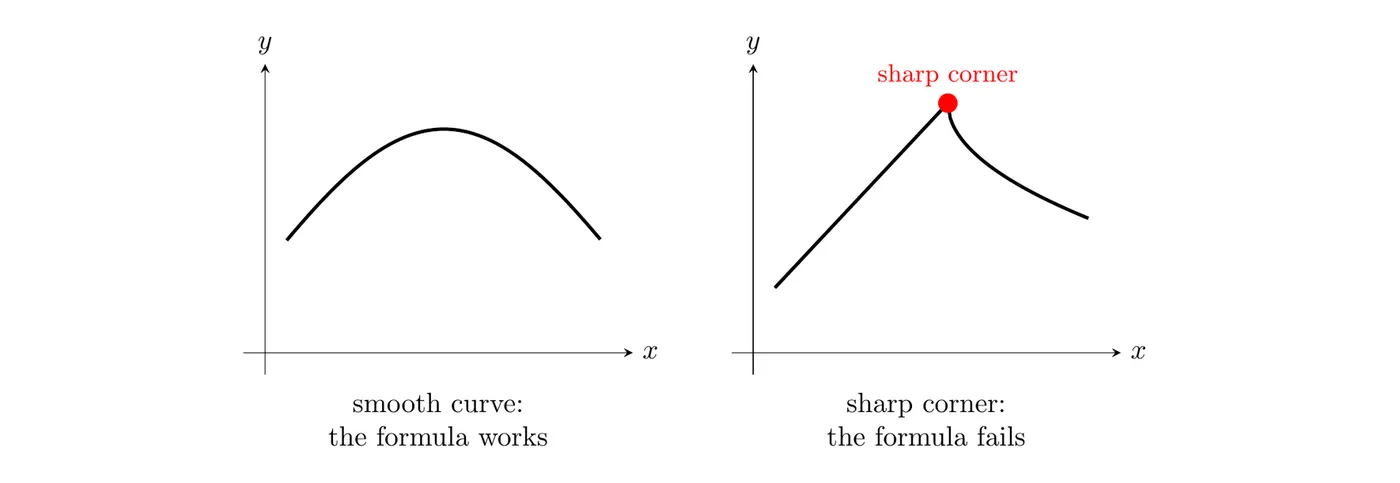
Important Requirements This formula only works when:
- The parametric curve is
smooth , with no sharp corners or cusps
- Both
x ( t ) x(t) x ( t ) and
y ( t ) y(t) y ( t ) are
differentiable on
[ a , b ] [a, b] [ a , b ] One more condition: the curve should be traced
exactly once as
t t t goes from
a a a to
b b b . If it doubles back over itself, the integral counts every pass. For example,
x = cos t x = \cos t x = cos t ,
y = sin t y = \sin t y = sin t from
t = 0 t = 0 t = 0 to
t = 4 π t = 4\pi t = 4 π gives
∫ 0 4 π 1 d t = 4 π \int_0^{4\pi} 1 \, dt = 4\pi ∫ 0 4 π 1 d t = 4 π , twice the circumference. That’s the distance a point moving along the curve travels (Topic 9.6), not the length of the curve itself.
Example 1: Circle (Pythagorean Identity) Find the arc length of the parametric curve
x = cos ( t ) x = \cos(t) x = cos ( t ) ,
y = sin ( t ) y = \sin(t) y = sin ( t ) from
t = 0 t = 0 t = 0 to
t = 2 π t = 2\pi t = 2 π .
Step 1: Find the derivatives
x ′ ( t ) = − sin ( t ) y ′ ( t ) = cos ( t ) x'(t) = -\sin(t) \qquad y'(t) = \cos(t) x ′ ( t ) = − sin ( t ) y ′ ( t ) = cos ( t ) Step 2: Square them
[ x ′ ( t ) ] 2 = sin 2 ( t ) [ y ′ ( t ) ] 2 = cos 2 ( t ) [x'(t)]^2 = \sin^2(t) \qquad [y'(t)]^2 = \cos^2(t) [ x ′ ( t ) ] 2 = sin 2 ( t ) [ y ′ ( t ) ] 2 = cos 2 ( t ) Step 3: Set up the arc length integral
L = ∫ 0 2 π sin 2 ( t ) + cos 2 ( t ) d t L = \int_0^{2\pi} \sqrt{\sin^2(t) + \cos^2(t)} \, dt L = ∫ 0 2 π sin 2 ( t ) + cos 2 ( t ) d t Step 4: Apply the Pythagorean identity
Recall that
sin 2 ( t ) + cos 2 ( t ) = 1 \sin^2(t) + \cos^2(t) = 1 sin 2 ( t ) + cos 2 ( t ) = 1 :
L = ∫ 0 2 π 1 d t = ∫ 0 2 π 1 d t L = \int_0^{2\pi} \sqrt{1} \, dt = \int_0^{2\pi} 1 \, dt L = ∫ 0 2 π 1 d t = ∫ 0 2 π 1 d t Step 5: Integrate
= [ t ] 0 2 π = 2 π − 0 = 2 π = [t]_0^{2\pi} = 2\pi - 0 = 2\pi = [ t ] 0 2 π = 2 π − 0 = 2 π Answer: L = 2 π L = 2\pi L = 2 π units
Interpretation: these parametric equations trace out a circle with radius 1. The arc length from
0 0 0 to
2 π 2\pi 2 π is just the circumference:
C = 2 π r = 2 π ( 1 ) = 2 π C = 2\pi r = 2\pi(1) = 2\pi C = 2 π r = 2 π ( 1 ) = 2 π . ✓
Example 2: Linear Parametric Curve Find the arc length of
x = 3 t − 5 x = 3t - 5 x = 3 t − 5 ,
y = 2 t + 7 y = 2t + 7 y = 2 t + 7 from
t = 0 t = 0 t = 0 to
t = 4 t = 4 t = 4 .
Step 1: Find the derivatives
x ′ ( t ) = 3 y ′ ( t ) = 2 x'(t) = 3 \qquad y'(t) = 2 x ′ ( t ) = 3 y ′ ( t ) = 2 Step 2: Square them
[ x ′ ( t ) ] 2 = 9 [ y ′ ( t ) ] 2 = 4 [x'(t)]^2 = 9 \qquad [y'(t)]^2 = 4 [ x ′ ( t ) ] 2 = 9 [ y ′ ( t ) ] 2 = 4 Step 3: Set up the integral
L = ∫ 0 4 9 + 4 d t = ∫ 0 4 13 d t L = \int_0^4 \sqrt{9 + 4} \, dt = \int_0^4 \sqrt{13} \, dt L = ∫ 0 4 9 + 4 d t = ∫ 0 4 13 d t Step 4: Integrate
Since
13 \sqrt{13} 13 is a constant:
= 13 ⋅ [ t ] 0 4 = 13 ( 4 − 0 ) = 4 13 = \sqrt{13} \cdot [t]_0^4 = \sqrt{13}(4 - 0) = 4\sqrt{13} = 13 ⋅ [ t ] 0 4 = 13 ( 4 − 0 ) = 4 13 Answer: L = 4 13 L = 4\sqrt{13} L = 4 13 units
Note: this parametric curve is actually a straight line, so the arc length formula is just giving us the distance along that line segment.
Example 3: Polynomial Parametric Curve Find the arc length of
x = t 2 x = t^2 x = t 2 ,
y = t 3 y = t^3 y = t 3 from
t = 0 t = 0 t = 0 to
t = 2 t = 2 t = 2 .
Step 1: Find the derivatives
x ′ ( t ) = 2 t y ′ ( t ) = 3 t 2 x'(t) = 2t \qquad y'(t) = 3t^2 x ′ ( t ) = 2 t y ′ ( t ) = 3 t 2 Step 2: Set up the integral
L = ∫ 0 2 ( 2 t ) 2 + ( 3 t 2 ) 2 d t = ∫ 0 2 4 t 2 + 9 t 4 d t L = \int_0^2 \sqrt{(2t)^2 + (3t^2)^2} \, dt = \int_0^2 \sqrt{4t^2 + 9t^4} \, dt L = ∫ 0 2 ( 2 t ) 2 + ( 3 t 2 ) 2 d t = ∫ 0 2 4 t 2 + 9 t 4 d t Step 3: Factor
= ∫ 0 2 t 2 ( 4 + 9 t 2 ) d t = ∫ 0 2 t 4 + 9 t 2 d t = \int_0^2 \sqrt{t^2(4 + 9t^2)} \, dt = \int_0^2 t\sqrt{4 + 9t^2} \, dt = ∫ 0 2 t 2 ( 4 + 9 t 2 ) d t = ∫ 0 2 t 4 + 9 t 2 d t We can drop the absolute value since
t ≥ 0 t \geq 0 t ≥ 0 on our interval.
Step 4: U-substitution
Let
u = 4 + 9 t 2 u = 4 + 9t^2 u = 4 + 9 t 2 , so
d u = 18 t d t du = 18t \, dt d u = 18 t d t , meaning
t d t = 1 18 d u t \, dt = \frac{1}{18} du t d t = 18 1 d u .
When
t = 0 t = 0 t = 0 :
u = 4 u = 4 u = 4 . When
t = 2 t = 2 t = 2 :
u = 4 + 9 ( 4 ) = 40 u = 4 + 9(4) = 40 u = 4 + 9 ( 4 ) = 40 .
L = ∫ 4 40 u ⋅ 1 18 d u = 1 18 ∫ 4 40 u 1 / 2 d u L = \int_4^{40} \sqrt{u} \cdot \frac{1}{18} \, du = \frac{1}{18} \int_4^{40} u^{1/2} \, du L = ∫ 4 40 u ⋅ 18 1 d u = 18 1 ∫ 4 40 u 1/2 d u = 1 18 [ 2 u 3 / 2 3 ] 4 40 = 1 27 [ u 3 / 2 ] 4 40 = \frac{1}{18} \left[\frac{2u^{3/2}}{3}\right]_4^{40} = \frac{1}{27}\left[u^{3/2}\right]_4^{40} = 18 1 [ 3 2 u 3/2 ] 4 40 = 27 1 [ u 3/2 ] 4 40 = 1 27 [ 40 3 / 2 − 4 3 / 2 ] = 1 27 [ 40 40 − 8 ] = 1 27 [ 80 10 − 8 ] = \frac{1}{27}\left[40^{3/2} - 4^{3/2}\right] = \frac{1}{27}\left[40\sqrt{40} - 8\right] = \frac{1}{27}\left[80\sqrt{10} - 8\right] = 27 1 [ 4 0 3/2 − 4 3/2 ] = 27 1 [ 40 40 − 8 ] = 27 1 [ 80 10 − 8 ] Answer: L = 80 10 − 8 27 L = \frac{80\sqrt{10} - 8}{27} L = 27 80 10 − 8 units, or about
9.07 9.07 9.07 units
Example 4: Ellipse Segment Find the arc length of
x = 4 cos ( t ) x = 4\cos(t) x = 4 cos ( t ) ,
y = 3 sin ( t ) y = 3\sin(t) y = 3 sin ( t ) from
t = 0 t = 0 t = 0 to
t = π 2 t = \frac{\pi}{2} t = 2 π .
Step 1: Find the derivatives
x ′ ( t ) = − 4 sin ( t ) y ′ ( t ) = 3 cos ( t ) x'(t) = -4\sin(t) \qquad y'(t) = 3\cos(t) x ′ ( t ) = − 4 sin ( t ) y ′ ( t ) = 3 cos ( t ) Step 2: Set up the integral
L = ∫ 0 π / 2 16 sin 2 ( t ) + 9 cos 2 ( t ) d t L = \int_0^{\pi/2} \sqrt{16\sin^2(t) + 9\cos^2(t)} \, dt L = ∫ 0 π /2 16 sin 2 ( t ) + 9 cos 2 ( t ) d t Step 3: Try to simplify
We can rewrite using
sin 2 ( t ) + cos 2 ( t ) = 1 \sin^2(t) + \cos^2(t) = 1 sin 2 ( t ) + cos 2 ( t ) = 1 :
= ∫ 0 π / 2 9 ( sin 2 ( t ) + cos 2 ( t ) ) + 7 sin 2 ( t ) d t = ∫ 0 π / 2 9 + 7 sin 2 ( t ) d t = \int_0^{\pi/2} \sqrt{9(\sin^2(t) + \cos^2(t)) + 7\sin^2(t)} \, dt = \int_0^{\pi/2} \sqrt{9 + 7\sin^2(t)} \, dt = ∫ 0 π /2 9 ( sin 2 ( t ) + cos 2 ( t )) + 7 sin 2 ( t ) d t = ∫ 0 π /2 9 + 7 sin 2 ( t ) d t Step 4: Use a calculator
This integral can’t be evaluated with elementary functions, since it requires an elliptic integral . Using numerical integration:
L ≈ 5.526 units L \approx 5.526 \text{ units} L ≈ 5.526 units Check: this quarter of the ellipse runs from
( 4 , 0 ) (4, 0) ( 4 , 0 ) to
( 0 , 3 ) (0, 3) ( 0 , 3 ) . The straight segment between those points has length
4 2 + 3 2 = 5 \sqrt{4^2 + 3^2} = 5 4 2 + 3 2 = 5 , and the curve has to be a little longer than that, so
5.526 5.526 5.526 makes sense.
Note: not every arc length problem has a nice closed-form solution. Some just need numerical methods.
Example 5: Exponential Curve Find the arc length of
x = e t cos ( t ) x = e^t\cos(t) x = e t cos ( t ) ,
y = e t sin ( t ) y = e^t\sin(t) y = e t sin ( t ) from
t = 0 t = 0 t = 0 to
t = 1 t = 1 t = 1 .
Step 1: Find the derivatives using the product rule
x ′ ( t ) = e t cos ( t ) + e t ( − sin ( t ) ) = e t ( cos ( t ) − sin ( t ) ) x'(t) = e^t\cos(t) + e^t(-\sin(t)) = e^t(\cos(t) - \sin(t)) x ′ ( t ) = e t cos ( t ) + e t ( − sin ( t )) = e t ( cos ( t ) − sin ( t )) y ′ ( t ) = e t sin ( t ) + e t cos ( t ) = e t ( sin ( t ) + cos ( t ) ) y'(t) = e^t\sin(t) + e^t\cos(t) = e^t(\sin(t) + \cos(t)) y ′ ( t ) = e t sin ( t ) + e t cos ( t ) = e t ( sin ( t ) + cos ( t )) Step 2: Square them
[ x ′ ( t ) ] 2 = e 2 t ( cos ( t ) − sin ( t ) ) 2 = e 2 t [ cos 2 ( t ) − 2 sin ( t ) cos ( t ) + sin 2 ( t ) ] [x'(t)]^2 = e^{2t}(\cos(t) - \sin(t))^2 = e^{2t}[\cos^2(t) - 2\sin(t)\cos(t) + \sin^2(t)] [ x ′ ( t ) ] 2 = e 2 t ( cos ( t ) − sin ( t ) ) 2 = e 2 t [ cos 2 ( t ) − 2 sin ( t ) cos ( t ) + sin 2 ( t )] [ y ′ ( t ) ] 2 = e 2 t ( sin ( t ) + cos ( t ) ) 2 = e 2 t [ sin 2 ( t ) + 2 sin ( t ) cos ( t ) + cos 2 ( t ) ] [y'(t)]^2 = e^{2t}(\sin(t) + \cos(t))^2 = e^{2t}[\sin^2(t) + 2\sin(t)\cos(t) + \cos^2(t)] [ y ′ ( t ) ] 2 = e 2 t ( sin ( t ) + cos ( t ) ) 2 = e 2 t [ sin 2 ( t ) + 2 sin ( t ) cos ( t ) + cos 2 ( t )] Step 3: Add them
[ x ′ ( t ) ] 2 + [ y ′ ( t ) ] 2 = e 2 t [ cos 2 ( t ) − 2 sin ( t ) cos ( t ) + sin 2 ( t ) + sin 2 ( t ) + 2 sin ( t ) cos ( t ) + cos 2 ( t ) ] [x'(t)]^2 + [y'(t)]^2 = e^{2t}[\cos^2(t) - 2\sin(t)\cos(t) + \sin^2(t) + \sin^2(t) + 2\sin(t)\cos(t) + \cos^2(t)] [ x ′ ( t ) ] 2 + [ y ′ ( t ) ] 2 = e 2 t [ cos 2 ( t ) − 2 sin ( t ) cos ( t ) + sin 2 ( t ) + sin 2 ( t ) + 2 sin ( t ) cos ( t ) + cos 2 ( t )] The middle terms cancel:
= e 2 t [ 2 cos 2 ( t ) + 2 sin 2 ( t ) ] = e 2 t ⋅ 2 [ cos 2 ( t ) + sin 2 ( t ) ] = 2 e 2 t = e^{2t}[2\cos^2(t) + 2\sin^2(t)] = e^{2t} \cdot 2[\cos^2(t) + \sin^2(t)] = 2e^{2t} = e 2 t [ 2 cos 2 ( t ) + 2 sin 2 ( t )] = e 2 t ⋅ 2 [ cos 2 ( t ) + sin 2 ( t )] = 2 e 2 t Step 4: Set up the integral
L = ∫ 0 1 2 e 2 t d t = ∫ 0 1 2 ⋅ e t d t = 2 [ e t ] 0 1 = 2 ( e − 1 ) L = \int_0^1 \sqrt{2e^{2t}} \, dt = \int_0^1 \sqrt{2} \cdot e^t \, dt = \sqrt{2} [e^t]_0^1 = \sqrt{2}(e - 1) L = ∫ 0 1 2 e 2 t d t = ∫ 0 1 2 ⋅ e t d t = 2 [ e t ] 0 1 = 2 ( e − 1 ) Answer: L = 2 ( e − 1 ) ≈ 2.43 L = \sqrt{2}(e - 1) \approx 2.43 L = 2 ( e − 1 ) ≈ 2.43 units
Comparison: Regular vs. Parametric Arc Length Regular function y = f ( x ) y = f(x) y = f ( x ) ∫ a b 1 + [ f ′ ( x ) ] 2 d x \int_a^b \sqrt{1 + [f'(x)]^2} \, dx ∫ a b 1 + [ f ′ ( x ) ] 2 d x Parametric curve x ( t ) , y ( t ) x(t), y(t) x ( t ) , y ( t ) ∫ a b [ x ′ ( t ) ] 2 + [ y ′ ( t ) ] 2 d t \int_a^b \sqrt{[x'(t)]^2 + [y'(t)]^2} \, dt ∫ a b [ x ′ ( t ) ] 2 + [ y ′ ( t ) ] 2 d t
Key Differences Regular functions need the 1 + 1 + 1 + Parametric curves add two squared derivatives, with no “1 + 1 + 1 + Parametric formulas integrate with respect to the parameter t t t Common Mistakes Mistake 1: Forgetting to square the derivatives
Wrong:
∫ a b x ′ ( t ) + y ′ ( t ) d t \int_a^b \sqrt{x'(t) + y'(t)} \, dt ∫ a b x ′ ( t ) + y ′ ( t ) d t Right:
∫ a b [ x ′ ( t ) ] 2 + [ y ′ ( t ) ] 2 d t \int_a^b \sqrt{[x'(t)]^2 + [y'(t)]^2} \, dt ∫ a b [ x ′ ( t ) ] 2 + [ y ′ ( t ) ] 2 d t Mistake 2: Mixing up the regular and parametric formulas
Don’t use
1 + [ f ′ ( t ) ] 2 \sqrt{1 + [f'(t)]^2} 1 + [ f ′ ( t ) ] 2 for parametric curves.
Mistake 3: Integrating with respect to the wrong variable
Parametric arc length always integrates with respect to
t t t , or whatever the parameter is, not
x x x .
Mistake 4: Not recognizing simplification opportunities
Look for:
- Pythagorean identities:
sin 2 ( t ) + cos 2 ( t ) = 1 \sin^2(t) + \cos^2(t) = 1 sin 2 ( t ) + cos 2 ( t ) = 1
- Factoring opportunities
- Perfect squares under the radical
When to Use a Calculator vs. Do It By Hand Solve by hand when: A Pythagorean identity shows up The expression under the radical simplifies to a constant A perfect square appears under the radical A standard u-substitution works cleanly Use a calculator when: The expression doesn’t simplify Elliptic integrals appear The problem explicitly tells you to Strategy Summary Verify the curve is smooth, with no corners or cusps Find x ′ ( t ) x'(t) x ′ ( t ) y ′ ( t ) y'(t) y ′ ( t ) Square both derivatives Set up L = ∫ a b [ x ′ ( t ) ] 2 + [ y ′ ( t ) ] 2 d t L = \int_a^b \sqrt{[x'(t)]^2 + [y'(t)]^2} \, dt L = ∫ a b [ x ′ ( t ) ] 2 + [ y ′ ( t ) ] 2 d t Simplify the expression under the square root Look for trig identities, factoring, or perfect squares Integrate, by hand if you can, otherwise with a calculator Key Takeaways Parametric arc length: L = ∫ a b [ x ′ ( t ) ] 2 + [ y ′ ( t ) ] 2 d t L = \int_a^b \sqrt{[x'(t)]^2 + [y'(t)]^2} \, dt L = ∫ a b [ x ′ ( t ) ] 2 + [ y ′ ( t ) ] 2 d t No “1 +” term , unlike the regular arc length formulaBoth derivatives get squared and added under the square rootIntegrate with respect to t t t x x x Smooth curves only. No sharp corners or discontinuitiesTraced once. If the curve retraces itself on [ a , b ] [a, b] [ a , b ] Look for Pythagorean identities. sin 2 + cos 2 = 1 \sin^2 + \cos^2 = 1 sin 2 + cos 2 = 1 U-substitution is common. Many parametric arc length problems need itSome integrals need calculators. Not every parametric arc length has an elementary antiderivative