

9.4 - Defining and Differentiating Vector-Valued Functions
Introduction to Vectors
A vector is a quantity that has both magnitude, meaning size or length, and direction.
Vectors are drawn as directed line segments, with an arrow showing the direction.
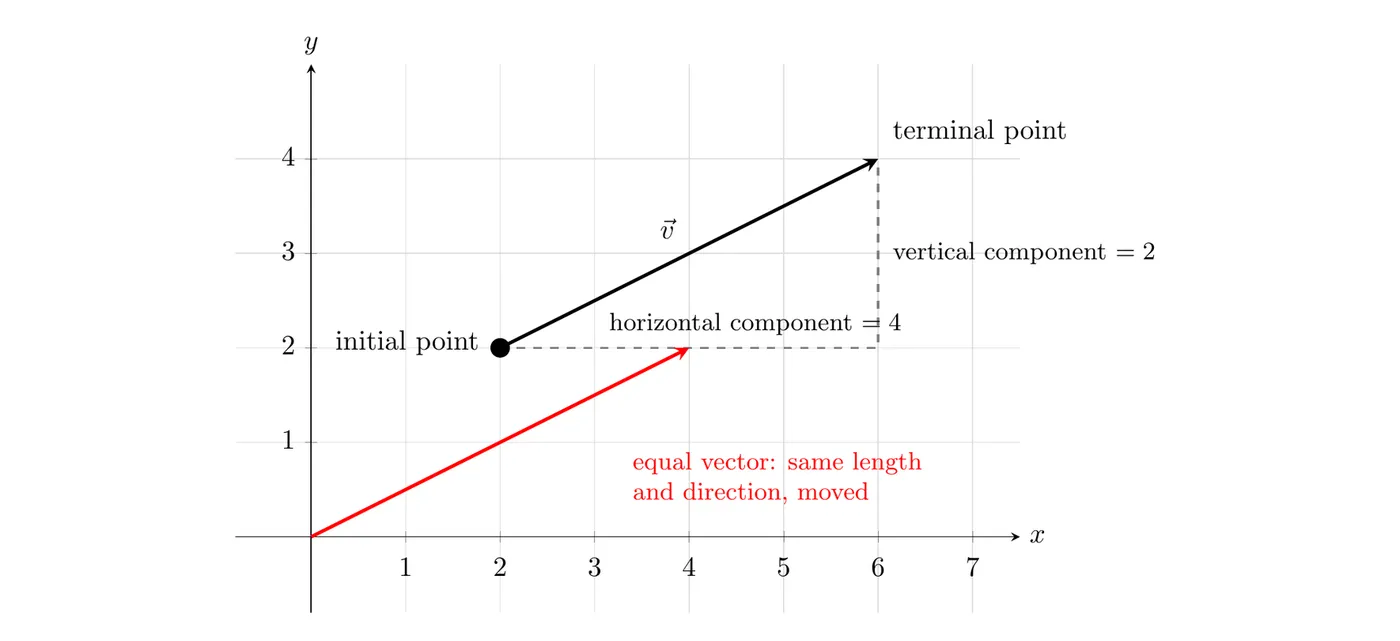
Key properties:
- Initial point: where the vector starts
- Terminal point: where the vector ends, at the arrow tip
- Direction: shown by the arrow
When Are Vectors Equal?
Two vectors are equal if and only if they have:
- The same magnitude, meaning length
- The same direction
Important: position doesn’t matter. Vectors sitting at different locations can still be equal.
Vector Components
Every vector can be broken into horizontal and vertical components.
Component form:
where:
- = the horizontal component, the change in the -direction
- = the vertical component, the change in the -direction
Note: the angle brackets are what distinguish vector notation from coordinates .
Finding Component Form
Given an initial point and a terminal point :
Example 1: Component Form
Given: a vector with initial point and terminal point .
Interpretation: the vector moves 4 units right and 2 units up.
Magnitude of a Vector
The magnitude, or length, of a vector is written with double bars:
Formula, straight from the Pythagorean theorem:
where and are the components of the vector.
Example 1, Continued: Magnitude
Given: the component form .
Simplified:
Interpretation: the vector has a length of units.
Vector-Valued Functions
A vector-valued function is a function whose output is a vector that depends on a parameter, usually :
where:
- = the horizontal component, a function of
- = the vertical component, a function of
- = the parameter, which often represents time
Connection to parametric equations: these are very similar. Instead of writing and separately, we write .
Derivative of a Vector-Valued Function
To find the derivative of a vector-valued function, differentiate each component separately:
That’s it. Take the derivative of the -component and the derivative of the -component.
Example 2: Basic Derivative
Given: . Find .
Differentiate each component:
Answer:
Properties of Vector Derivatives
These rules mirror the ones for regular derivatives.
Constant multiple:
Sum and difference:
Product rule:
Chain rule:
Example 3: Chain Rule with Vectors
Given: . Find the derivative of .
Step 1: Find
Step 2: Find
Substitute for :
Step 3: Apply the chain rule
Multiply by the derivative of the inside function, since :
For vectors, multiply each component by 2:
Answer:
Scalar Multiplication
When you multiply a vector by a scalar, meaning a regular number, multiply each component by that scalar:
Example:
Finding the Slope of a Parametric Path
When a vector-valued function describes a particle’s position, we can find the slope of its path at any time.
Key insight: the components are just parametric equations.
If , then:
- , the horizontal position
- , the vertical position
Slope formula:
This is exactly the same formula from parametric equations.
Example 4: Slope of a Particle’s Path
Given: . Find the slope of the particle’s path at .
Step 1: Identify the components
- , the horizontal component
- , the vertical component
Step 2: Find the derivatives
Step 3: Apply the slope formula
Step 4: Evaluate at
Answer: the slope at is 0, meaning a horizontal tangent line.
Example 5: Slope with Trigonometric Functions
Given: . Find the slope at .
Step 1: Set up the slope formula
Step 2: Evaluate at
Numerator:
Denominator:
Step 3: Divide
Answer: the slope is , which is about .
Velocity and Position
In physics applications:
- represents position at time
- represents velocity at time
Interpretation: the derivative vector points in the direction of motion, and its magnitude is the speed.
Summary: Finding Slopes vs. Finding Derivatives
To find the derivative vector :
This gives you a vector.
To find the slope :
This gives you a number, the slope of the tangent line.
Common Mistakes to Avoid
❌ Confusing component form with coordinates
Vectors use angle brackets: . Points use parentheses: .
❌ Forgetting the chain rule
When finding , don’t forget to multiply by 2.
❌ Flipping the slope formula
Wrong:
Correct:
❌ Mixing up position and velocity
is position, and is velocity.
Problem-Solving Strategy
To find component form: subtract the initial point from the terminal point:
To find magnitude: use
To find the derivative: differentiate each component separately, and keep the vector bracket notation
To find the slope at a specific time:
1. Identify and
2. Find and
3. Compute
4. Evaluate at the given -value
Key Takeaways
- Vector: has both magnitude (length) and direction
- Component form: represents the horizontal and vertical components
- Magnitude formula:
- Vector-valued function:
- Derivative: differentiate each component separately, so
- The chain rule still applies. Don’t forget to multiply by the derivative of the inside function
- Slope formula: , the same as parametric equations
- Scalar multiplication: multiply each component by the scalar
- Applications: vector-valued functions model particle motion and paths
- Notation matters. Use angle brackets for vectors, not parentheses