

9.1 - Defining and Differentiating Parametric Equations
What Are Parametric Equations?
Unlike standard functions where , parametric equations use a third variable (usually ) to define and separately.
Definition: if and are continuous functions of on an interval, then
are called parametric equations, and is the parameter, which often represents time.
Key difference: you have two separate equations instead of one relationship between and .
Graphing Parametric Equations
Method 1: Table of Values
To graph parametric equations, build a table by choosing values of and calculating the matching coordinates.
Example 1: Basic Parametric Curve
Given: and for
Point | |||
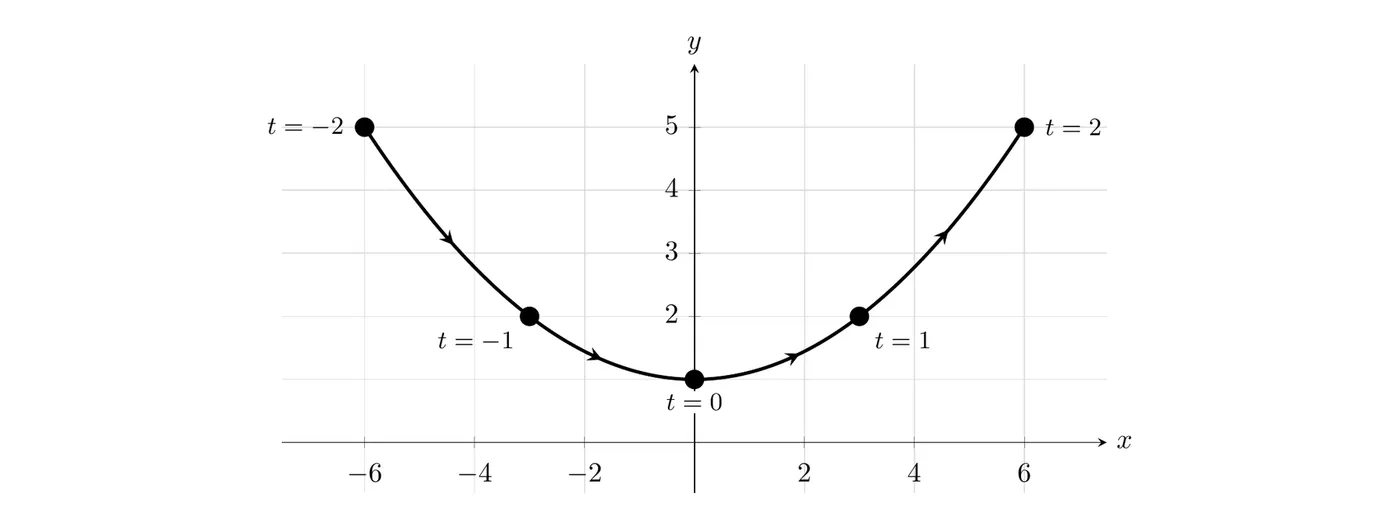
Important: the arrows show the direction of motion as increases. This matters, because parametric curves can cross themselves or reverse direction.
Calculator: Parametric Mode
On a TI-84
Step 1: Switch to parametric mode.
- Press MODE
- Scroll down and highlight PAR
- Press ENTER
Step 2: Enter the equations.
- Press Y=
- You’ll see X₁T = and Y₁T =
- Enter your equations, using the X,T,θ,n button for
Step 3: Set the window.
- Press WINDOW
- Set Tmin, Tmax, and Tstep
- Tmin and Tmax are the range of -values
- Tstep is the interval between calculated points, so smaller means a smoother curve
- Set Xmin, Xmax, Ymin, and Ymax as usual
Step 4: Press GRAPH.
Eliminating the Parameter
Eliminating the parameter means converting parametric equations back into a single equation in and , which is called rectangular form.
Example 2: Algebraic Elimination
Given: and
Step 1: Solve one equation for .
Step 2: Substitute into the other equation.
Result: the parametric equations describe the parabola .
Trigonometric Parametric Equations
When the parametric equations involve sine and cosine, use the Pythagorean identity:
Example 3: Circular Motion
Given: and
Step 1: Isolate sine and cosine.
Step 2: Apply the Pythagorean identity.
Step 3: Simplify. Multiply both sides by 9:
Result: a circle centered at the origin with radius 3.
Derivatives of Parametric Equations
To find for parametric equations, use
provided that .
Alternative notation:
Important: this is the slope of the tangent line at any point on the parametric curve.
Example 4: Finding the Derivative
Given: and . Find .
Step 1: Find .
Step 2: Find .
Step 3: Apply the formula.
Step 4: Simplify.
Answer:
Example 5: Derivative with Exponentials
Given: and . Find .
Step 1: Find the derivatives with respect to .
Step 2: Apply the formula.
Finding Tangent Lines to Parametric Curves
To find the equation of a tangent line at a specific value , you need three things:
- The -coordinate:
- The -coordinate:
- The slope:
Then use point-slope form: .
Example 6: Equation of a Tangent Line
Given: and . Find the tangent line when .
Step 1: Find the point at .
Point:
Step 2: Find .
Step 3: Evaluate the slope at .
Step 4: Write the equation in point-slope form.
Step 5: Solve for .
Answer:
Example 7: Tangent Line with Trig Functions
Given: and . Find the tangent line when .
Step 1: Find the point.
Step 2: Find .
Step 3: Evaluate at .
Step 4: Write the equation.
Simplified:
Horizontal and Vertical Tangent Lines
Because , look at the top and the bottom of the fraction separately:
- Horizontal tangent: and . The slope is divided by a number that isn’t zero, so the slope is .
- Vertical tangent: and . The slope is undefined, since you’d be dividing by zero.
Both equal to zero? Then the formula gives , and you can’t conclude anything yet. The curve might come to a sharp point (a cusp) there, like , at . It takes more work, like a limit, to figure out what happens.
Whenever , the formula can’t give you a number for the slope. That’s why it comes with the condition .
Example 8: Horizontal and Vertical Tangents
Given: and . Find every point where the tangent line is horizontal or vertical.
Step 1: Find both derivatives.
Step 2: Horizontal tangents. Set :
Check the bottom: at and at . Neither is zero, so both are horizontal tangents.
Step 3: Vertical tangents. Set :
Check the top: . So there’s a vertical tangent at , at the point .
Answer: horizontal tangents at and , and a vertical tangent at .
Important Distinctions
vs.
- tells you how changes with respect to the parameter
- tells you how changes with respect to
- tells you the slope of the tangent line to the curve, meaning how changes with
Remember:
Parametric Curves vs. Functions
Parametric curves are NOT necessarily functions of . They can:
- Loop back on themselves
- Have vertical tangent lines
- Pass through the same -value more than once
That’s exactly why parametric equations are more flexible than standard functions.
Common Mistakes to Avoid
Mixing up the order in the derivative formula.
Wrong:
Correct:
Think “dy on top, dx on the bottom.”
Forgetting the chain rule when finding or . If , then . Don’t lose the 2.
Not indicating direction on parametric graphs. Always show arrows for the direction as increases.
Dividing by zero. The formula only works when .
Problem-Solving Strategy
To graph parametric equations
- Choose several values of in the given interval
- Calculate the matching points
- Plot the points and connect them with a smooth curve
- Add arrows showing the direction as increases
To eliminate the parameter
- Solve one equation for
- Substitute into the other equation
- Simplify to get a relationship between and alone
For trig functions, use .
To find
- Find
- Find
- Divide:
- Simplify if you can
To find a tangent line
- Find the point
- Find the slope
- Use point-slope form:
- Solve for if needed
Key Takeaways
- Parametric equations: both and are functions of a parameter , so and
- The parameter usually represents time and determines your position along the curve
- Direction matters. Parametric curves have an orientation
- Eliminating the parameter: solve for in one equation and substitute into the other
- Pythagorean identity: use for trig parametric equations
- Derivative formula: , not the other way around
- Tangent lines need the point and the slope
- Horizontal tangents: with . Vertical tangents: with
- Calculator mode: switch to PAR for graphing parametric equations
- Not always functions. Parametric curves can loop, cross themselves, or have vertical tangents
- Flexibility is the point: parametric equations can represent curves that aren’t functions of