9.9 - Finding the Area of the Region Bounded by Two Polar Curves
Review
The area bounded by a single polar curve r=f(θ) is
A=21∫αβr2dθ
Same reminders as before: keep the 21, square the whole function, get the bounds right.
Area Common to Two Polar Curves
When two polar curves overlap, you have to think carefully about which curve actually forms the boundary at each angle.
The Rotating Line Method
Put a line at the origin pointing along the positive x-axis (θ=0)
Rotate it counterclockwise
At each angle, ask which curve the line hits first on its way out
Here’s the key rule: for the region common to both curves (inside both), the boundary at each angle is the curve closer to the origin, meaning the one with the smaller r. Whenever the two curves swap which one is closer, you split the integral there.
(This is the opposite of what your intuition might say. If you’re inside both regions, you can only go out as far as the nearer boundary lets you.)
Example 1: Two Overlapping Circles
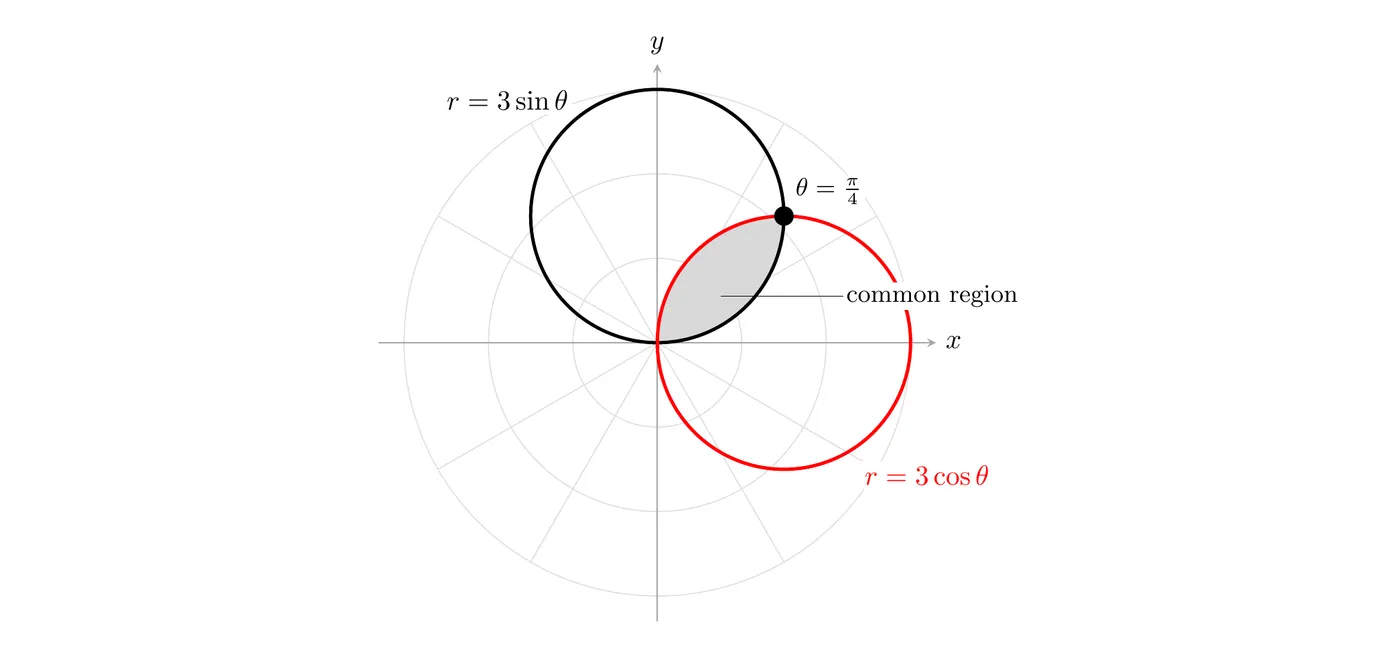
Find the area common to r=3sinθ and r=3cosθ.
Step 1: Find the intersection.
3sinθ=3cosθ⇒tanθ=1⇒θ=4π
Both curves also pass through the origin: r=3sinθ at θ=0, and r=3cosθ at θ=2π.
Step 2: Which curve is closer to the origin?
From θ=0 to θ=4π: sinθ<cosθ, so r=3sinθ is the inner curve
From θ=4π to θ=2π: r=3cosθ is the inner curve
Step 3: Set up. Use the inner curve on each piece.
A=21∫0π/49sin2θdθ+21∫π/4π/29cos2θdθ
By symmetry the two pieces are equal, so
A=2⋅29(8π−41)=9(8π−41)≈1.284
Sanity check: each circle has radius 1.5 and area ≈7.07. An overlap of 1.284 is a reasonable fraction of that.
Using Symmetry to Simplify
If the region is symmetric, compute one piece and multiply.
Example 2: Circle and Cardioid
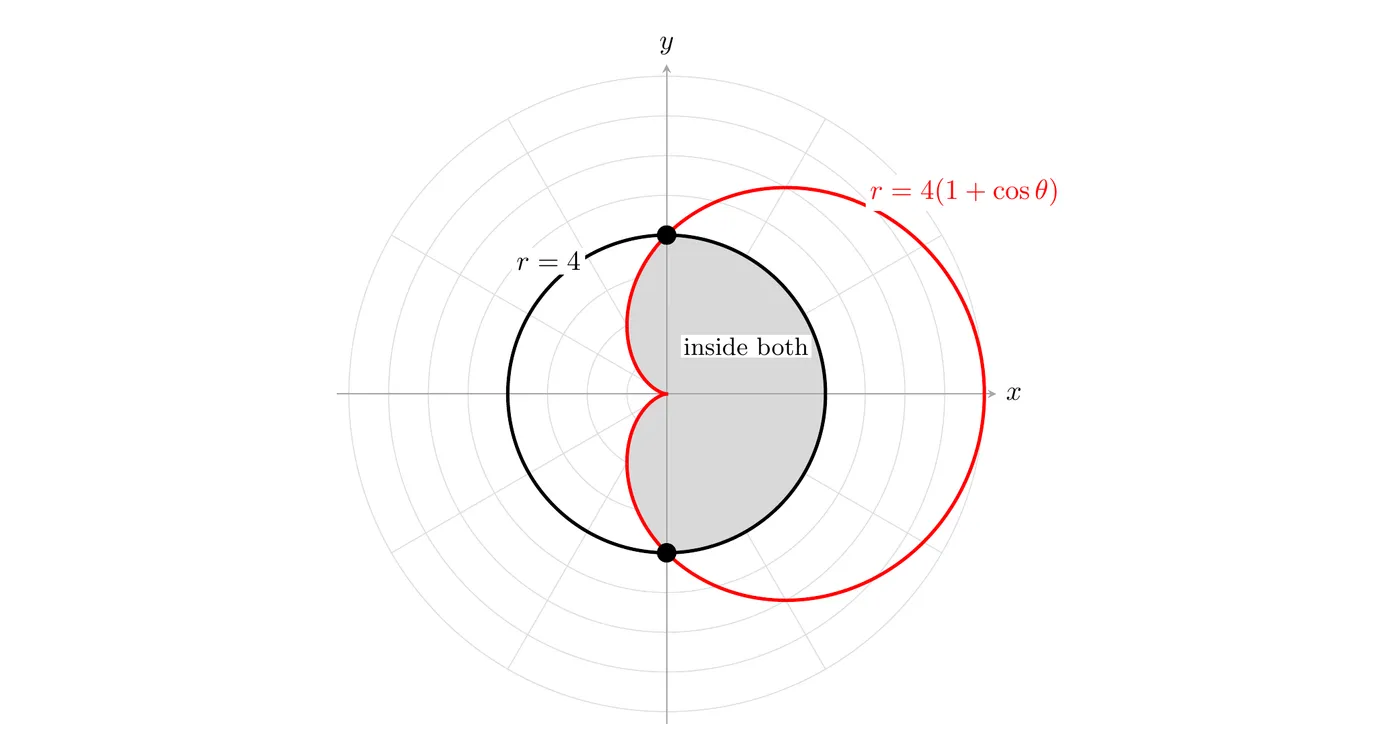
Find the area inside bothr=4 and r=4(1+cosθ).
Step 1: Find the intersections.
4=4(1+cosθ)⇒cosθ=0⇒θ=2π,23π
Step 2: Which curve is inner? The cardioid 4(1+cosθ) is bigger than 4 exactly when cosθ>0.
On (−2π,2π): the cardioid is farther out, so the circler=4 is the boundary
On (2π,23π): the cardioid is the boundary
Step 3: Set up.
A=21∫−π/2π/242dθ+21∫π/23π/2[4(1+cosθ)]2dθ
First piece: 21(16)(π)=8π≈25.133
Second piece: ≈5.699
A≈30.83 square units
Subtracting a Gap: Inside One, Outside Another
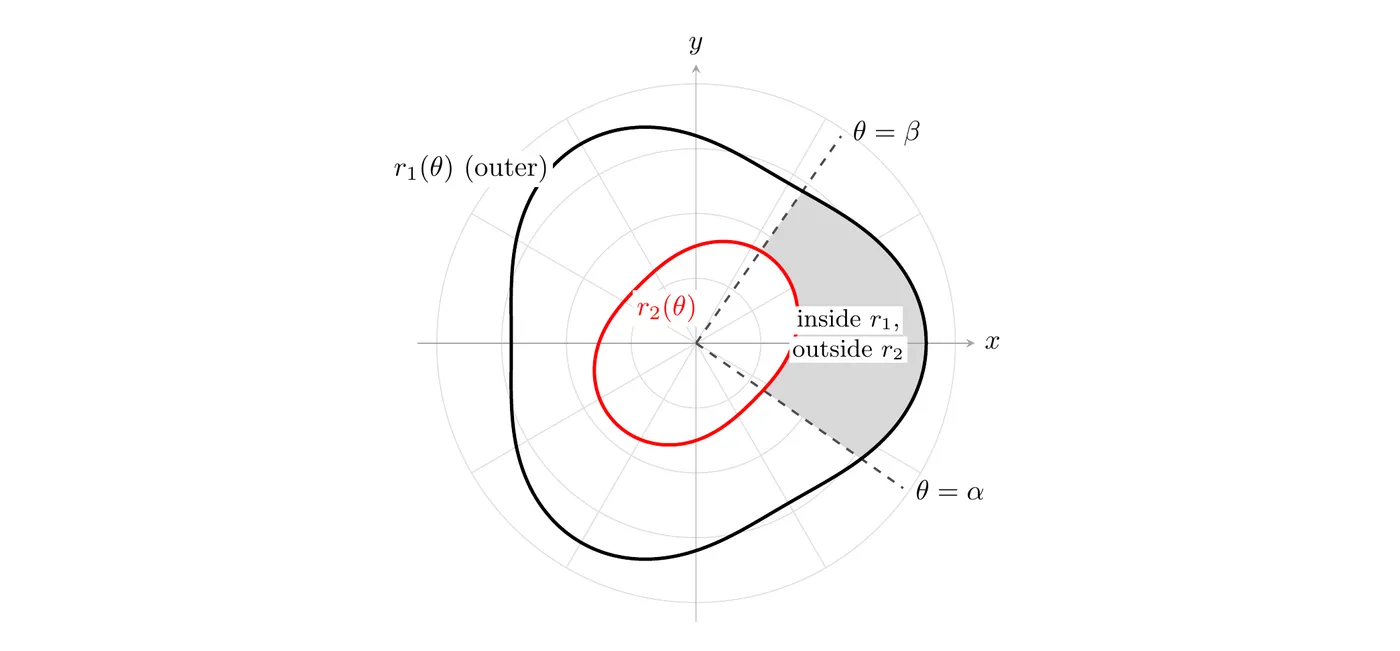
To find the area inside curve r1 but outside curve r2 (where r1>r2 on the interval):
A=21∫αβ[r12−r22]dθ
Equivalently:
A=21∫αβr12dθ−21∫αβr22dθ
Critical: each radius gets squared individually. Never write (r1−r2)2.
Example 3: Limaçon Outside a Circle
Find the area inside r=4+2cosθ and outside r=3.
Step 1: Intersections.
4+2cosθ=3⇒cosθ=−21⇒θ=32π,34π
Step 2: Where is the limaçon outside the circle? Wherever cosθ>−21, meaning −32π<θ<32π.
Expand the bracket: (4+2cosθ)2−9=9+16cosθ+2cos(2θ)
A=[9θ+16sinθ+sin(2θ)]02π/3≈31.84 square units
Example 4: Circle Outside a Cardioid
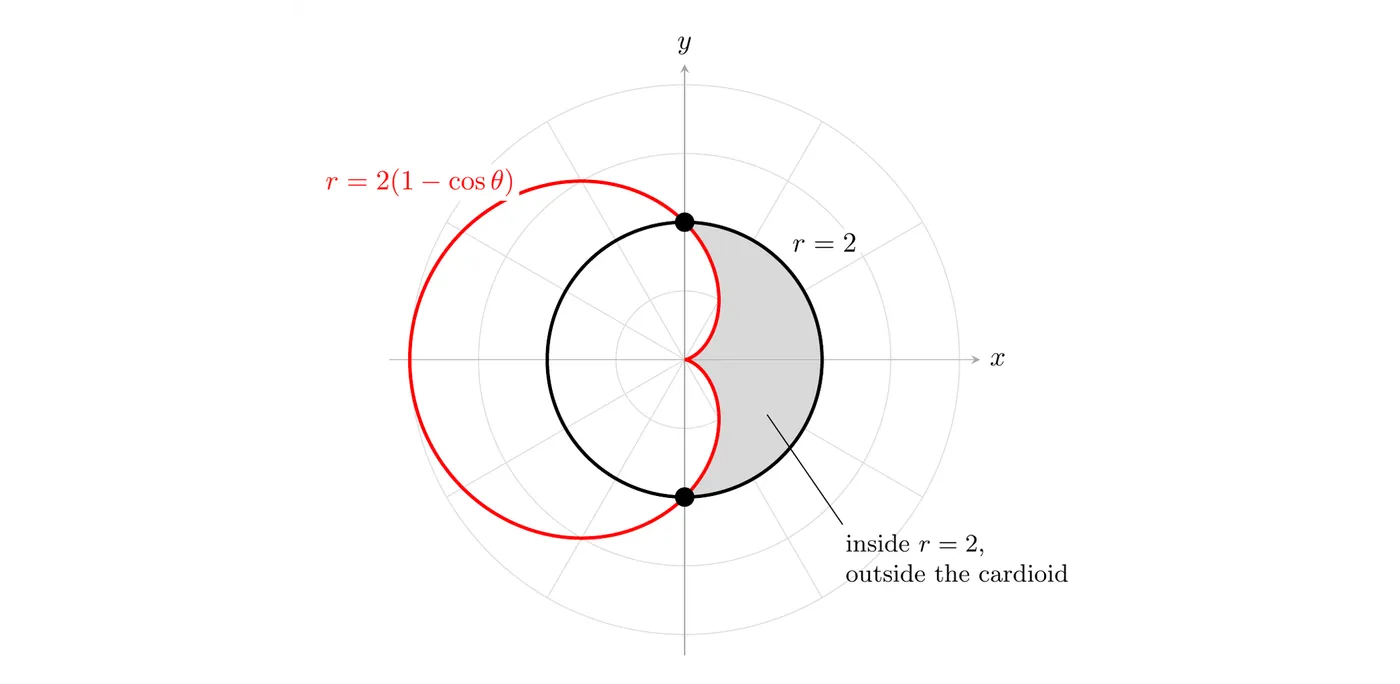
Find the area inside r=2 and outside r=2(1−cosθ).
Step 1: Intersections.
2=2(1−cosθ)⇒cosθ=0⇒θ=±2π
Step 2: Where is the circle outside the cardioid? Wherever cosθ>0, meaning −2π<θ<2π.
Step 3: Set up with symmetry.
A=21∫−π/2π/2[22−(2(1−cosθ))2]dθ=∫0π/2[4−4(1−cosθ)2]dθ≈4.858 square units
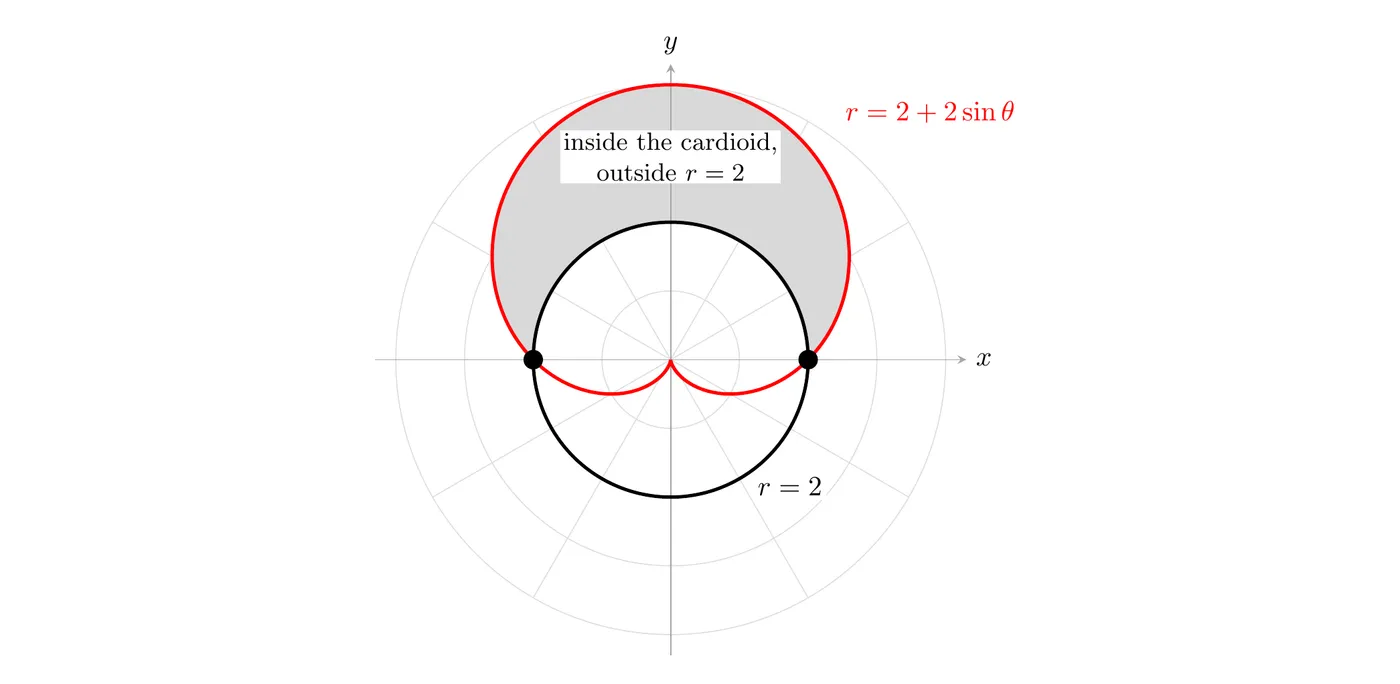
Example 5: Cardioid Outside a Circle
Find the area inside r=2+2sinθ and outside r=2.
Step 1: Intersections.
2+2sinθ=2⇒sinθ=0⇒θ=0,π
Step 2: Where is the cardioid outside the circle? Wherever sinθ>0, meaning 0<θ<π.
Step 3: Set up.
A=21∫0π[(2+2sinθ)2−22]dθ=21∫0π[8sinθ+4sin2θ]dθ=21[16+2π]=8+π≈11.14 square units
Common Mistakes
Squaring the difference instead of differencing the squares. Wrong: 21∫(r1−r2)2dθ. Right: 21∫(r12−r22)dθ.
Using the outer curve for a “common to both” region. For the region inside both curves, the boundary is the nearer curve, not the farther one.
Wrong bounds. Always verify with a graph, or trace which curve is the boundary at each angle.
Forgetting symmetry. If you computed half, remember to double it. Or cancel the 21 against the factor of 2 right away.
Not finding all the intersections. Set r1=r2, but also check where each curve hits the origin (r=0).
Step-by-Step Process
Graph both curves and look at the region
Find the intersections by setting r1=r2
Check for symmetry, since it can halve your work
Use the rotating line method: sweep counterclockwise and figure out which curve forms the boundary in each angular interval, splitting the integral where it changes
Set up the integrals:
For a region bounded by one curve: 21∫r2dθ
For “inside one, outside another”: 21∫(router2−rinner2)dθ
Evaluate
Apply the symmetry factor if you used one
Multiple Choice Strategy
On the AP exam you often just have to pick the correct integral setup. Check:
Is the 21 there?
Are the radii squared individually, not as a difference?
Are α and β right for the shaded region?
Does the integral switch at the intersection points?
Is symmetry handled correctly?
Key Takeaways
Area between polar curves often needs multiple integrals with different r functions
Rotating line method: sweep from the origin and see which curve bounds the region
For a region common to both curves, the boundary is the curve with the smallerr
Find intersections by setting r1=r2, and also check where each r=0
Symmetry saves work: compute one piece and multiply