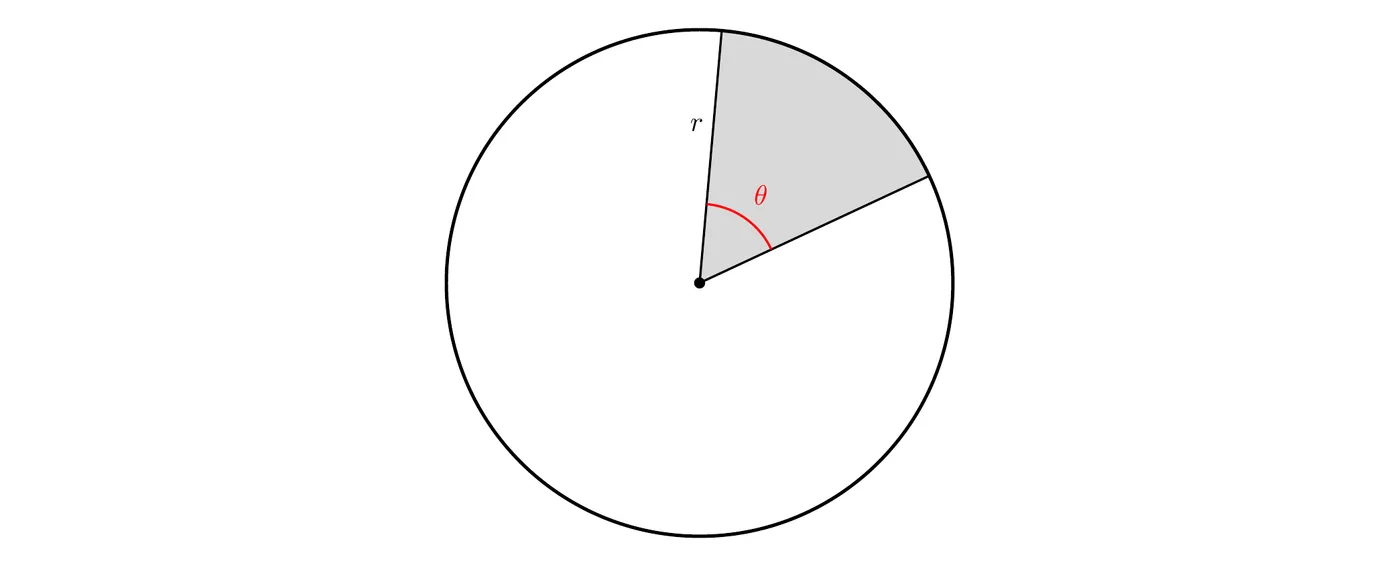
Area of a Sector Review From geometry, the area of a circular sector is
A = 1 2 θ r 2 A = \frac{1}{2}\theta r^2 A = 2 1 θ r 2 where
θ \theta θ is the central angle in radians and
r r r is the radius.
This formula is the foundation for everything below.
Developing the Polar Area Formula For a polar curve
r = f ( θ ) r = f(\theta) r = f ( θ ) , approximate the enclosed area by chopping it into a bunch of tiny sectors.
Setup:
r = f ( θ ) r = f(\theta) r = f ( θ ) α \alpha α β \beta β Divide the region into n n n Each small sector has:
Radius r i = f ( θ i ) r_i = f(\theta_i) r i = f ( θ i ) Angle width Δ θ = β − α n \Delta\theta = \frac{\beta - \alpha}{n} Δ θ = n β − α Area 1 2 ( Δ θ ) [ f ( θ i ) ] 2 \frac{1}{2}(\Delta\theta)[f(\theta_i)]^2 2 1 ( Δ θ ) [ f ( θ i ) ] 2 Total area is the sum of all sectors:
A ≈ ∑ i = 1 n 1 2 [ f ( θ i ) ] 2 Δ θ A \approx \sum_{i=1}^{n} \frac{1}{2}[f(\theta_i)]^2 \Delta\theta A ≈ i = 1 ∑ n 2 1 [ f ( θ i ) ] 2 Δ θ As
n → ∞ n \to \infty n → ∞ , this becomes a definite integral:
A = lim n → ∞ ∑ i = 1 n 1 2 [ f ( θ i ) ] 2 Δ θ = 1 2 ∫ α β [ f ( θ ) ] 2 d θ A = \lim_{n \to \infty} \sum_{i=1}^{n} \frac{1}{2}[f(\theta_i)]^2 \Delta\theta = \frac{1}{2}\int_{\alpha}^{\beta} [f(\theta)]^2 \, d\theta A = n → ∞ lim i = 1 ∑ n 2 1 [ f ( θ i ) ] 2 Δ θ = 2 1 ∫ α β [ f ( θ ) ] 2 d θ The General Formula A = 1 2 ∫ α β r 2 d θ A = \frac{1}{2}\int_{\alpha}^{\beta} r^2 \, d\theta A = 2 1 ∫ α β r 2 d θ Three things to watch:
Don’t forget the 1 2 \frac{1}{2} 2 1 r 2 r^2 r 2 entire function: [ f ( θ ) ] 2 [f(\theta)]^2 [ f ( θ ) ] 2 Getting the bounds α \alpha α β \beta β Finding the Bounds The usual move is to find where
r = 0 r = 0 r = 0 , which is where the curve passes through the origin.
Set r = 0 r = 0 r = 0 θ \theta θ Figure out which pair of values bounds one complete trace of the region Verify with a graphing calculator if you’re not sure Example 1: Circle Find the area enclosed by
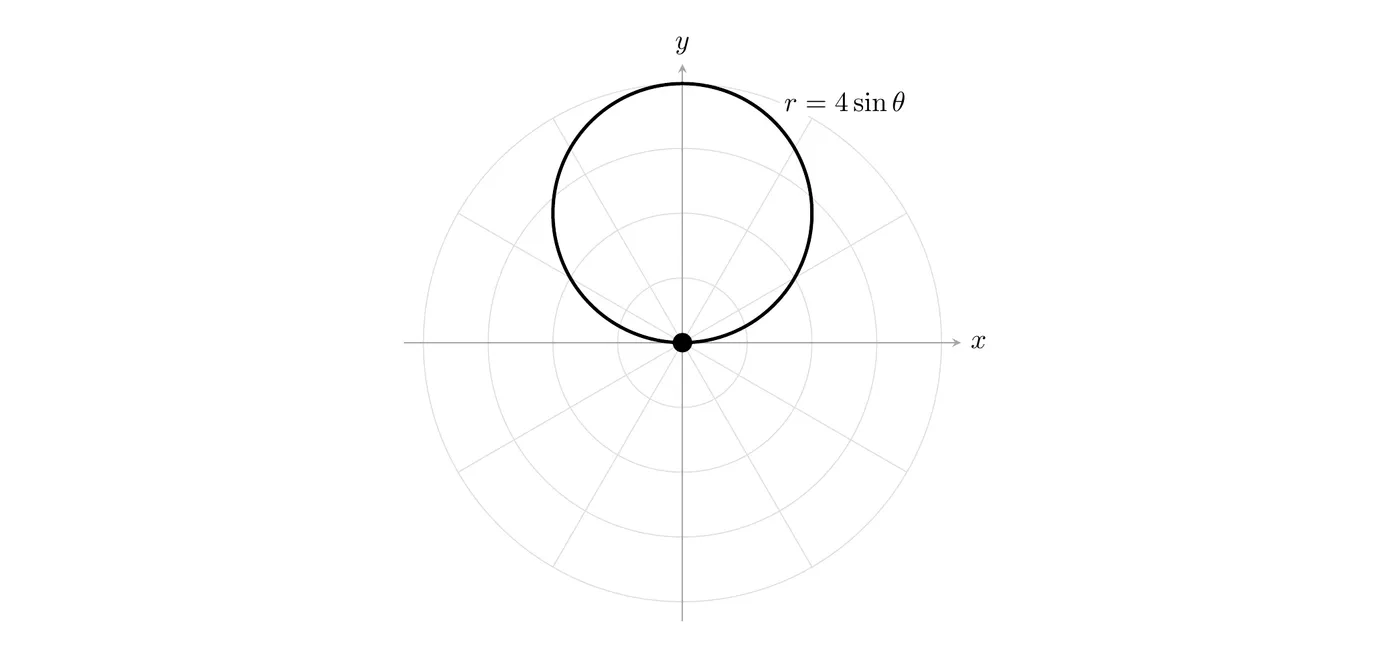
r = 4 sin θ r = 4\sin\theta r = 4 sin θ .
4 sin θ = 0 ⇒ θ = 0 , π , 2 π , … 4\sin\theta = 0 \quad \Rightarrow \quad \theta = 0, \pi, 2\pi, \ldots 4 sin θ = 0 ⇒ θ = 0 , π , 2 π , … The curve leaves the origin at
θ = 0 \theta = 0 θ = 0 and comes back to it at
θ = π \theta = \pi θ = π . Going from
π \pi π to
2 π 2\pi 2 π would just trace the same circle a second time.
A = 1 2 ∫ 0 π ( 4 sin θ ) 2 d θ = 1 2 ∫ 0 π 16 sin 2 θ d θ ≈ 12.566 A = \frac{1}{2}\int_{0}^{\pi} (4\sin\theta)^2 \, d\theta = \frac{1}{2}\int_{0}^{\pi} 16\sin^2\theta \, d\theta \approx 12.566 A = 2 1 ∫ 0 π ( 4 sin θ ) 2 d θ = 2 1 ∫ 0 π 16 sin 2 θ d θ ≈ 12.566 Check: this circle has radius 2, so
π r 2 = 4 π ≈ 12.566 \pi r^2 = 4\pi \approx 12.566 π r 2 = 4 π ≈ 12.566 . Matches.
Example 2: Limaçon (Full Trace) Find
1 2 ∫ 0 2 π ( 2 − 3 cos θ ) 2 d θ \frac{1}{2}\int_0^{2\pi}(2 - 3\cos\theta)^2\,d\theta 2 1 ∫ 0 2 π ( 2 − 3 cos θ ) 2 d θ for the limaçon
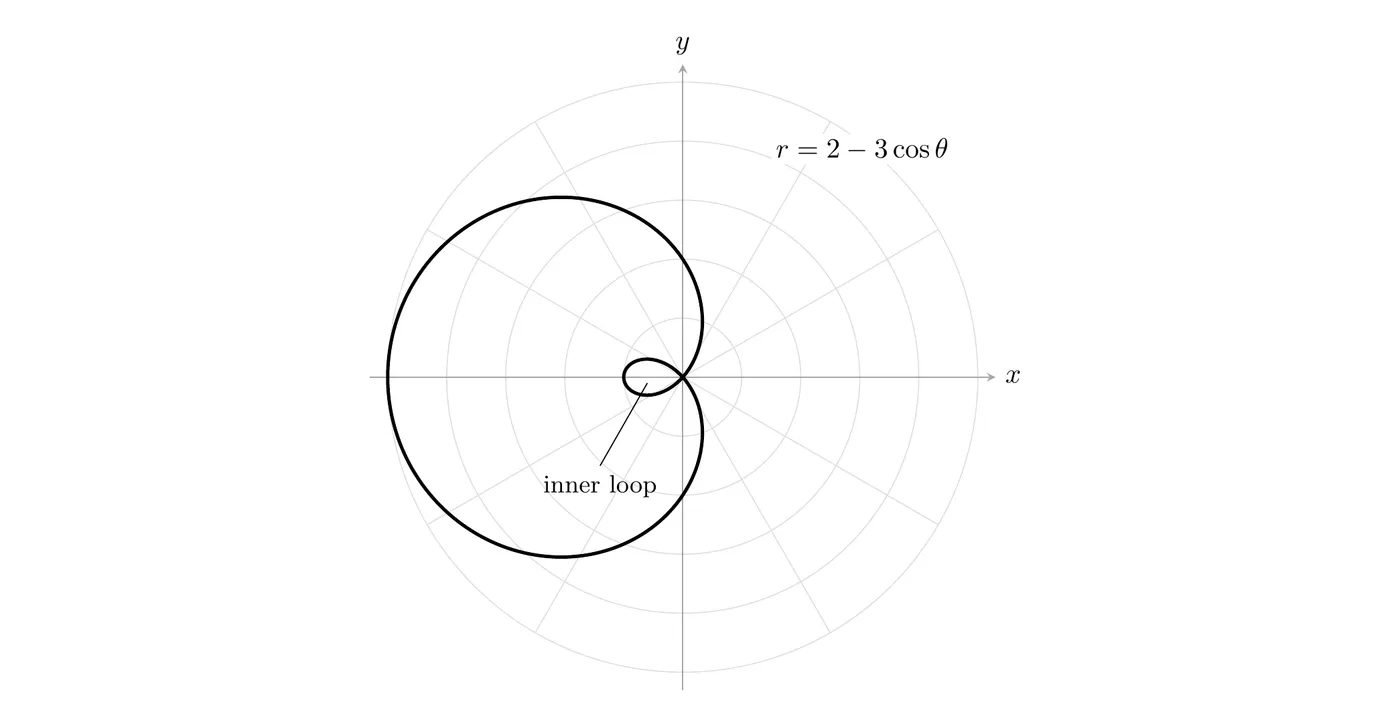
r = 2 − 3 cos θ r = 2 - 3\cos\theta r = 2 − 3 cos θ .
First, where is
r = 0 r = 0 r = 0 ?
2 − 3 cos θ = 0 ⇒ cos θ = 2 3 2 - 3\cos\theta = 0 \quad \Rightarrow \quad \cos\theta = \frac{2}{3} 2 − 3 cos θ = 0 ⇒ cos θ = 3 2 θ = arccos ( 2 3 ) ≈ 0.841 and 2 π − 0.841 ≈ 5.442 \theta = \arccos\left(\frac{2}{3}\right) \approx 0.841 \quad \text{and} \quad 2\pi - 0.841 \approx 5.442 θ = arccos ( 3 2 ) ≈ 0.841 and 2 π − 0.841 ≈ 5.442 Those are where the inner loop passes through the origin.
The full curve traces once from
θ = 0 \theta = 0 θ = 0 to
θ = 2 π \theta = 2\pi θ = 2 π :
1 2 ∫ 0 2 π ( 2 − 3 cos θ ) 2 d θ = 1 2 [ 8 π + 9 π ] = 17 π 2 ≈ 26.704 \frac{1}{2}\int_{0}^{2\pi} (2 - 3\cos\theta)^2 \, d\theta = \frac{1}{2}\left[8\pi + 9\pi\right] = \frac{17\pi}{2} \approx 26.704 2 1 ∫ 0 2 π ( 2 − 3 cos θ ) 2 d θ = 2 1 [ 8 π + 9 π ] = 2 17 π ≈ 26.704 Careful: this integral sweeps over the inner loop twice, so it isn’t literally “the area of the region.” If a problem wants just the outer-loop region, or just the inner loop, you have to restrict the bounds to the angles that trace only that piece.
Example 3: Limaçon (Inner Loop Only) Find the area of the
inner loop of
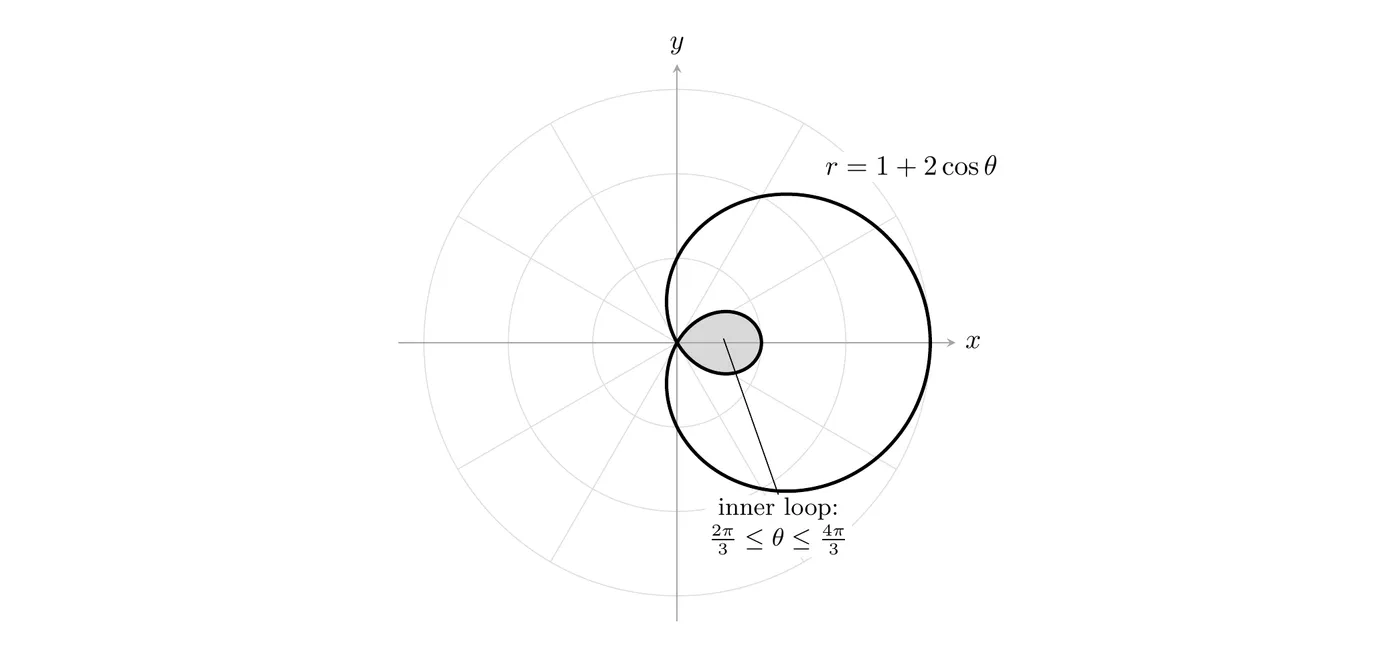
r = 1 + 2 cos θ r = 1 + 2\cos\theta r = 1 + 2 cos θ .
1 + 2 cos θ = 0 ⇒ cos θ = − 1 2 ⇒ θ = 2 π 3 , 4 π 3 1 + 2\cos\theta = 0 \quad \Rightarrow \quad \cos\theta = -\frac{1}{2} \quad \Rightarrow \quad \theta = \frac{2\pi}{3}, \frac{4\pi}{3} 1 + 2 cos θ = 0 ⇒ cos θ = − 2 1 ⇒ θ = 3 2 π , 3 4 π The inner loop forms between those two angles.
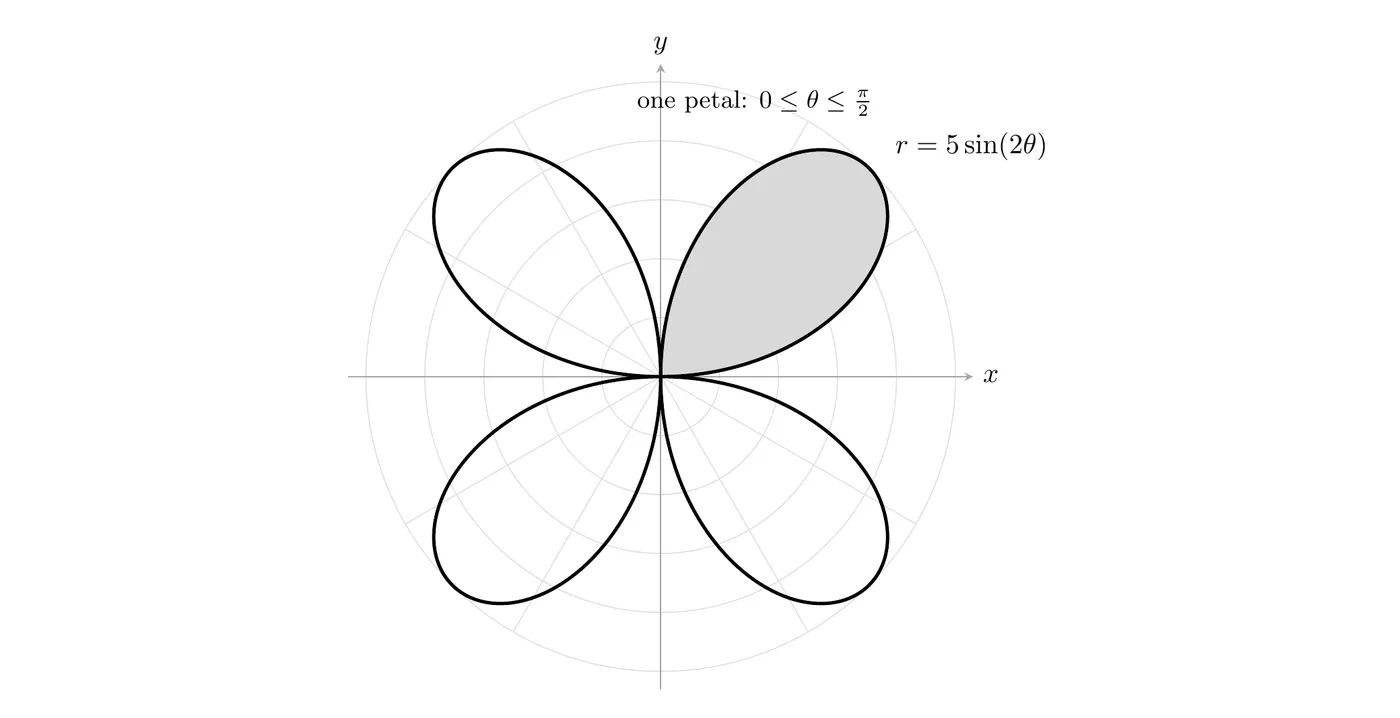
A = 1 2 ∫ 2 π / 3 4 π / 3 ( 1 + 2 cos θ ) 2 d θ = 1 2 ∫ 2 π / 3 4 π / 3 ( 1 + 4 cos θ + 4 cos 2 θ ) d θ ≈ 0.544 A = \frac{1}{2}\int_{2\pi/3}^{4\pi/3} (1 + 2\cos\theta)^2 \, d\theta = \frac{1}{2}\int_{2\pi/3}^{4\pi/3} (1 + 4\cos\theta + 4\cos^2\theta) \, d\theta \approx 0.544 A = 2 1 ∫ 2 π /3 4 π /3 ( 1 + 2 cos θ ) 2 d θ = 2 1 ∫ 2 π /3 4 π /3 ( 1 + 4 cos θ + 4 cos 2 θ ) d θ ≈ 0.544 Example 4: Rose Curve (One Petal) Find the area of one petal of
r = 5 sin ( 2 θ ) r = 5\sin(2\theta) r = 5 sin ( 2 θ ) .
sin ( 2 θ ) = 0 ⇒ 2 θ = 0 , π , 2 π , … ⇒ θ = 0 , π 2 , π , … \sin(2\theta) = 0 \quad \Rightarrow \quad 2\theta = 0, \pi, 2\pi, \ldots \quad \Rightarrow \quad \theta = 0, \frac{\pi}{2}, \pi, \ldots sin ( 2 θ ) = 0 ⇒ 2 θ = 0 , π , 2 π , … ⇒ θ = 0 , 2 π , π , … Trace it:
At θ = 0 \theta = 0 θ = 0 r = 0 r = 0 r = 0 At θ = π 4 \theta = \frac{\pi}{4} θ = 4 π r = 5 r = 5 r = 5 At θ = π 2 \theta = \frac{\pi}{2} θ = 2 π r = 0 r = 0 r = 0 So one petal runs from
θ = 0 \theta = 0 θ = 0 to
θ = π 2 \theta = \frac{\pi}{2} θ = 2 π .
A = 1 2 ∫ 0 π / 2 25 sin 2 ( 2 θ ) d θ = 25 π 8 ≈ 9.817 A = \frac{1}{2}\int_{0}^{\pi/2} 25\sin^2(2\theta) \, d\theta = \frac{25\pi}{8} \approx 9.817 A = 2 1 ∫ 0 π /2 25 sin 2 ( 2 θ ) d θ = 8 25 π ≈ 9.817 All four petals: multiply by 4, giving
≈ 39.270 \approx 39.270 ≈ 39.270 .
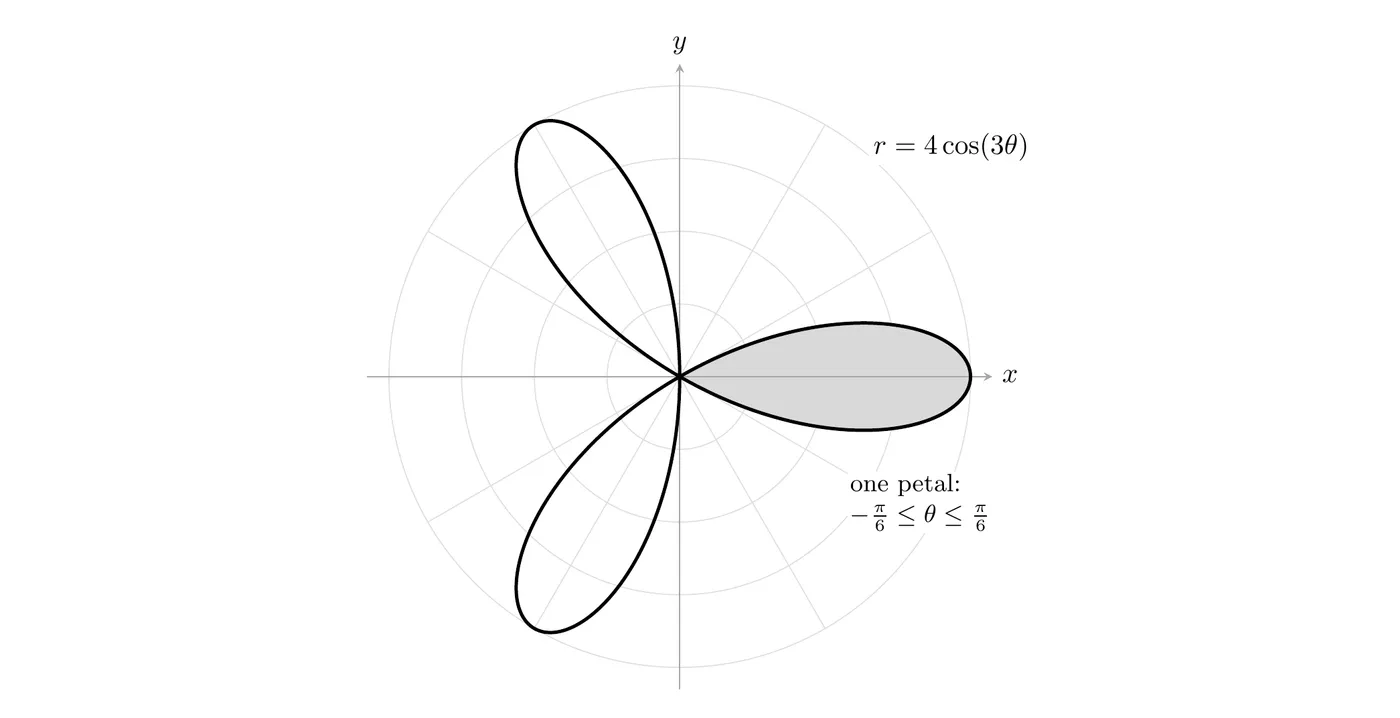
Example 5: Three-Petaled Rose Find the area of one petal of
r = 4 cos ( 3 θ ) r = 4\cos(3\theta) r = 4 cos ( 3 θ ) .
cos ( 3 θ ) = 0 ⇒ 3 θ = π 2 , 3 π 2 , 5 π 2 , … ⇒ θ = π 6 , π 2 , 5 π 6 , … \cos(3\theta) = 0 \quad \Rightarrow \quad 3\theta = \frac{\pi}{2}, \frac{3\pi}{2}, \frac{5\pi}{2}, \ldots \quad \Rightarrow \quad \theta = \frac{\pi}{6}, \frac{\pi}{2}, \frac{5\pi}{6}, \ldots cos ( 3 θ ) = 0 ⇒ 3 θ = 2 π , 2 3 π , 2 5 π , … ⇒ θ = 6 π , 2 π , 6 5 π , … Trace it:
At θ = 0 \theta = 0 θ = 0 r = 4 r = 4 r = 4 At θ = π 6 \theta = \frac{\pi}{6} θ = 6 π r = 0 r = 0 r = 0 At θ = π 3 \theta = \frac{\pi}{3} θ = 3 π r = − 4 r = -4 r = − 4 You can bound the first petal from
θ = − π 6 \theta = -\frac{\pi}{6} θ = − 6 π to
θ = π 6 \theta = \frac{\pi}{6} θ = 6 π (symmetric about
θ = 0 \theta = 0 θ = 0 ), or equivalently sweep
π 6 \frac{\pi}{6} 6 π to
π 2 \frac{\pi}{2} 2 π to trace a complete petal.
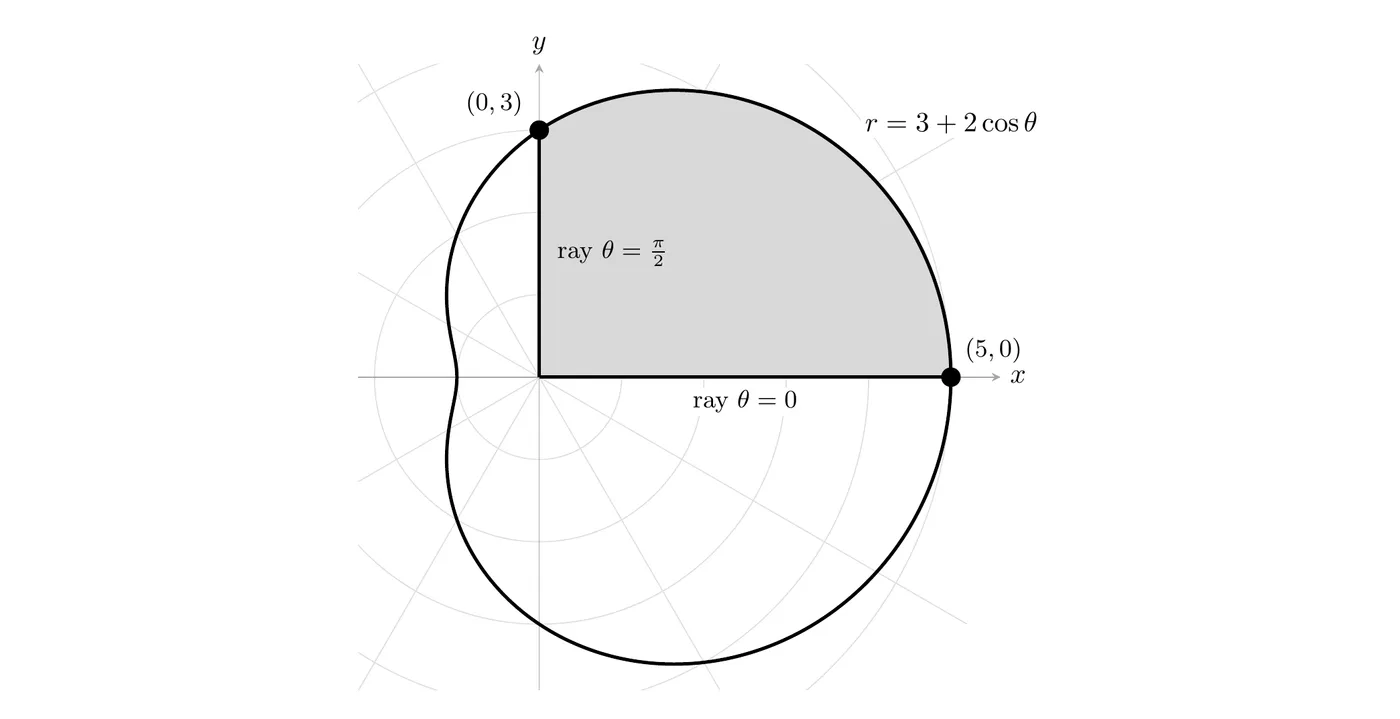
A = 1 2 ∫ π / 6 π / 2 16 cos 2 ( 3 θ ) d θ = 4 π 3 ≈ 4.189 A = \frac{1}{2}\int_{\pi/6}^{\pi/2} 16\cos^2(3\theta) \, d\theta = \frac{4\pi}{3} \approx 4.189 A = 2 1 ∫ π /6 π /2 16 cos 2 ( 3 θ ) d θ = 3 4 π ≈ 4.189 Example 6: A Region Cut Off by Rays Not every region starts and ends at the origin. Sometimes the problem gives you the rays that bound the region.
Find the area of the region in the first quadrant bounded by
r = 3 + 2 cos θ r = 3 + 2\cos\theta r = 3 + 2 cos θ and the positive
x x x - and
y y y -axes.
This curve never reaches the origin (
r ≥ 1 r \ge 1 r ≥ 1 for every
θ \theta θ ), so setting
r = 0 r = 0 r = 0 won’t help. The positive
x x x -axis is the ray
θ = 0 \theta = 0 θ = 0 , and the positive
y y y -axis is the ray
θ = π 2 \theta = \frac{\pi}{2} θ = 2 π . Those are the bounds.
A = 1 2 ∫ 0 π / 2 ( 3 + 2 cos θ ) 2 d θ = 1 2 ∫ 0 π / 2 ( 9 + 12 cos θ + 4 cos 2 θ ) d θ A = \frac{1}{2}\int_{0}^{\pi/2} (3 + 2\cos\theta)^2 \, d\theta = \frac{1}{2}\int_{0}^{\pi/2} \left(9 + 12\cos\theta + 4\cos^2\theta\right) d\theta A = 2 1 ∫ 0 π /2 ( 3 + 2 cos θ ) 2 d θ = 2 1 ∫ 0 π /2 ( 9 + 12 cos θ + 4 cos 2 θ ) d θ Use
4 cos 2 θ = 2 + 2 cos ( 2 θ ) 4\cos^2\theta = 2 + 2\cos(2\theta) 4 cos 2 θ = 2 + 2 cos ( 2 θ ) :
A = 1 2 ∫ 0 π / 2 ( 11 + 12 cos θ + 2 cos ( 2 θ ) ) d θ = 1 2 [ 11 θ + 12 sin θ + sin ( 2 θ ) ] 0 π / 2 A = \frac{1}{2}\int_{0}^{\pi/2} \left(11 + 12\cos\theta + 2\cos(2\theta)\right) d\theta = \frac{1}{2}\Big[11\theta + 12\sin\theta + \sin(2\theta)\Big]_0^{\pi/2} A = 2 1 ∫ 0 π /2 ( 11 + 12 cos θ + 2 cos ( 2 θ ) ) d θ = 2 1 [ 11 θ + 12 sin θ + sin ( 2 θ ) ] 0 π /2 = 1 2 ( 11 π 2 + 12 + 0 ) = 11 π 4 + 6 ≈ 14.639 = \frac{1}{2}\left(\frac{11\pi}{2} + 12 + 0\right) = \frac{11\pi}{4} + 6 \approx 14.639 = 2 1 ( 2 11 π + 12 + 0 ) = 4 11 π + 6 ≈ 14.639 Common Polar Curves and Their Bounds Circles r = a sin θ r = a\sin\theta r = a sin θ or
r = a cos θ r = a\cos\theta r = a cos θ : bounds
0 0 0 to
π \pi π .
Cardioids r = a ( 1 + cos θ ) r = a(1 + \cos\theta) r = a ( 1 + cos θ ) or
r = a ( 1 + sin θ ) r = a(1 + \sin\theta) r = a ( 1 + sin θ ) : bounds
0 0 0 to
2 π 2\pi 2 π for one complete trace.
Limaçons r = a + b cos θ r = a + b\cos\theta r = a + b cos θ with
∣ a ∣ < ∣ b ∣ |a| < |b| ∣ a ∣ < ∣ b ∣ : full trace is
0 0 0 to
2 π 2\pi 2 π , but for the inner loop, solve
r = 0 r = 0 r = 0 .
Rose curves r = a cos ( n θ ) r = a\cos(n\theta) r = a cos ( n θ ) or
r = a sin ( n θ ) r = a\sin(n\theta) r = a sin ( n θ ) : for one petal, use consecutive zeros of
r r r . If
n n n is odd there are
n n n petals; if
n n n is even there are
2 n 2n 2 n .
Calculator Verification Before you calculate:
Enter the polar function in polar mode (MODE → POLAR) Set the window’s θ min \theta_{\min} θ m i n θ max \theta_{\max} θ m a x Graph it and check you’re capturing exactly the region you want Shrink θ step \theta_{\text{step}} θ step Watch out for:
Using 0 0 0 2 π 2\pi 2 π 0 0 0 π \pi π Wrong bounds on rose petals or limaçon loops Forgetting the 1 2 \frac{1}{2} 2 1 Step-by-Step Process Identify the curve type (circle, rose, limaçon, cardioid)Find the bounds by setting r = 0 r = 0 r = 0 Confirm the interval with a graph or with what you know about the curveSet up: A = 1 2 ∫ α β r 2 d θ A = \frac{1}{2}\int_{\alpha}^{\beta} r^2 \, d\theta A = 2 1 ∫ α β r 2 d θ Evaluate , and don’t forget the 1 2 \frac{1}{2} 2 1 Sanity check the answer against the size of the regionKey Takeaways Polar area formula: A = 1 2 ∫ α β r 2 d θ A = \frac{1}{2}\int_{\alpha}^{\beta} r^2 \, d\theta A = 2 1 ∫ α β r 2 d θ Don’t forget the 1 2 \frac{1}{2} 2 1 Square the entire function: r 2 = [ f ( θ ) ] 2 r^2 = [f(\theta)]^2 r 2 = [ f ( θ ) ] 2 Find bounds by solving r = 0 r = 0 r = 0 If the region is cut off by rays (like the x x x y y y Verify bounds with a calculator to make sure you get exactly one trace Circles r = a sin θ r = a\sin\theta r = a sin θ r = a cos θ r = a\cos\theta r = a cos θ [ 0 , π ] [0, \pi] [ 0 , π ] Rose petals need consecutive zeros of r r r Limaçon inner loops are bounded by the two angles where r = 0 r = 0 r = 0 Watch for curves that retrace the same region