Dove's LibraryDove's Library

9.7 - Defining Polar Coordinates and Differentiating in Polar Form

Polar Coordinate System Basics

Rectangular vs. Polar Coordinates

Rectangular (Cartesian) coordinates: points are written as (x,y)(x, y)
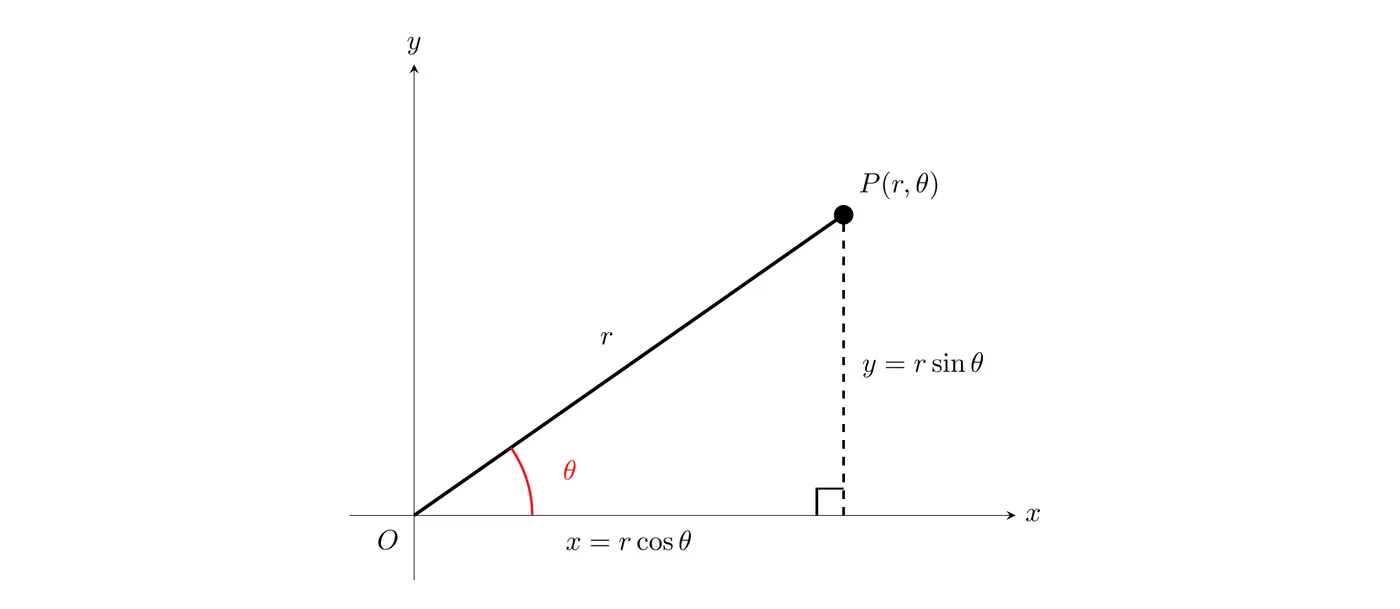
Polar coordinates: points are written as (r,θ)(r, \theta), where: - rr = the directed distance from the origin to the point - θ\theta = the directed angle from the positive xx-axis
9.7 - Defining Polar Coordinates and Differentiating in Polar Form
Important: - Positive rr extends in the direction of the angle θ\theta - Negative rr extends in the opposite direction - Positive θ\theta is measured counterclockwise - Negative θ\theta is measured clockwise

Multiple Representations

The same point can have multiple polar coordinate representations.
Example: these all represent the same point: - (2,π3)\left(2, \frac{\pi}{3}\right) - (−2,4π3)\left(-2, \frac{4\pi}{3}\right) - (2,−5π3)\left(2, -\frac{5\pi}{3}\right)

Converting Between Coordinate Systems

From Polar to Rectangular

x=rcos⁡(θ)y=rsin⁡(θ)x = r\cos(\theta) \qquad y = r\sin(\theta)

From Rectangular to Polar

r2=x2+y2θ=arctan⁡(yx)r^2 = x^2 + y^2 \qquad \theta = \arctan\left(\frac{y}{x}\right)
Also useful:
sin⁡(θ)=yrcos⁡(θ)=xr\sin(\theta) = \frac{y}{r} \qquad \cos(\theta) = \frac{x}{r}
Careful with arctan⁡\arctan: it only gives angles between −π2-\frac{\pi}{2} and π2\frac{\pi}{2}, which point into Quadrant I or IV. If the point is in Quadrant II or III, add π\pi. For example, (−1,1)(-1, 1) gives arctan⁡(−1)=−π4\arctan(-1) = -\frac{\pi}{4}, but the point is in Quadrant II, so θ=−π4+π=3π4\theta = -\frac{\pi}{4} + \pi = \frac{3\pi}{4}, with r=2r = \sqrt{2}.

Converting Polar Equations to Rectangular Form

Example 1: Vertical Line

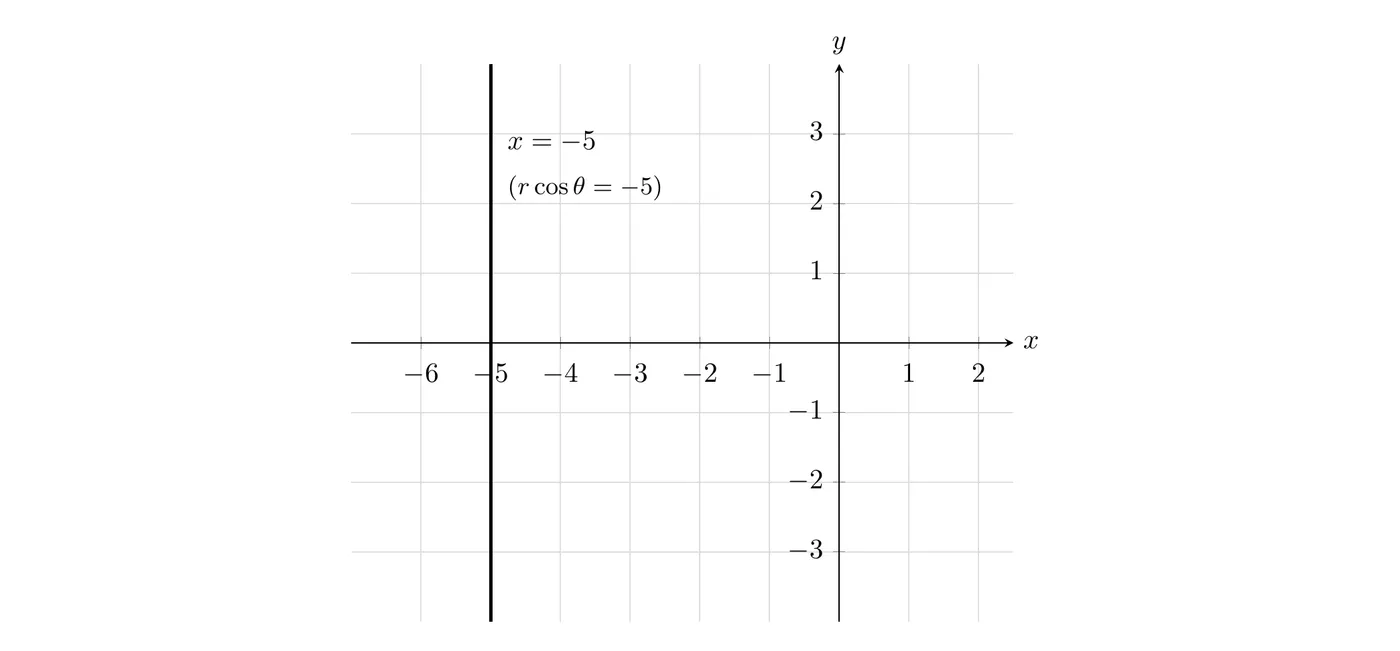
Convert rcos⁡(θ)=−5r\cos(\theta) = -5.
Since rcos⁡(θ)=xr\cos(\theta) = x:
x=−5x = -5
This is a vertical line at x=−5x = -5.
9.7 - Defining Polar Coordinates and Differentiating in Polar Form

Example 2: Circle

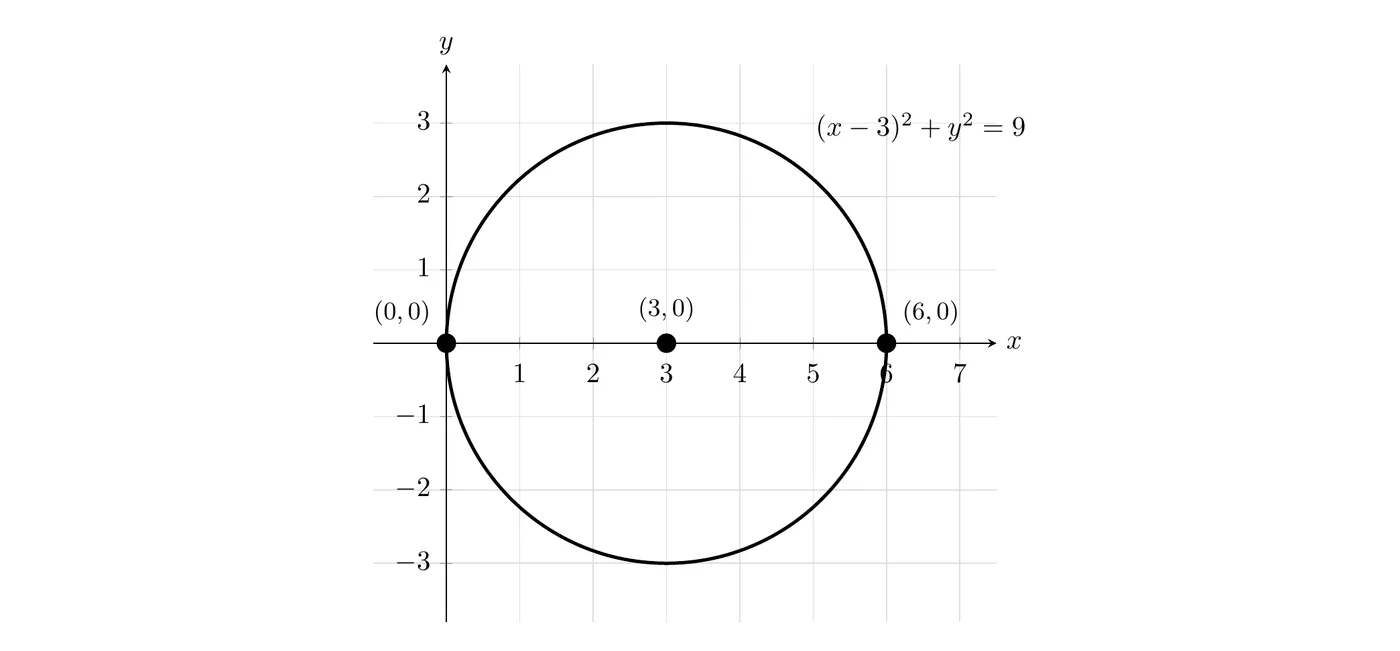
Convert 6x=r26x = r^2.
Since rcos⁡(θ)=xr\cos(\theta) = x and r2=x2+y2r^2 = x^2 + y^2:
6x=x2+y26x = x^2 + y^20=x2−6x+y20 = x^2 - 6x + y^2
Complete the square on xx:
0+9=x2−6x+9+y20 + 9 = x^2 - 6x + 9 + y^29=(x−3)2+y29 = (x - 3)^2 + y^2
This is a circle with center (3,0)(3, 0) and radius 33.
9.7 - Defining Polar Coordinates and Differentiating in Polar Form

Example 3: Linear Equation

Convert r(3cos⁡(θ)−sin⁡(θ))=5r(3\cos(\theta) - \sin(\theta)) = 5.
Distribute the rr:
3rcos⁡(θ)−rsin⁡(θ)=53r\cos(\theta) - r\sin(\theta) = 5
Substitute xx and yy:
3x−y=5⇒y=3x−53x - y = 5 \quad \Rightarrow \quad y = 3x - 5
This is a line with slope 33 and yy-intercept −5-5.

Graphing Polar Equations with Technology

Calculator setup:
  1. Set the mode to POLAR, not function or parametric
  1. In the equation editor, you’ll see r1=r_1 =, r2=r_2 =, and so on
  1. Enter your equations in the form r=f(θ)r = f(\theta)
  1. Adjust the window settings:
      • θmin=0\theta_{\text{min}} = 0, θmax=2π\theta_{\text{max}} = 2\pi
      • θstep\theta_{\text{step}} controls smoothness, and smaller means smoother
Tracing: - You can trace along the curve or jump to specific θ\theta values - Enter a specific angle, like π4\frac{\pi}{4}, to see the coordinates at that point

Finding the Slope of Polar Curves

Conversion to Parametric Form

A polar equation r=f(θ)r = f(\theta) can be written parametrically:
x=f(θ)cos⁡(θ)y=f(θ)sin⁡(θ)x = f(\theta)\cos(\theta) \qquad y = f(\theta)\sin(\theta)

Derivative Formula

The slope of a polar curve is:
dydx=dydθdxdθ=y′(θ)x′(θ)\frac{dy}{dx} = \frac{\frac{dy}{d\theta}}{\frac{dx}{d\theta}} = \frac{y'(\theta)}{x'(\theta)}
Expanded form:
dydx=f′(θ)sin⁡(θ)+f(θ)cos⁡(θ)f′(θ)cos⁡(θ)−f(θ)sin⁡(θ)\frac{dy}{dx} = \frac{f'(\theta)\sin(\theta) + f(\theta)\cos(\theta)}{f'(\theta)\cos(\theta) - f(\theta)\sin(\theta)}
where f(θ)=rf(\theta) = r, and you use the product rule on both the numerator and the denominator.

Example 4: Slope at a Point

Find the slope of r=2+3sin⁡(θ)r = 2 + 3\sin(\theta) at θ=0\theta = 0.
First, express it in parametric form:
y=(2+3sin⁡θ)sin⁡θ=2sin⁡θ+3sin⁡2θy = (2 + 3\sin\theta)\sin\theta = 2\sin\theta + 3\sin^2\thetax=(2+3sin⁡θ)cos⁡θ=2cos⁡θ+3sin⁡θcos⁡θx = (2 + 3\sin\theta)\cos\theta = 2\cos\theta + 3\sin\theta\cos\theta
Find the derivatives:
dydθ=2cos⁡θ+6sin⁡θcos⁡θ\frac{dy}{d\theta} = 2\cos\theta + 6\sin\theta\cos\thetadxdθ=−2sin⁡θ+3cos⁡2θ−3sin⁡2θ=−2sin⁡θ+3(cos⁡2θ−sin⁡2θ)\frac{dx}{d\theta} = -2\sin\theta + 3\cos^2\theta - 3\sin^2\theta = -2\sin\theta + 3(\cos^2\theta - \sin^2\theta)
Evaluate at θ=0\theta = 0:
dydθ∣θ=0=2cos⁡(0)+6sin⁡(0)cos⁡(0)=2(1)+0=2\frac{dy}{d\theta}\bigg|_{\theta=0} = 2\cos(0) + 6\sin(0)\cos(0) = 2(1) + 0 = 2dxdθ∣θ=0=−2sin⁡(0)+3cos⁡2(0)−3sin⁡2(0)=0+3(1)−0=3\frac{dx}{d\theta}\bigg|_{\theta=0} = -2\sin(0) + 3\cos^2(0) - 3\sin^2(0) = 0 + 3(1) - 0 = 3
Therefore:
dydx∣θ=0=23\frac{dy}{dx}\bigg|_{\theta=0} = \frac{2}{3}

Horizontal and Vertical Tangent Lines

Finding Horizontal Tangents

Horizontal tangent lines happen when the slope equals zero:
dydx=0  ⟹  dydθ=0 (and dxdθ≠0)\frac{dy}{dx} = 0 \implies \frac{dy}{d\theta} = 0 \text{ (and } \frac{dx}{d\theta} \neq 0\text{)}
Steps: 1. Find y=rsin⁡(θ)y = r\sin(\theta) 2. Compute dydθ\frac{dy}{d\theta} 3. Solve dydθ=0\frac{dy}{d\theta} = 0

Finding Vertical Tangents

Vertical tangent lines happen when the slope is undefined:
dydx undefined  ⟹  dxdθ=0 (and dydθ≠0)\frac{dy}{dx} \text{ undefined} \implies \frac{dx}{d\theta} = 0 \text{ (and } \frac{dy}{d\theta} \neq 0\text{)}
Steps: 1. Find x=rcos⁡(θ)x = r\cos(\theta) 2. Compute dxdθ\frac{dx}{d\theta} 3. Solve dxdθ=0\frac{dx}{d\theta} = 0

Example 5: Finding Tangent Lines

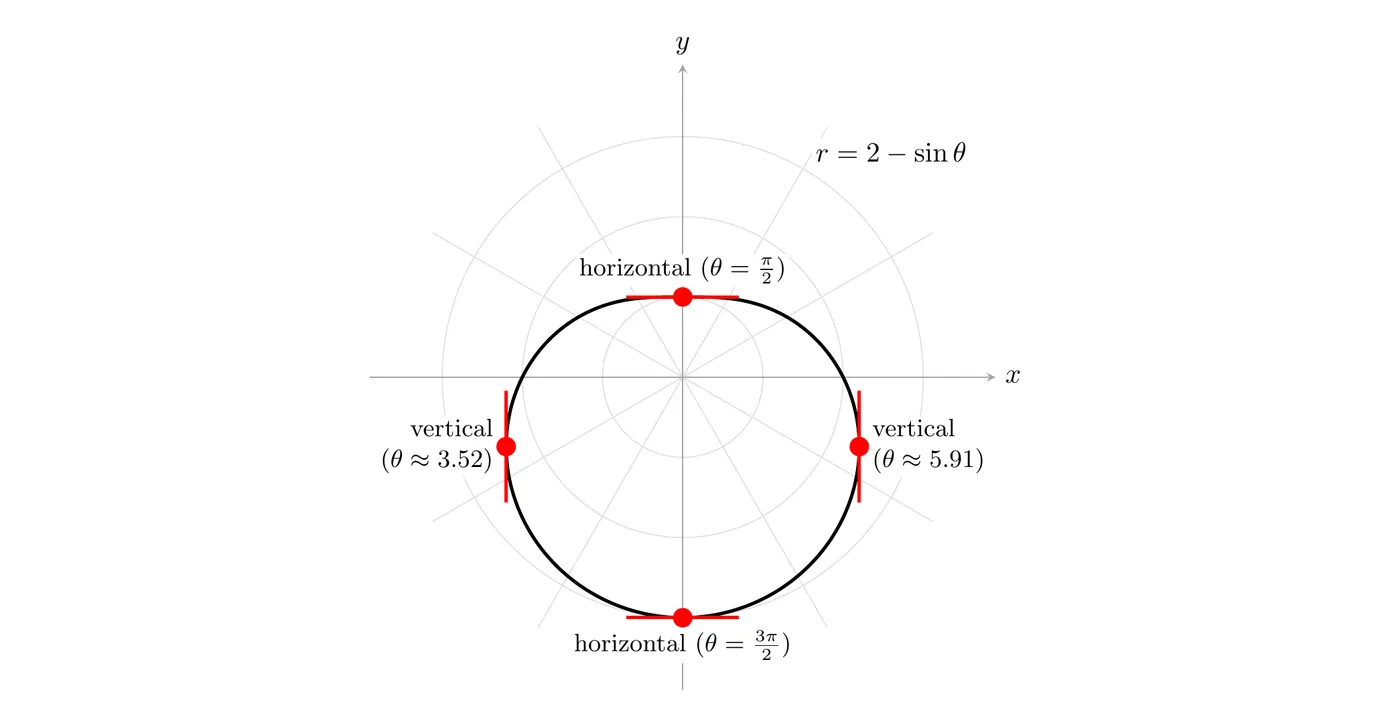
Find the horizontal and vertical tangents for r=2−sin⁡(θ)r = 2 - \sin(\theta) on [0,2π)[0, 2\pi).
9.7 - Defining Polar Coordinates and Differentiating in Polar Form
For horizontal tangents:
y=(2−sin⁡θ)sin⁡θ=2sin⁡θ−sin⁡2θy = (2 - \sin\theta)\sin\theta = 2\sin\theta - \sin^2\thetadydθ=2cos⁡θ−2sin⁡θcos⁡θ=2cos⁡θ(1−sin⁡θ)\frac{dy}{d\theta} = 2\cos\theta - 2\sin\theta\cos\theta = 2\cos\theta(1 - \sin\theta)
Set it equal to zero:
2cos⁡θ(1−sin⁡θ)=02\cos\theta(1 - \sin\theta) = 0
Solutions:
cos⁡θ=0  ⟹  θ=π2,3π2\cos\theta = 0 \implies \theta = \frac{\pi}{2}, \frac{3\pi}{2}1−sin⁡θ=0  ⟹  sin⁡θ=1  ⟹  θ=π21 - \sin\theta = 0 \implies \sin\theta = 1 \implies \theta = \frac{\pi}{2}
We’ll check which ones are valid after finding the vertical tangents.
For vertical tangents:
x=(2−sin⁡θ)cos⁡θ=2cos⁡θ−sin⁡θcos⁡θx = (2 - \sin\theta)\cos\theta = 2\cos\theta - \sin\theta\cos\thetadxdθ=−2sin⁡θ−cos⁡2θ+sin⁡2θ\frac{dx}{d\theta} = -2\sin\theta - \cos^2\theta + \sin^2\theta=−2sin⁡θ−(1−sin⁡2θ)+sin⁡2θ= -2\sin\theta - (1 - \sin^2\theta) + \sin^2\theta=−2sin⁡θ−1+sin⁡2θ+sin⁡2θ= -2\sin\theta - 1 + \sin^2\theta + \sin^2\theta=2sin⁡2θ−2sin⁡θ−1= 2\sin^2\theta - 2\sin\theta - 1
Set it equal to zero, treating it as a quadratic in sin⁡θ\sin\theta:
2sin⁡2θ−2sin⁡θ−1=02\sin^2\theta - 2\sin\theta - 1 = 0
Using the quadratic formula with u=sin⁡θu = \sin\theta:
sin⁡θ=2±4+84=2±124=2±234=1±32\sin\theta = \frac{2 \pm \sqrt{4 + 8}}{4} = \frac{2 \pm \sqrt{12}}{4} = \frac{2 \pm 2\sqrt{3}}{4} = \frac{1 \pm \sqrt{3}}{2}sin⁡θ=1+32≈1.366(impossible, since ∣sin⁡θ∣≤1)\sin\theta = \frac{1 + \sqrt{3}}{2} \approx 1.366 \quad \text{(impossible, since } |\sin\theta| \leq 1\text{)}sin⁡θ=1−32≈−0.366\sin\theta = \frac{1 - \sqrt{3}}{2} \approx -0.366
Find θ\theta where sin⁡θ≈−0.366\sin\theta \approx -0.366:
θ≈3.516, 5.908 radians\theta \approx 3.516, \, 5.908 \text{ radians}
When both are zero: if a value of θ\theta makes both dydθ=0\frac{dy}{d\theta} = 0 and dxdθ=0\frac{dx}{d\theta} = 0, the slope formula gives 00\frac{0}{0}, so you can’t call it a horizontal or vertical tangent yet. For a polar curve this only happens at the origin, and it’s often a cusp (a sharp point), like the tip of the cardioid r=1+cos⁡θr = 1 + \cos\theta at θ=π\theta = \pi. It takes more work, like a limit, to know for sure.
In this example, θ=π2\theta = \frac{\pi}{2} shows up twice in the horizontal list, but not in the vertical list: at that angle dx/dθ = 2 - 2 - 1 = -1, not 0. So it isn’t a cusp. It’s a horizontal tangent at the point (0, 1).
Final answers: - Horizontal tangents: θ=π2, 3π2\theta = \frac{\pi}{2}, \, \frac{3\pi}{2} - Vertical tangents: θ≈3.516, 5.908\theta \approx 3.516, \, 5.908

Advanced Factoring Techniques

When you’re solving trig equations that come from derivatives, keep these in mind.

Pythagorean Identities

sin⁡2(θ)+cos⁡2(θ)=1\sin^2(\theta) + \cos^2(\theta) = 11−sin⁡2(θ)=cos⁡2(θ)1 - \sin^2(\theta) = \cos^2(\theta)1−cos⁡2(θ)=sin⁡2(θ)1 - \cos^2(\theta) = \sin^2(\theta)

Factoring Trigonometric Polynomials

Treat sin⁡(θ)\sin(\theta) or cos⁡(θ)\cos(\theta) as a variable, like xx, and factor accordingly.
Example: 2sin⁡2θ−3sin⁡θ+1=02\sin^2\theta - 3\sin\theta + 1 = 0
Factor: (2sin⁡θ−1)(sin⁡θ−1)=0(2\sin\theta - 1)(\sin\theta - 1) = 0
Solutions: sin⁡θ=12\sin\theta = \frac{1}{2} or sin⁡θ=1\sin\theta = 1

What the Derivatives Tell You About a Polar Curve

A polar curve r=f(θ)r = f(\theta) comes with several derivatives, and each one answers a different question about the curve.
Derivative
What it tells you
drdθ\frac{dr}{d\theta}
How the distance from the origin is changing as θ\theta increases (sign rule below)
dxdθ\frac{dx}{d\theta}
Positive: the point moves right as θ\theta increases. Negative: it moves left
dydθ\frac{dy}{d\theta}
Positive: the point moves up as θ\theta increases. Negative: it moves down
dydx\frac{dy}{dx}
The slope of the tangent line
d2ydx2\frac{d^2y}{dx^2}
Concavity: positive means concave up, negative means concave down

Moving Toward or Away from the Origin

The distance from the origin is ∣r∣|r|, not rr, because rr can be negative. So compare the signs of rr and drdθ\frac{dr}{d\theta}:
  • Same sign (both positive or both negative): ∣r∣|r| is increasing, so the point is moving away from the origin
  • Opposite signs: ∣r∣|r| is decreasing, so the point is moving toward the origin
When r>0r > 0, this is just “drdθ>0\frac{dr}{d\theta} > 0 means moving away.” The sign check matters when rr is negative.

Example 6: Distance from the Origin

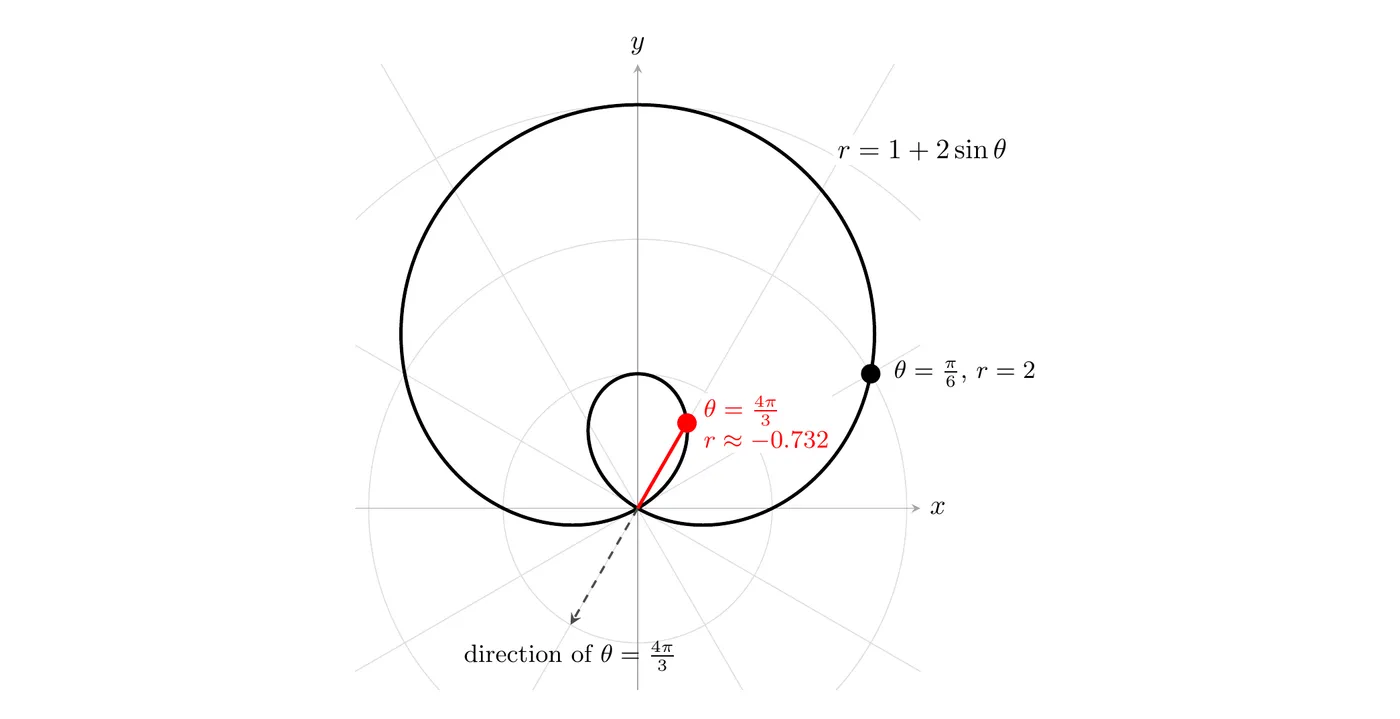
For r=1+2sin⁡θr = 1 + 2\sin\theta, is the point moving toward or away from the origin at θ=π6\theta = \frac{\pi}{6}? At θ=4π3\theta = \frac{4\pi}{3}?
9.7 - Defining Polar Coordinates and Differentiating in Polar Form
drdθ=2cos⁡θ\frac{dr}{d\theta} = 2\cos\theta
At θ=π6\theta = \frac{\pi}{6}: r=1+2(12)=2r = 1 + 2\left(\frac{1}{2}\right) = 2 and drdθ=2(32)=3\frac{dr}{d\theta} = 2\left(\frac{\sqrt{3}}{2}\right) = \sqrt{3}. Both are positive, so the point is moving away from the origin.
At θ=4π3\theta = \frac{4\pi}{3}: r=1+2(−32)=1−3≈−0.732r = 1 + 2\left(-\frac{\sqrt{3}}{2}\right) = 1 - \sqrt{3} \approx -0.732 and drdθ=2(−12)=−1\frac{dr}{d\theta} = 2\left(-\frac{1}{2}\right) = -1. Both are negative, so the point is moving away from the origin here too. rr is decreasing, but it’s getting more negative, so the distance ∣r∣|r| is growing.
Since rr is negative at θ=4π3\theta = \frac{4\pi}{3}, the point is plotted in the opposite direction. It lands on the inner loop in Quadrant I, not in Quadrant III.

Second Derivative in Polar Form

Since xx and yy are both functions of θ\theta, the second derivative works just like Topic 9.2, with θ\theta in place of tt:
d2ydx2=ddθ[dydx]dxdθ\frac{d^2y}{dx^2} = \frac{\frac{d}{d\theta}\left[\frac{dy}{dx}\right]}{\frac{dx}{d\theta}}

Example 7: Concavity of a Polar Curve

Is the curve r=4cos⁡θr = 4\cos\theta concave up or concave down at θ=π8\theta = \frac{\pi}{8}?
Step 1: Write xx and yy in terms of θ\theta. Use the double angle identities cos⁡2θ=1+cos⁡(2θ)2\cos^2\theta = \frac{1 + \cos(2\theta)}{2} and 2sin⁡θcos⁡θ=sin⁡(2θ)2\sin\theta\cos\theta = \sin(2\theta):
x=4cos⁡2θ=2+2cos⁡(2θ)y=4sin⁡θcos⁡θ=2sin⁡(2θ)x = 4\cos^2\theta = 2 + 2\cos(2\theta) \qquad y = 4\sin\theta\cos\theta = 2\sin(2\theta)
Step 2: Find dydx\frac{dy}{dx}.
dxdθ=−4sin⁡(2θ)dydθ=4cos⁡(2θ)dydx=4cos⁡(2θ)−4sin⁡(2θ)=−cot⁡(2θ)\frac{dx}{d\theta} = -4\sin(2\theta) \qquad \frac{dy}{d\theta} = 4\cos(2\theta) \qquad \frac{dy}{dx} = \frac{4\cos(2\theta)}{-4\sin(2\theta)} = -\cot(2\theta)
Step 3: Find d2ydx2\frac{d^2y}{dx^2}. The derivative of −cot⁡(2θ)-\cot(2\theta) is 2csc⁡2(2θ)2\csc^2(2\theta) (chain rule), and the denominator is dxdθ\frac{dx}{d\theta}:
d2ydx2=2csc⁡2(2θ)−4sin⁡(2θ)=−12csc⁡3(2θ)\frac{d^2y}{dx^2} = \frac{2\csc^2(2\theta)}{-4\sin(2\theta)} = -\frac{1}{2}\csc^3(2\theta)
Step 4: Evaluate at θ=π8\theta = \frac{\pi}{8}. Here 2θ=π42\theta = \frac{\pi}{4}, and csc⁡(π4)=2\csc\left(\frac{\pi}{4}\right) = \sqrt{2}:
d2ydx2∣θ=π/8=−12(2)3=−12(22)=−2≈−1.414\frac{d^2y}{dx^2}\bigg|_{\theta=\pi/8} = -\frac{1}{2}\left(\sqrt{2}\right)^3 = -\frac{1}{2}\left(2\sqrt{2}\right) = -\sqrt{2} \approx -1.414
Answer: negative, so the curve is concave down at θ=π8\theta = \frac{\pi}{8}. That makes sense: r=4cos⁡θr = 4\cos\theta is the circle (x−2)2+y2=4(x - 2)^2 + y^2 = 4, and θ=π8\theta = \frac{\pi}{8} lands on its top half, at (2+2,2)\left(2 + \sqrt{2}, \sqrt{2}\right).

Key Takeaways

  • Polar coordinates: (r,θ)(r, \theta), where rr is the distance and θ\theta is the angle
  • Multiple representations are possible for the same point
  • Conversion formulas: x=rcos⁡θx = r\cos\theta, y=rsin⁡θy = r\sin\theta, r2=x2+y2r^2 = x^2 + y^2
  • Slope of a polar curve: dydx=dy/dθdx/dθ\frac{dy}{dx} = \frac{dy/d\theta}{dx/d\theta}, so treat it like a parametric curve
  • The product rule is required for both dydθ\frac{dy}{d\theta} and dxdθ\frac{dx}{d\theta}
  • Horizontal tangents: dydθ=0\frac{dy}{d\theta} = 0, and dxdθ≠0\frac{dx}{d\theta} \neq 0
  • Vertical tangents: dxdθ=0\frac{dx}{d\theta} = 0, and dydθ≠0\frac{dy}{d\theta} \neq 0
  • Both derivatives zero at the same θ\theta gives 00\frac{0}{0}, so there’s no conclusion yet (it’s often a cusp)
  • Pythagorean identities are often needed to simplify expressions
  • Distance from the origin: moving away when rr and drdθ\frac{dr}{d\theta} have the same sign, toward when they have opposite signs
  • Second derivative: d2ydx2=ddθ[dydx]dxdθ\frac{d^2y}{dx^2} = \frac{\frac{d}{d\theta}\left[\frac{dy}{dx}\right]}{\frac{dx}{d\theta}}, the same as for parametric equations
  • Graphing technology helps for visualizing polar curves and checking tangent lines

AP® is a registered trademark of the College Board, which is not affiliated with Dove's Library and was not involved in the production of, and does not endorse, this website.

Providing free, high-quality AP notes to help students succeed, earn college credit, and reach their educational goals, ensuring everyone has access to the resources they need.

© 2026 Standard Learning Group, Inc., which operates Dove's Library. All rights reserved.