

1.8 - Valence Electrons and Ionic Compounds
Overview
Why does sodium react violently with chlorine while neon reacts with almost nothing? The answer is in the valence electrons and how strongly each nucleus holds them. This topic connects electron configurations and periodic trends to which elements form bonds, which formulas their compounds have, and which charges their ions carry.
Valence electrons decide whether atoms bond
Whether two elements form a bond depends on the interactions between their valence electrons and their nuclei, the same Coulomb's law ideas as in 1.7.
- Metals (left side of the table) have few valence electrons and low ionization energies. They lose electrons easily and form cations.
- Nonmetals (right side) have more valence electrons, high ionization energies, and high electron affinities and electronegativities. They gain electrons to form anions, or they share electrons.
- A metal and a nonmetal usually transfer electrons: the metal's loosely held valence electrons go to the nonmetal, and the ions that form attract each other. That's an ionic compound, like NaCl.
- Two nonmetals both hold their electrons tightly, so neither gives them up. They share electrons in covalent bonds, like (more in Unit 2).
- Noble gases have filled valence shells, very high ionization energies, and no tendency to gain an electron, so they almost never form compounds.
Reactivity trends
- Group 1 metals get more reactive going down the group. Each one has a single valence electron with , but going down the group that electron is in a farther shell, so it is held less tightly. Potassium's first ionization energy is 419 kJ/mol compared with 496 kJ/mol for sodium and 520 kJ/mol for lithium. You can see this in the lab: lithium fizzes steadily in water, sodium melts into a ball and skids across the surface, and potassium bursts into a lilac flame.
- Group 17 nonmetals get less reactive going down the group. A small halogen atom attracts an incoming electron strongly because that electron gets close to the nucleus. Larger halogens hold an extra electron less tightly, and their electronegativity drops: F 3.98, Cl 3.16, Br 2.96, I 2.66. Fluorine is the most reactive element of all. (An isolated chlorine atom releases slightly more energy than fluorine when it gains an electron, as 1.7 explains, but fluorine still reacts more vigorously, partly because the bond in is unusually weak.)
Same column, same kind of compound
Elements in the same group have the same number of valence electrons, so they tend to form analogous compounds: compounds with the same formula pattern.
Group | Elements | One series | Another series |
1 | Li, Na, K | LiCl, NaCl, KCl | , , |
2 | Mg, Ca, Sr | , , | MgO, CaO, SrO |
13 | Al, Ga | , | , |
14 | C, Si, Ge | , , | , , |
15 | N, P, As | , , | , , |
16 | O, S, Se | , , | , , |
17 | F, Cl, Br | NaF, NaCl, NaBr | HF, HCl, HBr |
This lets you predict formulas you've never seen. Radium is below calcium, so radium chloride should be , like .
Be careful: the same formula pattern doesn't mean the same properties. Water is a liquid at room temperature while is a gas, and is a gas while (quartz, sand) is a hard solid. Units 2 and 3 explain why.
Typical charges of ions
The charge an atom usually takes in an ionic compound is set by its number of valence electrons, so you can read it from the periodic table. Main-group atoms tend to lose or gain electrons until they have the same configuration as the nearest noble gas (filled and subshells in the outer shell).
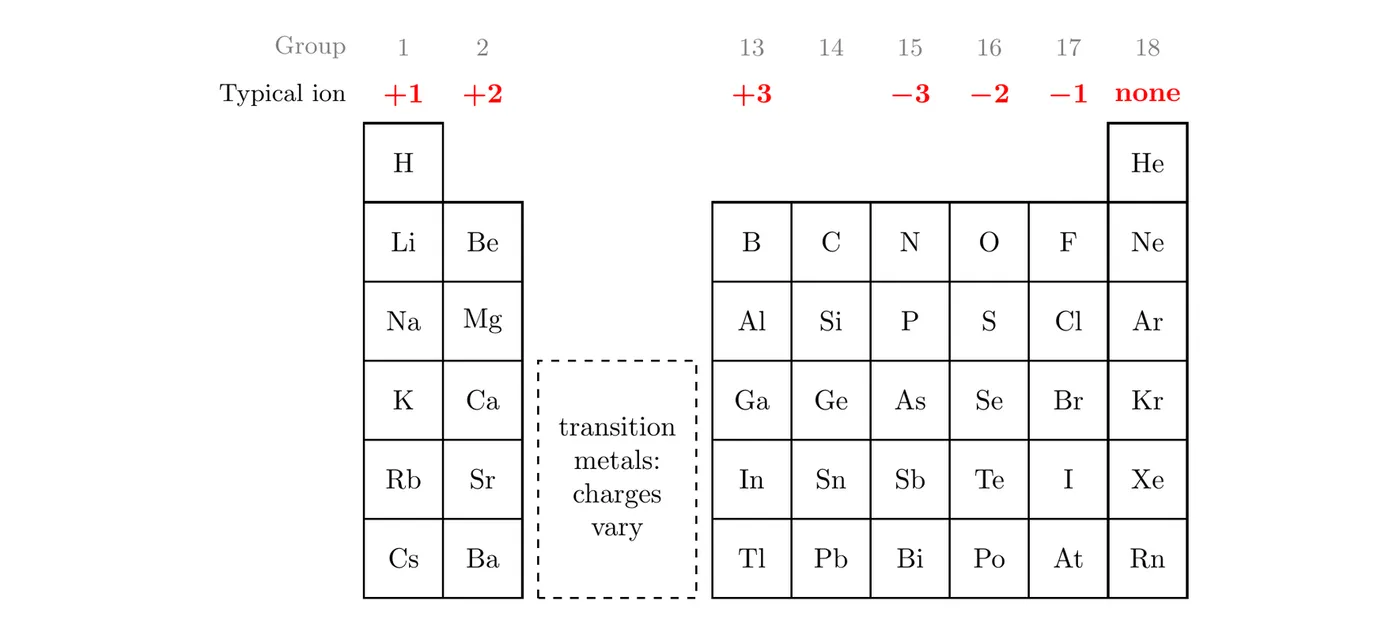
- Group 1: lose 1 electron, charge . Na () becomes ().
- Group 2: lose 2, charge (, ).
- Group 13: lose 3, charge (). Boron shares electrons instead of forming ions.
- Group 15: gain 3, charge (, ).
- Group 16: gain 2, charge (, ).
- Group 17: gain 1, charge (, ).
- Group 18: no ions in ordinary compounds.
A few cautions:
- Group 14: carbon and silicon almost always share electrons rather than forming ions.
- Hydrogen sits in group 1 but is a nonmetal. It can form or, with very reactive metals, (as in NaH).
- Transition metals often have more than one possible charge, usually or ( and , and ). They lose their electrons first (1.5). Names show the charge with a Roman numeral, as in iron(III) oxide, . On the exam you'll be given the charge or can work it out from a formula.
Why the charges stop where they do: successive ionization energies
You can remove electrons one at a time, and each removal has its own ionization energy. Each one takes more energy than the last, since the same protons are pulling on fewer electrons. But there is a huge jump as soon as you reach the core electrons.
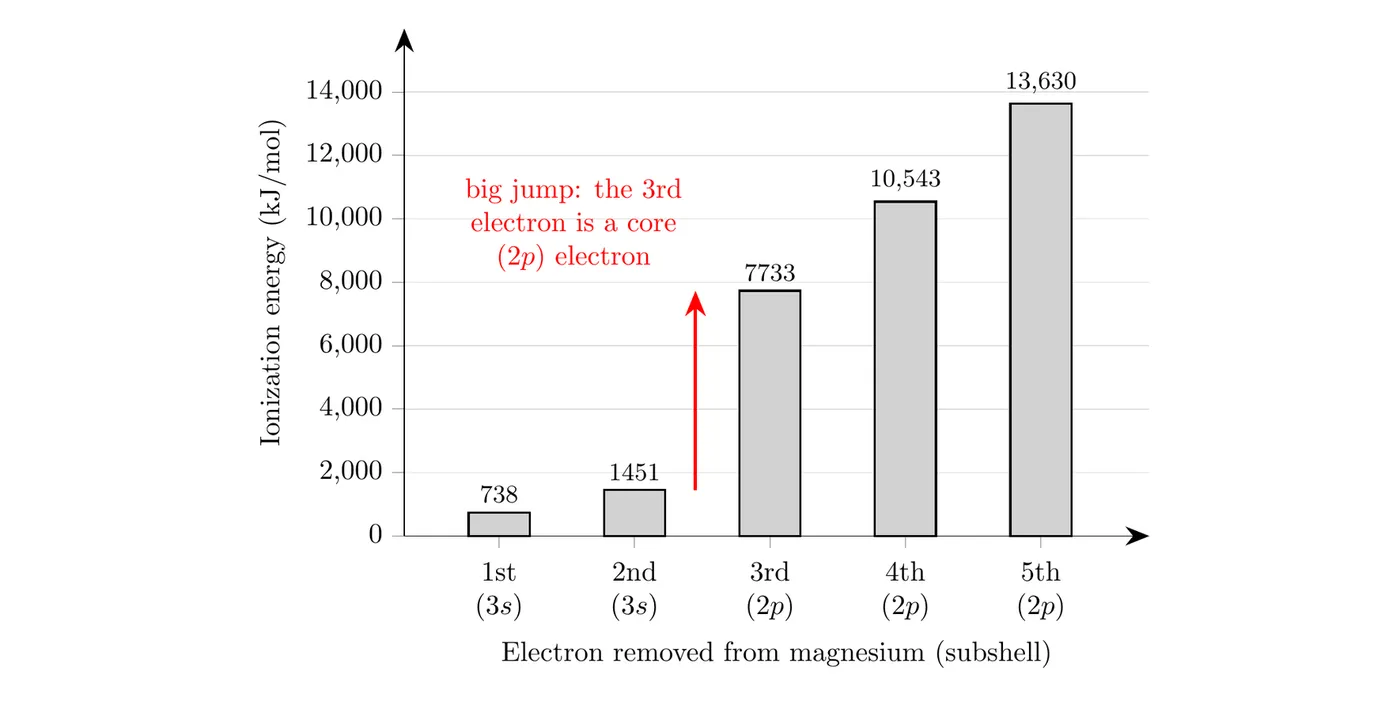
Magnesium's first two electrons come from (738 and 1451 kJ/mol). The third has to come from , a shell closer to the nucleus with much less shielding, so it takes 7733 kJ/mol, about 5.3 times the second. The energy released when an ionic compound forms can make up for removing two valence electrons, but not a core electron. That's why magnesium is always in its compounds and never .
In general, the big jump comes right after the last valence electron. The number of electrons removed before the jump equals the number of valence electrons, which is the usual positive charge.
Writing formulas for ionic compounds
An ionic compound has no overall charge, so the total positive charge must equal the total negative charge. Write the ions, then find the smallest whole-number ratio that makes the charges add to zero. The metal goes first, and charges don't appear in the formula.
- and : one needs two , so .
- and : , so .
- and : , so .
- and : the charges already cancel 1 to 1, so MgO (not ).
Example 1: Predicting formulas from the periodic table
Predict the formula of the ionic compound formed by (a) strontium and bromine, (b) aluminum and sulfur, (c) potassium and nitrogen.
(a) Strontium is in group 2, so . Bromine is in group 17, so . Two bromide ions balance one strontium ion: .
(b) Aluminum forms and sulfur (group 16) forms . The smallest total that both 3 and 2 divide into is 6, so two Al and three S: , giving .
(c) Potassium forms and nitrogen (group 15) forms . Three potassium ions balance one nitride ion: .
Answer: , , and .
Example 2: Using successive ionization energies (AP-style)
Element X is in period 3. Its first five ionization energies, in kJ/mol, are 578, 1817, 2745, 11,577, and 14,842. (a) Identify X. (b) Predict the formulas of its oxide and its chloride. (c) Use Coulomb's law to explain the large jump.
Step 1: Find the jump. Compare each ionization energy with the one before it:
The biggest jump is from the third to the fourth ionization energy.
(a) Three electrons come off before the jump, so X has 3 valence electrons and is in group 13. The group 13 element in period 3 is aluminum.
(b) Aluminum forms . With the oxide is , and with the chloride is .
(c) The first three electrons come from the shell (). The fourth must come from the subshell, which is in a shell closer to the nucleus and shielded only by the two electrons, so it feels a much larger effective nuclear charge. By Coulomb's law, a closer electron feeling more charge is held much more strongly, so removing it takes far more energy.
Example 3: Explaining reactivity (AP-style)
Potassium reacts with water much more vigorously than sodium does. Explain this in terms of the electronic structure of the atoms.
Step 1: Compare the valence electrons. Na is and K is . Each has one valence electron with ( and ).
Step 2: Compare distance. Potassium's valence electron is in shell 4, farther from the nucleus than sodium's in shell 3.
Answer: By Coulomb's law, the same effective charge at a greater distance gives a weaker attraction, so potassium's valence electron is easier to remove (first ionization energy 419 kJ/mol versus 496 kJ/mol). In the reaction with water, the metal atoms lose that electron, so the atom that loses it more easily reacts more vigorously. This is the link between a particle-level property (how tightly an electron is held) and what you see in the beaker.
Example 4: Predicting analogous compounds
(a) Calcium forms CaO and . Predict the formula of the compound of strontium and sulfur. (b) Hydrogen and oxygen form . Predict the formula of the compound of hydrogen and tellurium. (c) Carbon forms . Predict the formula of silicon's oxide. Should it also be a gas?
(a) Strontium is in the same group as calcium and sulfur is in the same group as oxygen, so the compound follows CaO: SrS.
(b) Tellurium is in group 16 with oxygen, so the compound follows : .
(c) Silicon is in group 14 with carbon, so its oxide is . The formula matches, but the properties don't: is a hard solid (quartz). Same column predicts the formula pattern, not every property.
Common mistakes
- Writing charges inside a formula () or not balancing them (MgCl). The formula is .
- Forgetting to reduce: and make MgO, not .
- Giving transition metals a single fixed charge based on their column.
- Giving carbon or silicon or ions in ordinary compounds. They share electrons.
- Explaining charges only with “atoms want a full octet”. On the AP exam, back it up with ionization energies and Coulomb's law: removing a core electron costs far too much energy.
- Saying halogens get more reactive going down the group, like the alkali metals. It's the opposite: fluorine is the most reactive halogen.