

3.1 - Intermolecular and Interparticle Forces
Overview
Intermolecular forces are the attractions between separate particles: molecules, atoms, and ions. They're much weaker than the covalent and ionic bonds inside a substance, but they decide whether it's a gas, liquid, or solid at room temperature, how high it boils, and what it mixes with. This topic covers each type of force, what makes it stronger, and how to explain a comparison the way the AP exam expects.
Intermolecular vs. intramolecular forces
- Intramolecular forces are the bonds inside a molecule, like the covalent bonds in water.
- Intermolecular forces (IMFs) are attractions between neighboring particles, like the H of one water molecule attracted to the O of another.
When water boils, the molecules move apart, but each molecule stays in one piece. Boiling overcomes intermolecular forces, not covalent bonds: steam is still .
Every force in this topic is Coulombic. Opposite charges, full or partial, attract, and the attraction is stronger when the charges are bigger and closer together (Coulomb's law, Unit 1).
London dispersion forces
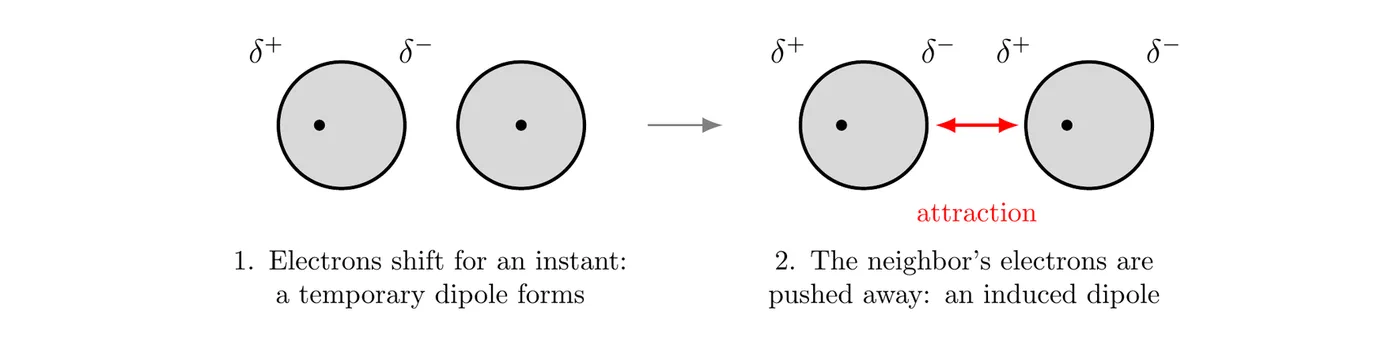
Every atom and molecule has London dispersion forces (LDFs), even nonpolar ones like , , and the noble gases. Electrons are always moving, so for an instant the electron cloud can be lopsided. That makes a temporary dipole: a slightly negative side () and a slightly positive side (). The temporary dipole pushes on the electrons of a neighbor and induces a dipole there too, and the two attract. These dipoles flicker on and off constantly, but on average there's a net attraction.
What makes dispersion forces stronger
- Polarizability: how easily an electron cloud gets distorted. It increases with more electrons and a larger electron cloud, and pi bonds add to it because pi electrons are spread out and loosely held. That's why the halogens go from gases (, ) to a liquid () to a solid () at room temperature.
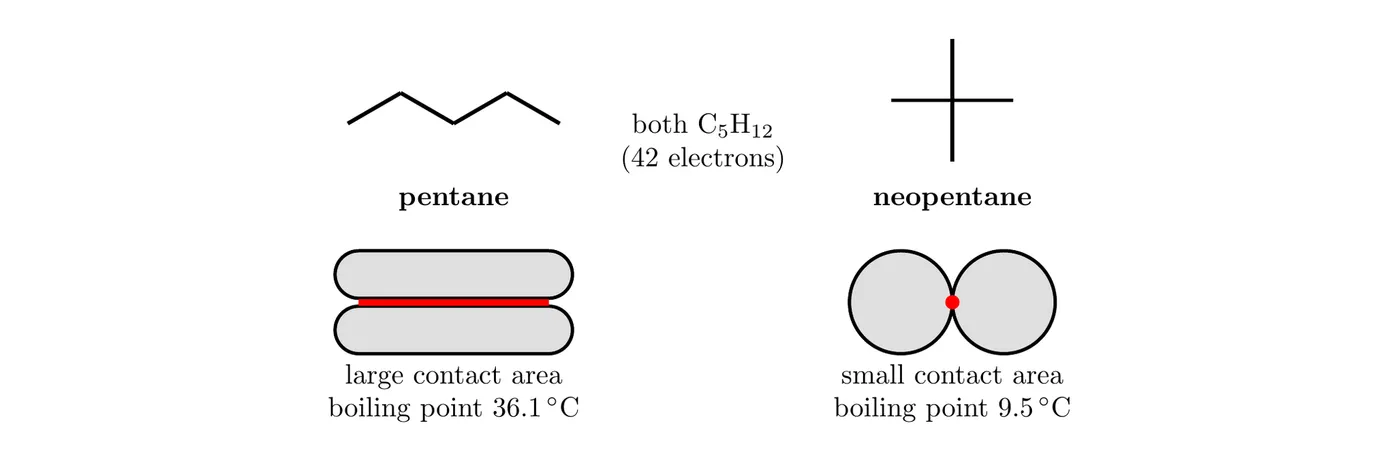
- Contact area: molecules that can line up along more of their surface have more places to interact. Pentane and neopentane are both with 42 electrons, but long, straight pentane boils at 36.1 °C while compact, ball-shaped neopentane boils at 9.5 °C.
Dispersion forces in large molecules
Dispersion forces are the only IMF between nonpolar molecules, but they act between all particles, and they are often the largest part of the attraction between big molecules, polar or not. Compare and : is more polar, but has 54 electrons to 's 18, so its dispersion forces are much stronger and it boils higher (Example 2 below works through this).
A note on "van der Waals forces"
Some books use van der Waals forces as a group name for dispersion forces and dipole forces together. It is not another name for London dispersion forces, and the CED says not to use it that way. When you mean dispersion forces, say "London dispersion forces."
Forces from permanent dipoles
A polar molecule has a permanent dipole moment (Topic 2.7): one end is always partly negative and the other partly positive. That permanent dipole adds new interactions on top of dispersion forces. Which ones depend on what the polar molecule is next to.
Dipole-induced dipole forces
A polar molecule next to a nonpolar one distorts the nonpolar molecule's electron cloud and induces a dipole that always points the attractive way, so these forces are always attractive. They get stronger with a bigger dipole on the polar molecule and a more polarizable nonpolar molecule. This is part of how a little dissolves in water.
Dipole-dipole forces
Between two polar molecules, the end of one attracts the end of the other. The strength depends on the size of the dipoles and how they're oriented: head to tail they attract, and like ends facing each other repel. In a liquid or solid, molecules spend more time in attractive orientations, so the net effect is an attraction.

For molecules of similar size, polar ones usually attract each other more than nonpolar ones, because dipole-dipole forces act in addition to dispersion forces. Propane (, nonpolar, 26 electrons) boils at −42 °C, while acetaldehyde (, polar, 24 electrons) boils at 20 °C.
Ion-dipole forces
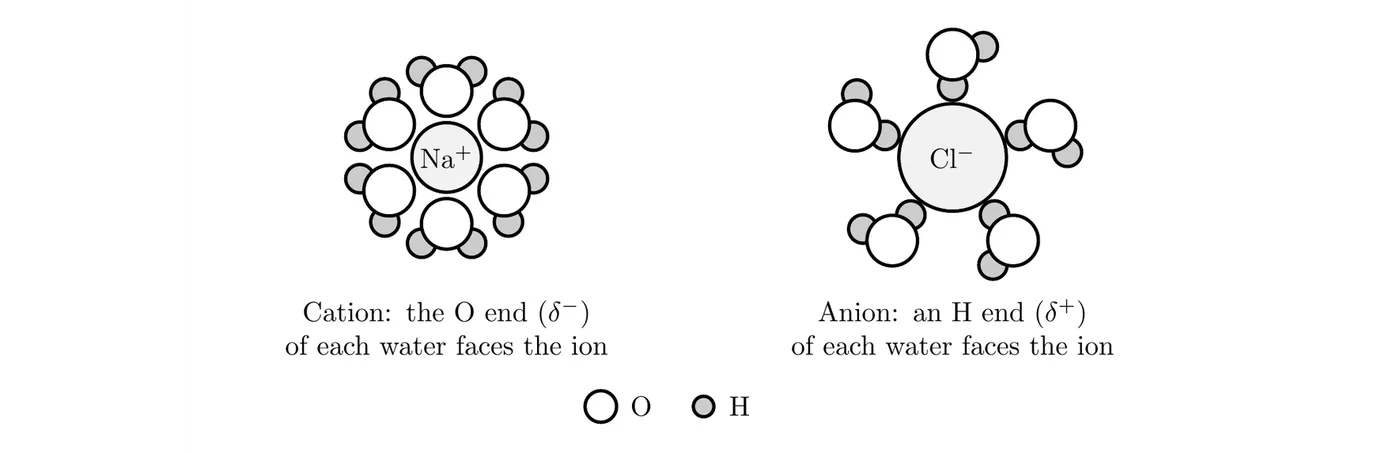
An ion attracts the oppositely charged end of a polar molecule. Around a cation like , water molecules turn their O end () toward the ion. Around an anion like , they turn an H end () toward it. Ion-dipole forces are usually stronger than dipole-dipole forces, because a full charge is bigger than a partial charge. They're why ionic compounds dissolve in water, and AP free-response questions often ask you to draw this orientation.
Reasoning with partial charges
To predict how strong one of these attractions is and which way the molecules point, ask two questions: which charges face each other, and how big and how close are they? Bigger charges at shorter distances attract more strongly. That's why holds water molecules more tightly than , and why a small ion holds water more tightly than a large ion with the same charge.
Hydrogen bonding
A hydrogen bond is an especially strong dipole-dipole attraction. It forms when an H atom covalently bonded to N, O, or F is attracted to a lone pair on an N, O, or F atom in a different molecule (or in a different part of the same molecule).
Why only N, O, and F? They're very electronegative and small, so the H bonded to them is left with a large and almost no electron cloud of its own, and it can get very close to the lone pair on its neighbor.
- Donor: the molecule with H bonded to N, O, or F, like the in water or the in ammonia.
- Acceptor: the molecule with a lone pair on N, O, or F.
Two different substances can hydrogen bond with each other even if one can't do it on its own. In acetone, , every H is bonded to C, so acetone molecules don't hydrogen bond with each other. But acetone's O can accept a hydrogen bond from water's , which is one reason the two mix.
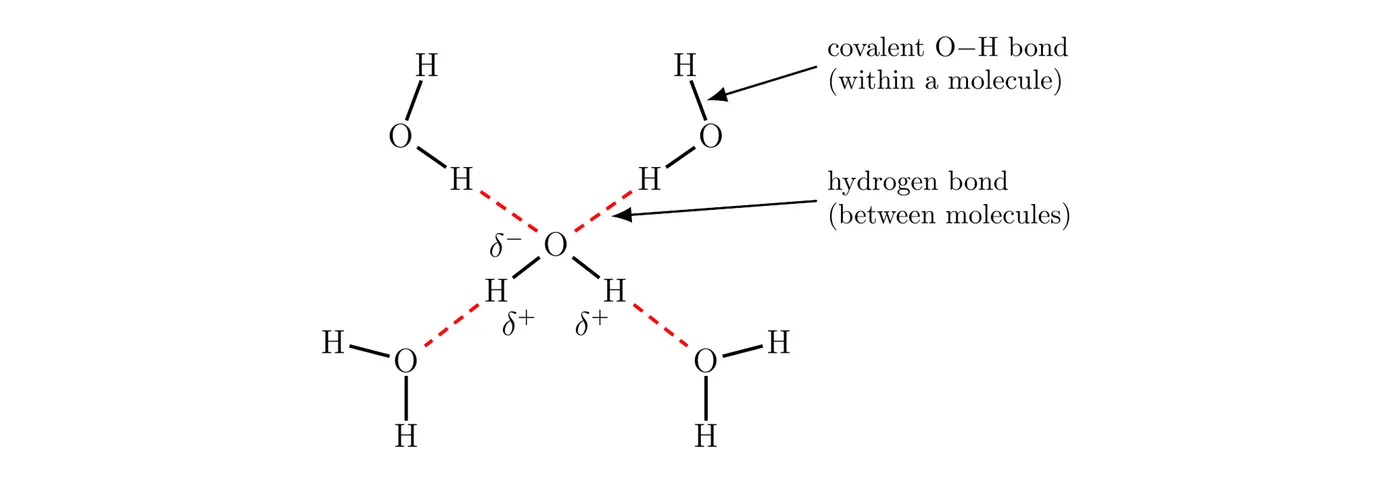
Hydrogen bonds are still intermolecular forces: the dashed lines in the figure are much weaker than the covalent bonds drawn as solid lines.
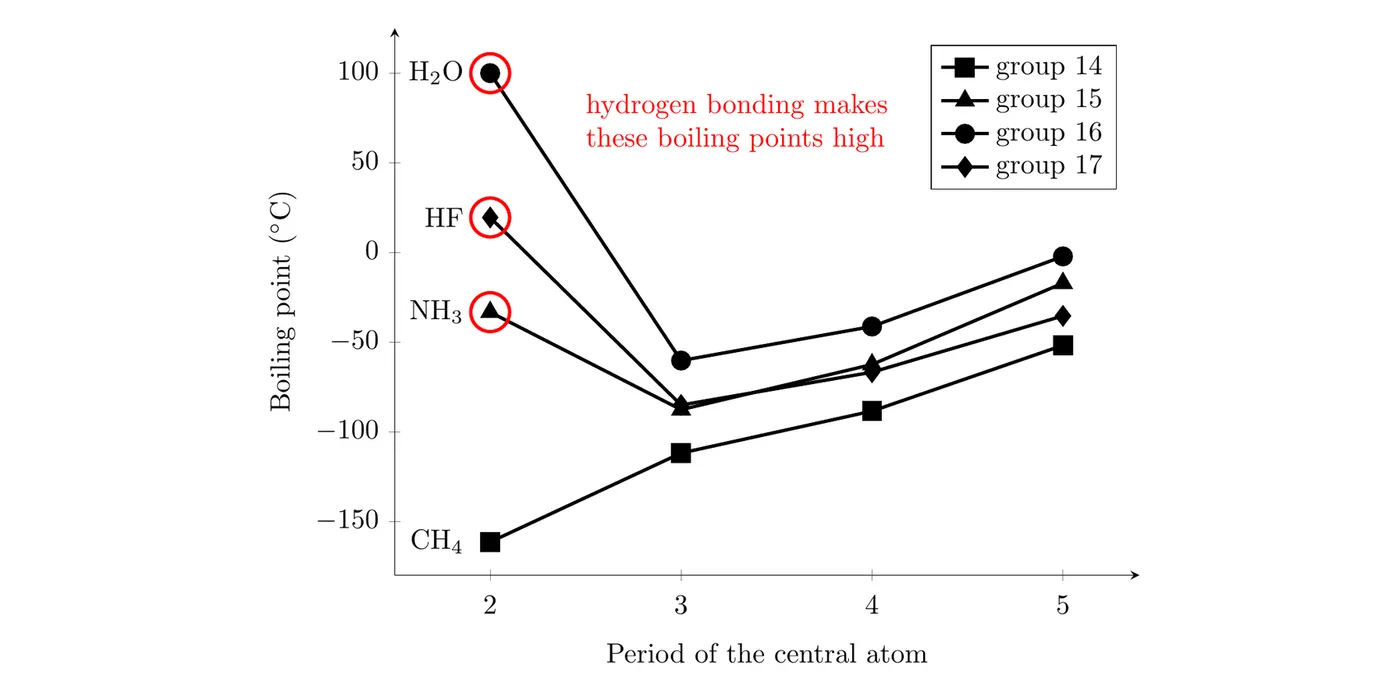
Their effect on boiling points is dramatic. Going down a group, boiling points usually rise because more electrons mean stronger dispersion forces. But , , and break the trend and boil far higher than the next hydrides in their groups, because of hydrogen bonding. can't hydrogen bond, so group 14 follows the normal trend.
Noncovalent interactions in large biomolecules
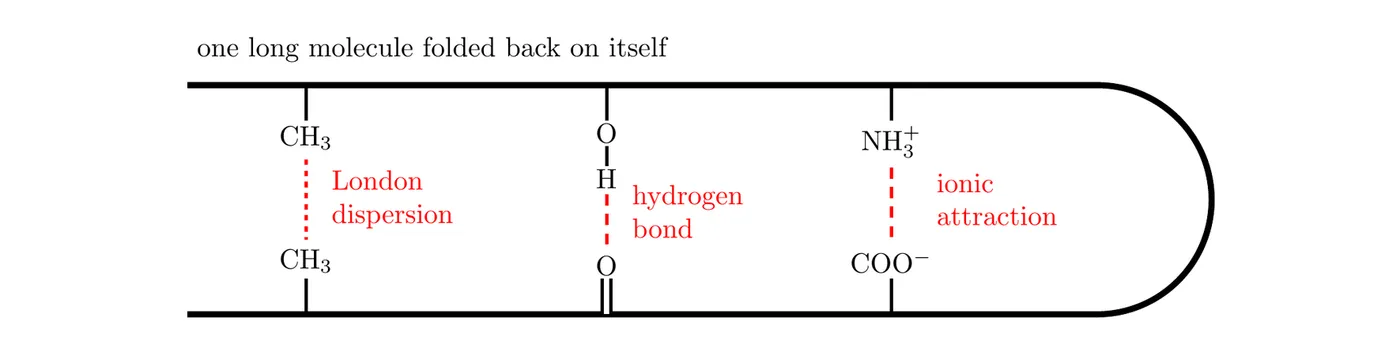
Proteins, DNA, and other large biomolecules are long enough that different parts of the same molecule can attract each other. Hydrogen bonds, dipole forces, dispersion forces between nonpolar groups, and ionic attractions between charged groups like and all act between regions of one molecule. The same interactions also hold separate molecules together: the two strands of DNA are held to each other by hydrogen bonds between their bases. Topic 3.2 explains why the resulting shape matters.
Summary of the forces
Force | Acts between | Stronger with |
London dispersion | all particles | more electrons (more polarizable), more contact area |
Dipole-induced dipole | a polar molecule and a nonpolar one | a bigger dipole, a more polarizable partner |
Dipole-dipole | polar molecules | bigger dipoles, attractive orientation |
Hydrogen bonding | H on N, O, or F and a lone pair on N, O, or F | more hydrogen-bonding sites per molecule |
Ion-dipole | an ion and a polar molecule | a larger ion charge, a smaller ion |
For small molecules the usual order is ion-dipole, then hydrogen bonding, then dipole-dipole, then dispersion. For large molecules, dispersion forces can outweigh everything else, so always compare the actual molecules.
How to explain a comparison on the AP exam
- Name the specific forces in each substance. "IMFs" alone isn't enough.
- Say which force makes the difference and why it's stronger in one substance, using structure: number of electrons, polarity, H bonded to N, O, or F, or shape.
- Connect it to the property: stronger attractions take more energy to overcome, so the boiling point is higher (and the vapor pressure lower).
Don't stop at "stronger" or "weaker." The CED warns that this is where students lose points: name the force and give the structural reason.
Example 1: Naming the forces
List every intermolecular force present in each case: (a) , (b) formaldehyde, , (c) methanol, , (d) dissolved in water, (e) acetone mixed with water.
- (a) is linear, so its two polar bonds cancel and the molecule is nonpolar. London dispersion forces only.
- (b) is trigonal planar with a polar bond, so it's polar: dipole-dipole and London dispersion forces. No hydrogen bonding between formaldehyde molecules, because its H atoms are bonded to C.
- (c) has an bond: hydrogen bonding, plus dipole-dipole and London dispersion forces.
- (d) Ion-dipole forces between and the O end of water, and between and the H end of water. The water molecules also hydrogen bond with each other.
- (e) Hydrogen bonds from water's to acetone's O, plus dipole-dipole and London dispersion forces between the two kinds of molecules.
Example 2: Polarity vs. size (AP-style)
boils at −85.1 °C and boils at −35.4 °C, even though is more polar. Explain the order of the boiling points in terms of intermolecular forces.
Model answer:
- Both substances have dipole-dipole and London dispersion forces. Neither has hydrogen bonding, because H is bonded to Cl or I, not to N, O, or F.
- Cl is more electronegative than I, so has the larger dipole and the stronger dipole-dipole forces.
- has 54 electrons to 's 18. Its larger, more polarizable electron cloud gives much stronger London dispersion forces.
- The stronger dispersion forces in outweigh 's advantage in dipole-dipole forces, so the total attraction between molecules is greater. More energy is needed to separate them, so has the higher boiling point.
The answer names each force, says which one decides the comparison, and ties it to structure. That's the pattern graders look for.
Common mistakes
- Saying boiling breaks covalent bonds. Boiling water separates whole molecules; the bonds stay intact.
- Saying any molecule containing H and N, O, or F can hydrogen bond. The H must be bonded directly to N, O, or F: and can't hydrogen bond with themselves.
- Forgetting dispersion forces in polar molecules. Every molecule has them, and they can be the largest force.
- Using "van der Waals forces" to mean London dispersion forces.
- Writing "stronger IMFs" without naming the force and the structural reason.
- Drawing ion-dipole diagrams backward. Water's O faces a cation; an H faces an anion.