

3.6 - Firms’ Short-Run Decisions to Produce and Long-Run Decisions to Enter or Exit a Market
Fixed vs. Variable Costs
When a firm is losing money in the short run, it has to decide whether to stay open or pause. That decision hinges on the type of cost:
- Fixed costs (sunk costs): owed no matter what, even at zero output. Since they’re sunk, they shouldn’t factor into the shutdown decision.
- Variable costs: only show up when the firm is actually producing. Zero output means zero variable costs.
The Shutdown Rule
A shutdown is temporary (like a mini-golf course closing for winter), while an exit is permanent.
- Stay open if total revenue exceeds variable costs, even while losing money overall, because whatever’s left over after covering variable costs helps chip away at the fixed costs you owe anyway.
- Shut down if price (average revenue) falls below average variable cost (AVC). At that point you’re losing more by staying open than by closing, so it’s cheaper to just pay the fixed costs and produce nothing.
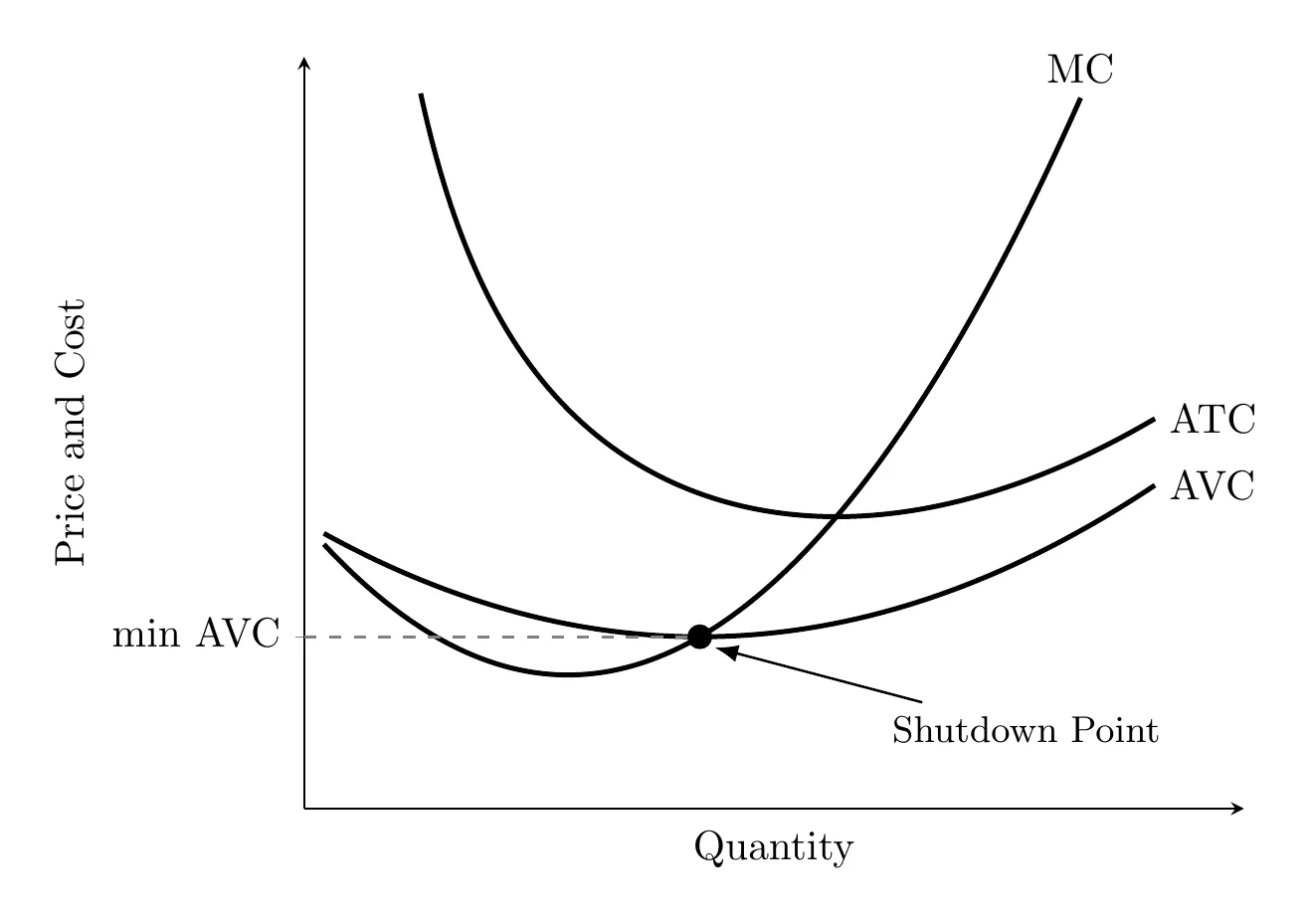
Putting it together, compare the price to the lowest points of the two average cost curves:
- P above min ATC: the firm earns an economic profit. Keep producing.
- P between min AVC and min ATC: the firm takes a loss but keeps producing in the short run, since revenue covers all its variable costs and part of its fixed costs. The loss is smaller than its fixed costs.
- P equal to min AVC (the shutdown point): the firm loses exactly its fixed costs whether it produces or not.
- P below min AVC: shut down. Producing would lose more than the fixed costs, so it’s cheaper to make nothing.
Example: a firm has $12 in fixed costs. Its lowest AVC is $5 and its lowest ATC is $8.
- At P = $6, MR = MC at 4 units. TR = $24, TVC = $21, and TC = $33. Producing loses $24 − $33 = $9, but shutting down would lose the full $12 of fixed costs. Since TR ($24) is more than TVC ($21), stay open: the extra $3 helps pay the fixed costs.
- At P = $4, MR = MC at 3 units. TR = $12, but TVC = $15 and TC = $27. Producing loses $12 − $27 = $15, more than the $12 lost by shutting down. Since TR is less than TVC (P is below AVC), shut down.
The Firm’s Short-Run Supply Curve
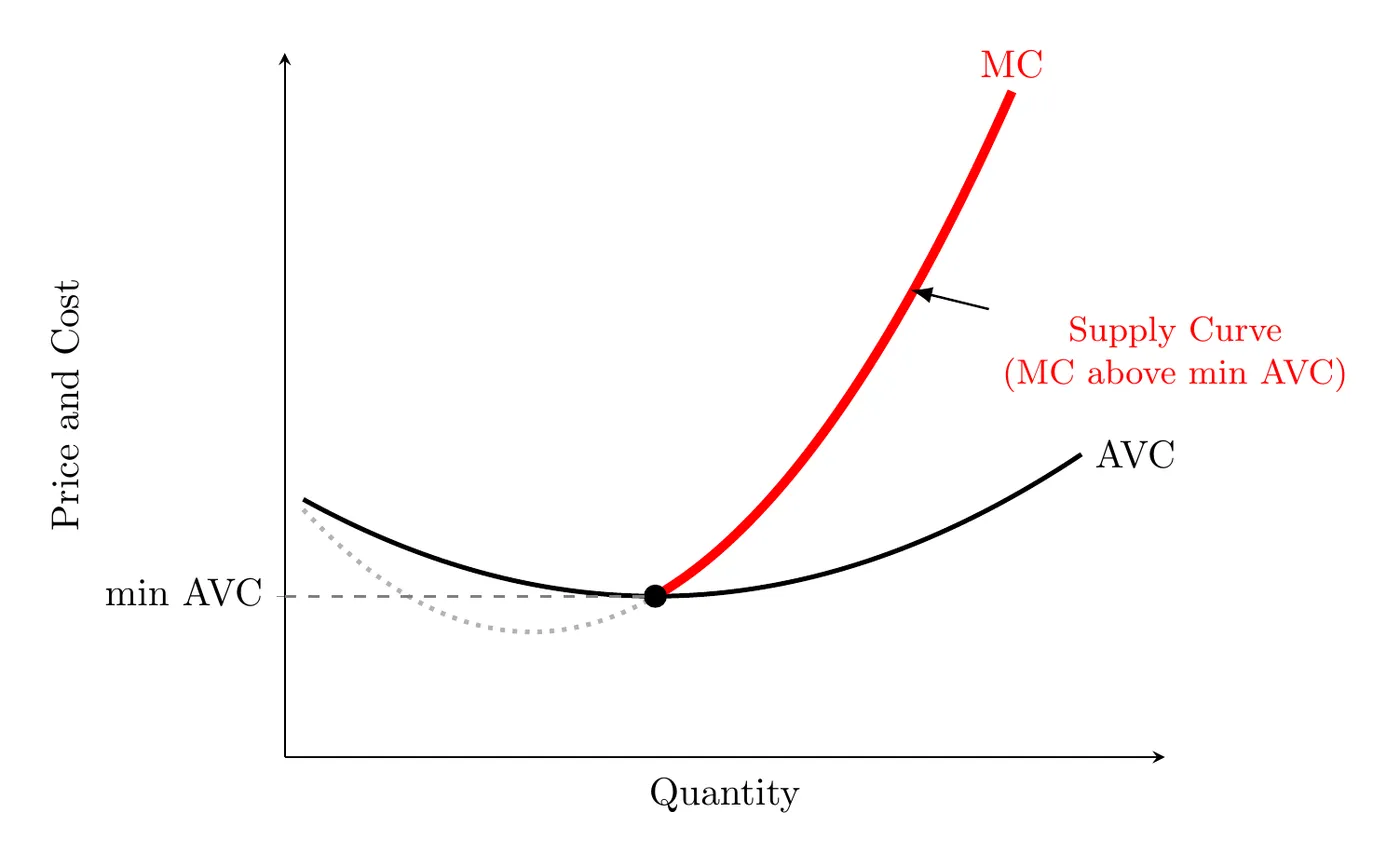
A firm produces wherever price (which equals MR) equals marginal cost. Since a firm won’t produce at all if price falls below minimum AVC, the firm’s supply curve is just its MC curve above the minimum of AVC.
Long-Run Entry and Exit
In the long run, all costs become variable, and firms are free to come or go.
- Profits attract entry: new firms jump in, supply shifts right, and price falls until profit disappears.
- Losses drive exit: firms leave, supply shifts left, and price rises until the losses stop.
- Long-run equilibrium: in competitive markets with low entry barriers, firms eventually just break even, earning a normal profit.
- Long-run rule: in the long run there are no fixed costs, so a firm compares price to ATC instead of AVC. It stays only if it expects (enough to cover every cost, including a normal profit), and exits if it expects to continue. Entry and exit respond to economic profit, not accounting profit.
Bottom line: in the short run, a firm should only stay open if the price covers its variable costs, anything left over helps with the fixed costs it owes regardless. But the long run is a break-even world: persistent profits attract competitors who push prices down, while persistent losses push firms out until the survivors are just covering their opportunity costs.