

3.1 - The Production Function
This section covers the production function, the relationship between inputs and output, and how marginal returns and costs change as a firm adds more workers in the short run.
The production function and time horizons
The production function is the relationship between input quantities (labor, land, physical capital) and the resulting output.
- Short run: at least one input, usually physical capital like machinery or office space, is fixed. Output changes by varying other inputs, like hiring more labor.
- Long run: all inputs are variable. A firm can expand its footprint or buy new equipment.
Total product and marginal product
- Total product (TP): total output from a given number of workers.
- Marginal product (MP): the extra output from hiring one more worker, calculated as the change in total product divided by the change in labor. Since labor usually increases one worker at a time, MP is often just the new total product minus the previous one.
The three phases of production
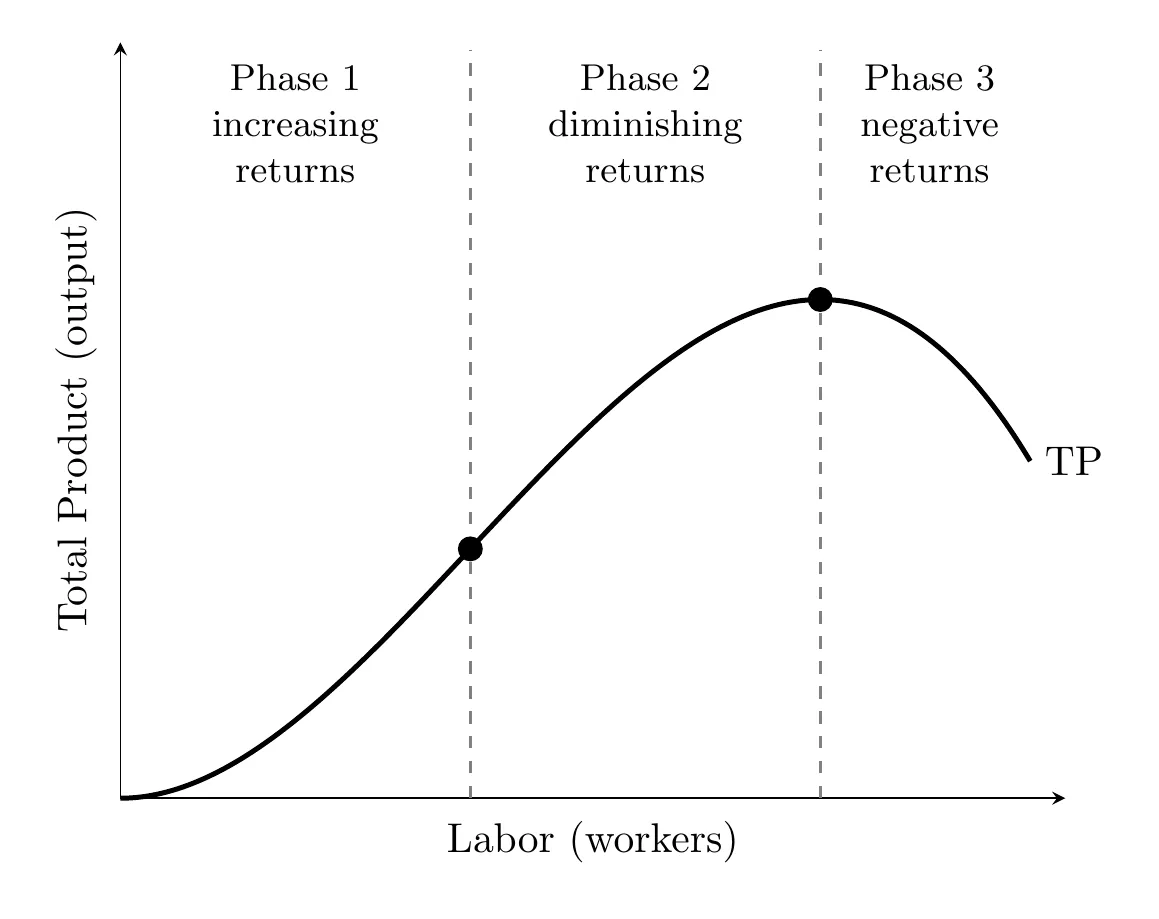
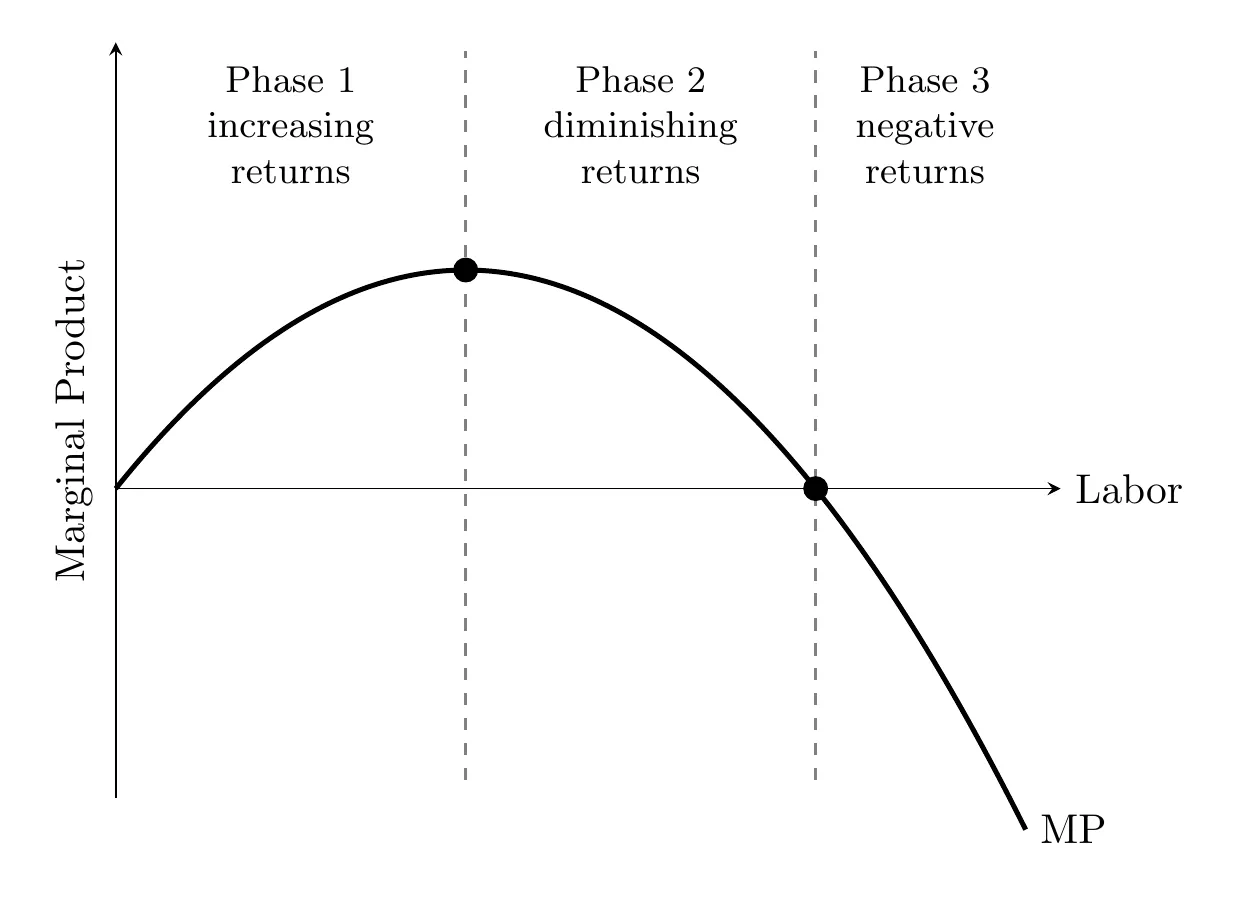
- Increasing marginal returns: each new worker adds more than the last, driven by specialization. In a small bike shop, one worker doing everything (welding, painting, assembly) is inefficient from constantly switching tasks. Adding more workers lets each specialize, boosting marginal product.
- Diminishing marginal returns: total product keeps rising but more slowly, since workers are being spread across fixed capital. If a shop only has three welding stations, a fourth or fifth welder has to share tools or wait, making them less productive than the last hire.
- This is the law of diminishing marginal returns: in the short run, if a firm keeps adding more of one input (like labor) while holding the other inputs (like capital) constant, the marginal product of that input eventually falls. It only happens in the short run, because it depends on something being held fixed.
- Negative returns: total product actually falls and marginal product goes negative, since there are now so many workers they get in each other’s way.
Average product
Average product (AP) is total product divided by number of workers.
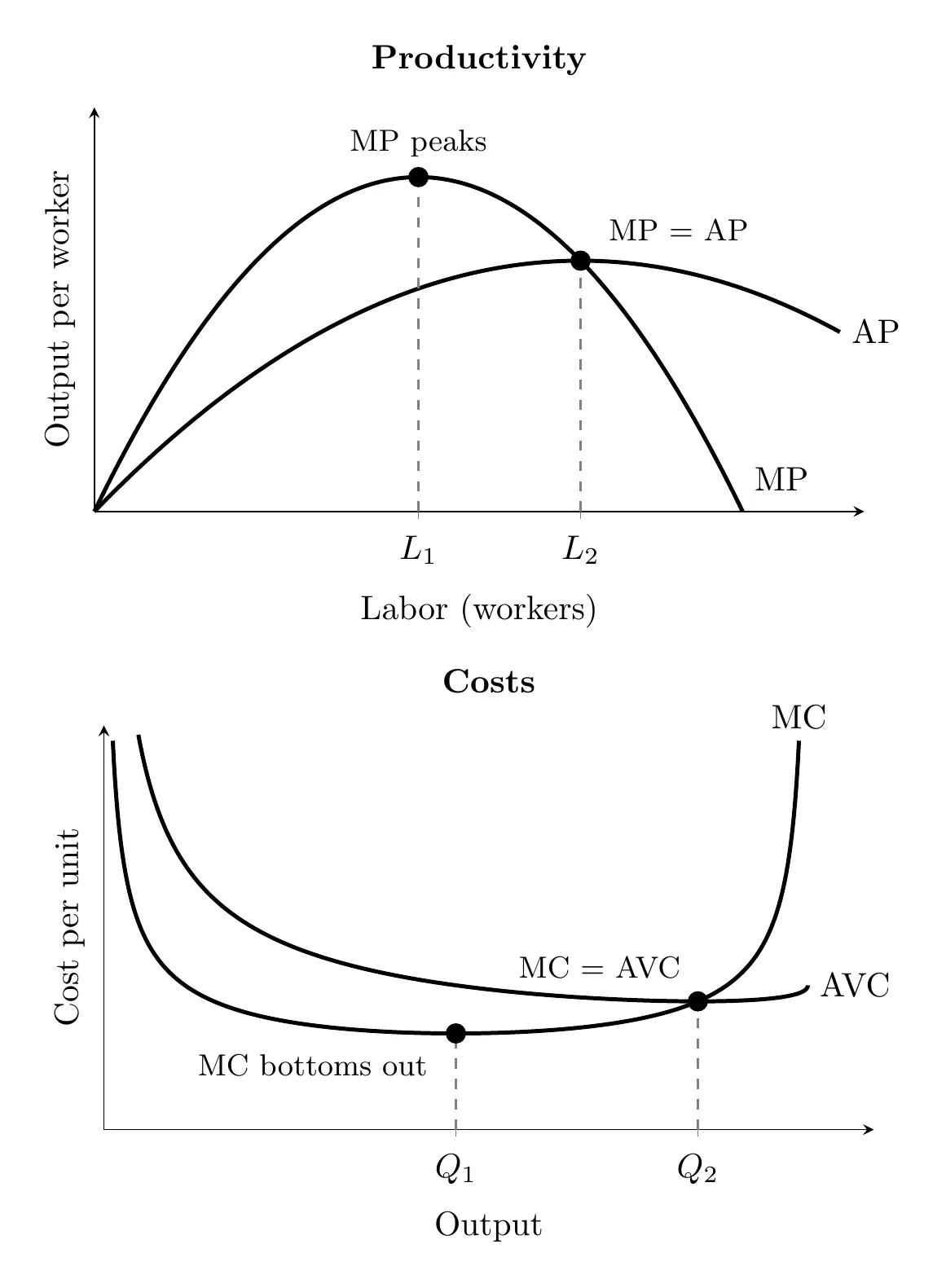
- If marginal product is above the average, average product rises.
- Once marginal product drops below the average, average product starts falling.
- So average product peaks exactly where it crosses the marginal product curve.
Calculating productivity from a table
A bakery has one oven (its fixed capital) and hires more bakers (labor). Output is loaves of bread per day.
Workers (L) | Total product (TP) | Marginal product (MP) | Average product (AP) |
0 | 0 | ||
1 | 10 | 10 | 10 |
2 | 30 | 20 | 15 |
3 | 46 | 16 | 15.33 |
4 | 58 | 12 | 14.50 |
5 | 64 | 6 | 12.80 |
6 | 64 | 0 | 10.67 |
7 | 58 | −6 | 8.29 |
- MP is the change in TP from one more worker. Worker 2 adds 30 − 10 = 20 loaves.
- AP is TP divided by the number of workers. With 3 workers, AP = 46 / 3 = 15.33 loaves per worker.
- Workers 1 and 2 show increasing marginal returns (MP rises from 10 to 20). From worker 3 on, there are diminishing marginal returns (MP falls). Worker 7 brings negative returns (MP = −6, so TP drops from 64 to 58).
- AP is highest with 3 workers. Worker 3’s MP (16) is above the old average (15), so AP rises. Worker 4’s MP (12) is below the new average (15.33), so AP starts falling.
- TP hits its maximum (64) when MP reaches 0, at worker 6.
From productivity to costs
- Marginal cost (MC): the cost of producing one more unit, found by dividing the wage by marginal product.
- Average variable cost (AVC): total wage bill divided by total product.
- Example: if each baker in the table above earns $120 a day, worker 2 adds 20 loaves, so MC = $120 / 20 = $6 per loaf. Worker 5 adds only 6 loaves, so MC = $120 / 6 = $20 per loaf. As MP falls, MC rises.
Productivity curves and cost curves are essentially mirror images. When marginal product rises (thanks to specialization), marginal cost falls. When diminishing returns kick in and marginal product falls, marginal cost rises. Same relationship between average product and average variable cost.
Takeaway
A firm’s output depends on how efficiently it uses its inputs. Specialization initially boosts productivity and lowers marginal costs, but fixed capital eventually forces diminishing marginal returns. The most efficient point for labor (max average product) happens right where it meets marginal product, and total product peaks exactly when marginal product hits zero.
Analogy: think of one computer being used to write a book. One writer does everything alone. Add an editor, and they can work while the writer sleeps, boosting efficiency through specialization. But hire ten writers for that single computer, and they’ll spend more time arguing over who gets to type than actually writing. Output eventually drops because they’re getting in each other’s way.