

1.16 - Working with the Intermediate Value Theorem (IVT)
Introduction
The Intermediate Value Theorem (IVT) is a fundamental idea in calculus, and at its core it’s pretty intuitive. The hard part isn’t understanding the concept. It’s learning to properly justify using it by stating three required conditions and writing a formal conclusion.
Understanding the Concept
The Informal Idea
If a continuous function starts at one -value and ends at a different -value, it has to pass through every -value in between.
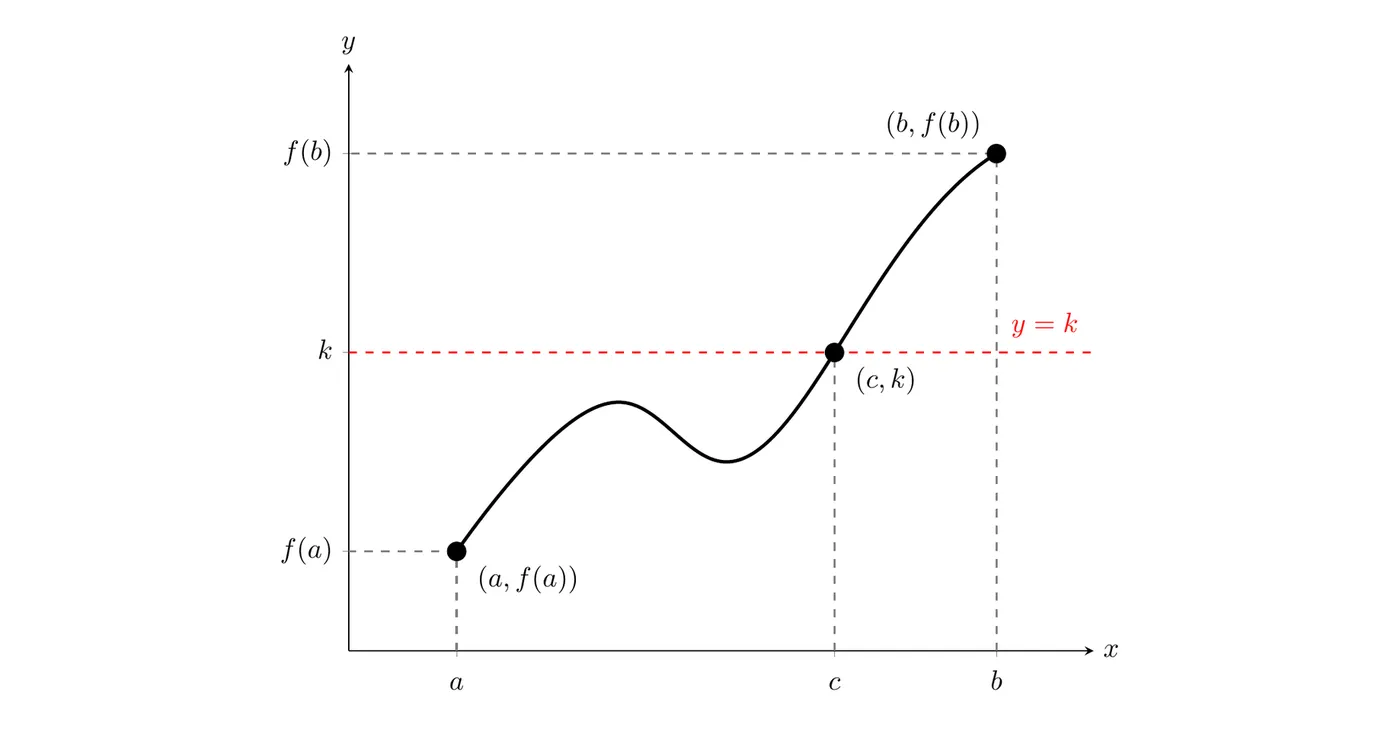
In the graph above, the function is continuous from to . Since it starts at height and ends at height , it has to cross every horizontal line between those values at least once.
Formal Statement of the IVT
If:
- is continuous on the closed interval
- (the endpoints have different -values)
- is any value between and
Then:
There exists at least one value in the interval such that .
The Three Required Conditions
To use the IVT, you have to verify three conditions.
Condition 1: Continuity on the Interval
The function has to have no breaks, jumps, or holes anywhere on the interval from to .
Condition 2: Different Endpoint Values
The function values at the endpoints have to be different. If they’re the same, the theorem doesn’t apply.
Condition 3: Target Value Between Endpoints
The value you’re looking for has to lie between the two endpoint values. You can write this as:
depending on which endpoint is larger.
Writing the Conclusion
Once all three conditions check out, write the conclusion:
Therefore, by the Intermediate Value Theorem, there exists a value in such that .
Shorthand notation: (three dots in a triangle) means “therefore.”
Example 1: Using IVT with a Polynomial
Problem: Show that takes on the value somewhere on the interval .
Condition 1: Check continuity
is a polynomial, and polynomials are continuous everywhere. So is continuous on . ✓
Condition 2: Check that endpoint values differ
Since and , we know . ✓
Condition 3: Check that the target value is between the endpoints
We’re looking for . Is between and ?
Yes. ✓
Conclusion:
Therefore, by the Intermediate Value Theorem, there exists a value in such that .
Example 2: Rational Function with a Restricted Domain
Problem: Determine whether has to equal somewhere on the interval .
Condition 1: Check continuity on
The function has a discontinuity at (a vertical asymptote). But is not in the interval , so is continuous on . ✓
Condition 2: Check endpoint values
So . ✓
Condition 3: Check the target value
We want . Is between and ?
Yes. ✓
Conclusion:
Therefore, by IVT, there exists a value in such that .
Example 3: A Discontinuous Function Where IVT Does Not Apply
Problem: Does necessarily equal on the interval ?
Condition 1: Check continuity
Factor it:
The factor cancels, but there’s still a hole at . Since is inside the interval , the function is not continuous on . ✗
Conclusion:
The IVT does not apply because Condition 1 fails. We can’t use IVT to conclude whether has a solution on this interval.
Example 4: Using a Table of Values
Problem: The function is continuous. Use the table to determine whether there has to be a value where on the interval .
1 | 2 | 3 | 4 | |
3 | 7 | 8 | 9 |
Condition 1: Continuity
We’re told is continuous. ✓
Condition 2: Endpoint values differ
✓
Condition 3: Target value between endpoints
We want . Is ? Yes. ✓
Conclusion:
Therefore, by IVT, there exists a value in such that .
Example 5: Counting Minimum Crossings
Problem: Given the table for the continuous function , what is the minimum number of times on the interval ?
0 | 2 | 5 | 7 | 10 | |
2 | 6 | 1 | 5 | 3 |
We need to find the intervals where crosses .
Interval : and . Since , the function has to equal 4 at least once. ✓
Interval : and . Since , the function has to equal 4 at least once. ✓
Interval : and . Since , the function has to equal 4 at least once. ✓
Interval : and . Since , the function has to equal 4 at least once. ✓
Answer: The function has to equal 4 at least 4 times on .
Common Mistakes to Avoid
Mistake 1: Forgetting to check continuity
❌ Wrong: “Since and , and is between them, there must be a solution.”
✓ Correct: First verify that is continuous on .
Mistake 2: Checking the wrong interval
When you’re given a table with lots of values, make sure you only check the specified interval, not the entire table.
Mistake 3: Not checking whether is strictly between
If or , the value is already sitting at an endpoint. Technically the IVT still applies (the value exists at the endpoint), but it isn’t interesting.
Mistake 4: Forgetting to state all three conditions
On AP Calculus exams, you have to explicitly state all three conditions to get full credit.
Writing a Complete IVT Justification
Template for Full Credit
1. State continuity:
“ is continuous on ” with a brief justification if needed, like “because is a polynomial.”
2. Calculate and compare endpoints:
“, , therefore ”
3. Check the target value:
“ is between and ”
You can write it as or .
4. Write the conclusion:
“Therefore, by the Intermediate Value Theorem, there exists a value in such that .”
Practice Problems
Problem 1
Show that has a zero on .
Answer:
- is continuous on since it’s a polynomial
- and , so
- is between and
Therefore, by IVT, there exists a value in such that .
Problem 2
Can IVT be used to show equals on ?
Answer:
No. has discontinuities at and , and both are inside . Condition 1 fails, so IVT does not apply.
Problem 3
Given the continuous function :
0 | 3 | 6 | |
5 | 2 | 7 |
Must somewhere on ?
Answer:
Check : and . Is ? Yes.
So yes, by IVT there exists a value in where .
Key Takeaways
- The IVT guarantees that continuous functions hit all intermediate values
- Three conditions have to be verified: continuity, different endpoints, and target between endpoints
- Always state all three conditions explicitly for full credit
- The conclusion is always: “there exists a value in such that ”
- Discontinuities inside the interval mean IVT does not apply
- With tables, check specific intervals, not just the endpoints of the entire table
- IVT tells you a solution exists, but not where it is or how many there are
- Use IVT to establish existence, not to find exact values
- Polynomial, exponential, and trigonometric functions are continuous everywhere (for trig, on their domains)
- Rational functions are continuous except where the denominator equals zero