8.13 - The Arc Length of a Smooth, Planar Curve and Distance Traveled (BC ONLY)
Note: this is a BC Calculus topic. AB students can skip this section.
Review: The Distance Formula
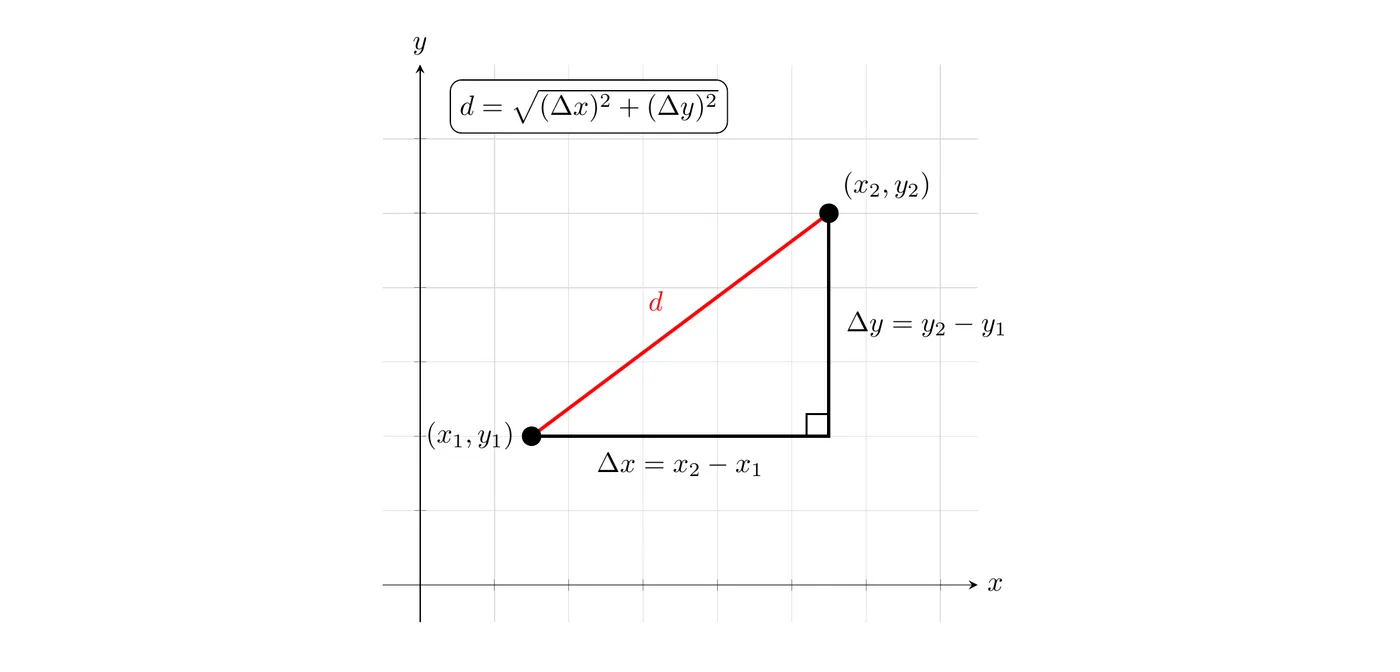
The distance formula between two points comes straight from the Pythagorean Theorem.
For two points (x1,y1) and (x2,y2):
d=(x2−x1)2+(y2−y1)2
Or in change notation:
d=(Δx)2+(Δy)2
This is just c=a2+b2 from the Pythagorean Theorem.
The Concept of Arc Length
Say we want the length of a curve between two points. We can’t just draw a straight line, because we need to account for the curve itself.
Approximating with Line Segments
The key insight is to approximate the curve with many small line segments.
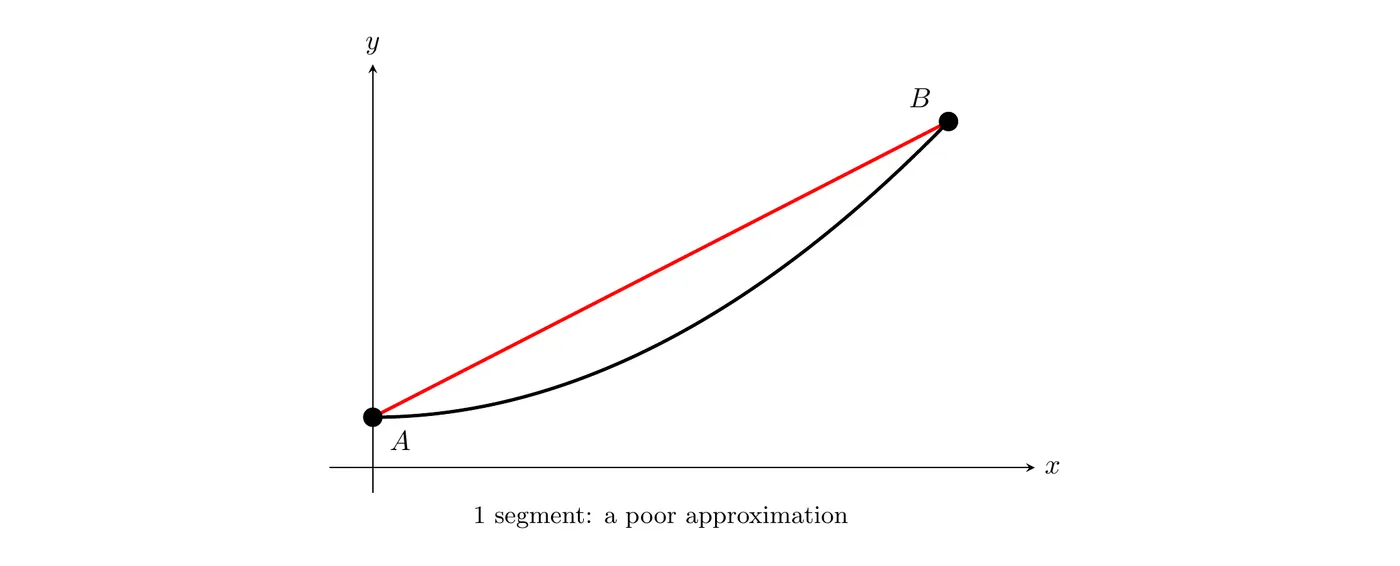
One Line Segment (a Poor Approximation)
A single line segment from start to finish gives a terrible approximation.
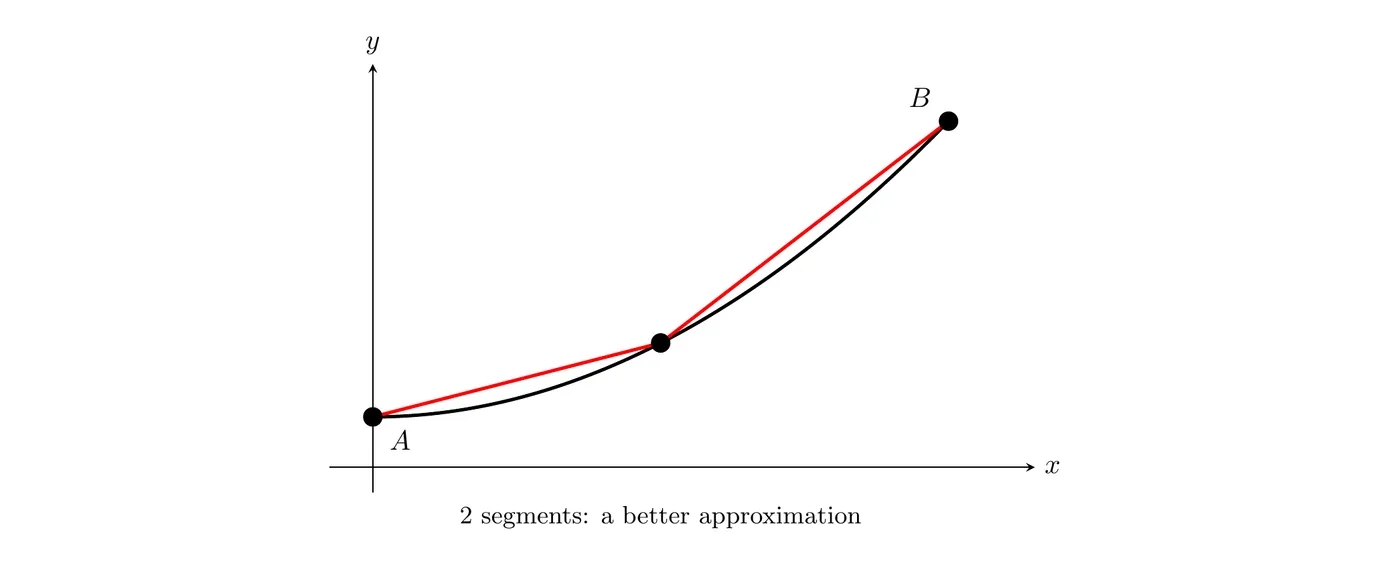
Two Line Segments (Better)
Two segments follow the curve more closely.
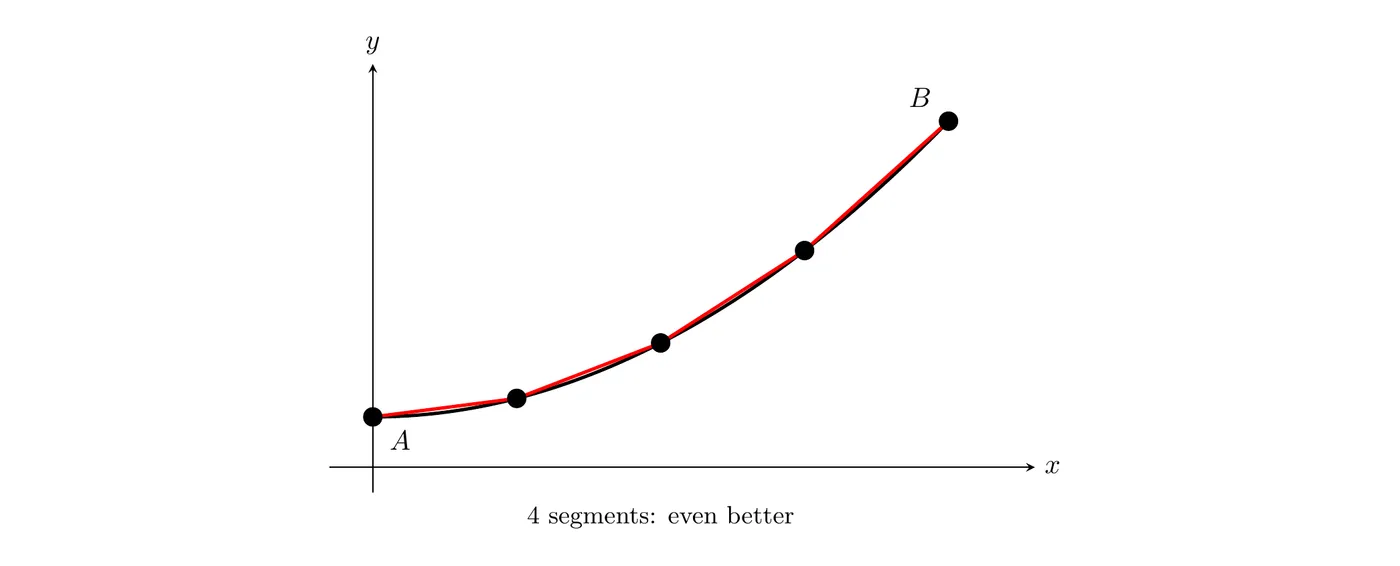
Four Line Segments (Even Better)
With four segments, we’re getting pretty close to the actual curve length.
The Calculus Approach
Key idea: as the number of line segments approaches infinity, the sum of their lengths approaches the actual arc length.
If we label the points x0,x1,x2,x3,…,xn, where x0=a is the start and xn=b is the end, each tiny segment has a length given by the distance formula. As n→∞, the sum of those segments becomes an integral.
The Arc Length Formula
For a smooth, continuous, differentiable function y=f(x) on the interval [a,b]:
L=∫ab1+[f′(x)]2dx
Important Notes
The function has to be smooth and continuous, with no corners or discontinuities
The curve has to be differentiable throughout the interval
Look carefully: it’s [f′(x)]2, not [f(x)]2
If the curve is written as x=g(y) for c≤y≤d, swap the roles: L=∫cd1+[g′(y)]2dy
Why This Formula?
The 1+[f′(x)]2 comes from applying the distance formula to infinitesimally small segments. Each tiny piece of the curve behaves like a miniature tangent line with slope f′(x).
Example 1: Setting Up Arc Length
Find the arc length of y=61x3+2x1 from x=1 to x=2.
This topic’s title pairs arc length with distance traveled. If an object moves along the graph of y=f(x) from x=a to x=b without turning back, the distance it travels along the path is the arc length:
Distance traveled=L=∫ab1+[f′(x)]2dx
Compare this with 8.2. There the object moves along a straight line, so distance traveled is ∫∣v(t)∣dt. Here the path itself curves, so you measure the length of the path. (In Unit 9 you’ll get the same distance from the velocity in both directions, ∫(x′(t))2+(y′(t))2dt.)
Example 5: Distance Along a Curved Path
A bug crawls along the curve y=x3/2 from (0,0) to (4,8), with distances in centimeters. How far does it crawl?
Step 1: Find the derivative.
y′=23x1/2⇒[y′]2=49x
Step 2: Set up the integral.
L=∫041+49xdx
Step 3: Integrate with u-substitution. Let u=1+49x, so du=49dx and dx=94du. When x=0, u=1. When x=4, u=10.
L=94∫110u1/2du=94⋅32[u3/2]110=278(1010−1)
Answer:L=278(1010−1)≈9.073 cm
Sanity check: the straight line from (0,0) to (4,8) is 42+82=80≈8.944 cm. The curved path is a little longer, as it should be. Arc length is never shorter than the straight-line distance between the endpoints.
Common Algebraic Technique: Factoring Out Constants
When 1+[f′(x)]2 comes out messy, you can often factor a constant out from under the square root.
Example Pattern
If you have
1+16x2⋅g(x)
factor out 161:
=161(16+x2⋅g(x))=4116+x2⋅g(x)
This often reveals a perfect square hiding inside.
Common Mistakes
Mistake 1: Using f(x) Instead of f′(x)
Wrong:∫ab1+[f(x)]2dx
Right:∫ab1+[f′(x)]2dx
You have to take the derivative first.
Mistake 2: Forgetting to Square the Derivative
Wrong:∫ab1+f′(x)dx
Right:∫ab1+[f′(x)]2dx
Mistake 3: Not Checking for Perfect Squares
A lot of arc length problems are designed so that 1+[f′(x)]2 turns out to be a perfect square. Look for that pattern before you start trying to integrate.
Mistake 4: Calculator in Degrees Instead of Radians
For trig arc length problems, always double-check that your calculator is in radian mode.
When Does the Arc Length Formula Apply?
The formula requires that the function is:
Continuous on [a,b]
Differentiable on [a,b]
Smooth, with no sharp corners
If any of those fail, the formula doesn’t apply.
Why Does This Formula Work? (Optional Proof Sketch)
Note: you don’t need this derivation for the AP exam, but it gives you the mathematical insight.
Step 1: Sum of Line Segments
For n segments from x0 to xn, the length of segment i is