

10.1 - Defining Convergent and Divergent Infinite Series
Sequences: The Fundamentals
A sequence is a function that produces terms based on the position , where is a positive integer. The notation means the th term.
Example 1: Finding Terms
Given , find the first five terms.
The sequence is
One-to-one correspondence: a sequence puts its numbers in one-to-one correspondence with the positive integers. The 1st term is uniquely , the 2nd is uniquely , and so on. Every position has exactly one value.
Special Properties of Sequences
Monotonic Sequences
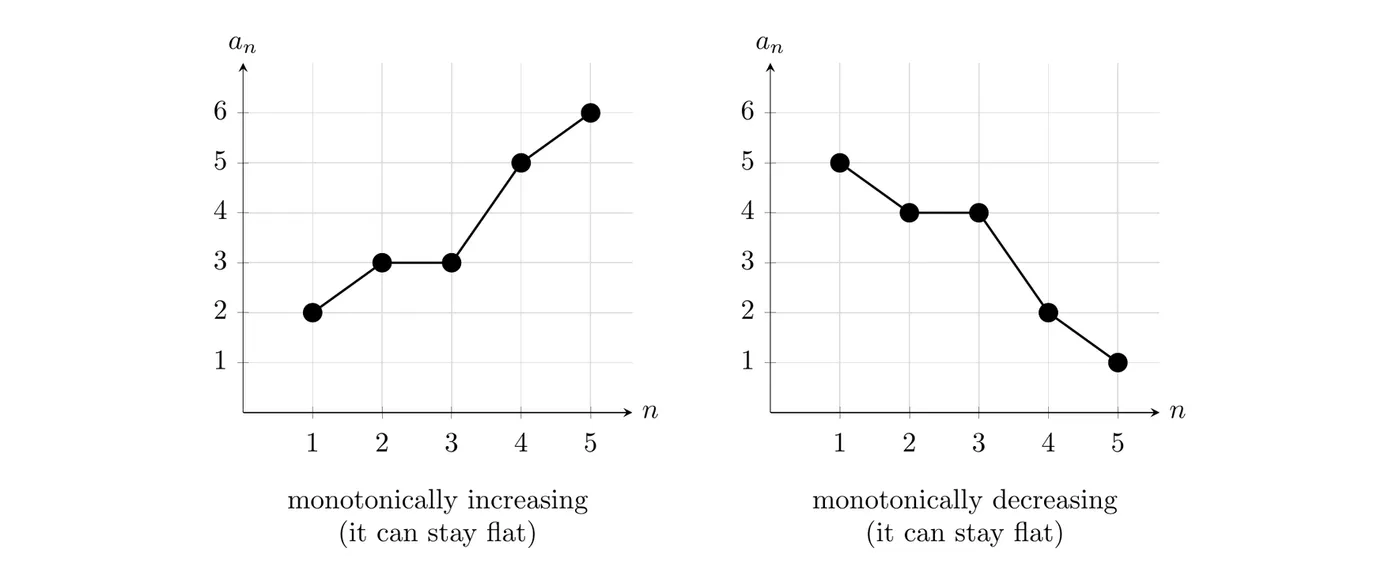
A sequence is monotonic if it satisfies one of these:
Monotonically increasing (non-decreasing):
The terms never decrease. They can stay flat or go up.
Monotonically decreasing (non-increasing):
The terms never increase.
Bounded Sequences
Bounded above: there’s an upper bound with for all .
Bounded below: there’s a lower bound with for all .
Bounded: both, so for all .
Infinite Series and Partial Sums
An infinite series is the sum of every term in an infinite sequence:
The th partial sum is the sum of just the first terms:
Critical Distinction: vs.
- is the th term, a single value
- is the sum of the first terms, an accumulated total
Example 2
Given the sequence with :
Series and Limits
The sum of an infinite series is the limit of its partial sums.
Convergence and Divergence
For with partial sums :
Convergent: the series converges to if
where is a finite number. We then write .
Divergent: the series diverges if doesn’t exist or equals .
Checking by partial sums: compute several and look for a pattern. If they seem to approach a specific number, the series likely converges. If they grow without bound, it diverges.
Example 3: Testing for Convergence
Does converge or diverge?
The partial sums look like they’re heading for , which suggests convergence to .
Finding a Formula for
For some series you can derive an explicit formula for and then take the limit.
Example 4: Deriving
Find .
Step 1: Write out .
Step 2: Multiply by .
Step 3: Subtract. Almost everything cancels, leaving only the first term of and the last term of :
Step 4: Simplify.
Step 5: Take the limit. As , , so
The series converges to .
Using Technology for Partial Sums
For series without a nice closed form, approximate big partial sums on the calculator.
Example 5: Calculator Method
Find for .
TI-84 steps:
- Press
MATH, scroll to0: sum(
- Enter
sum(seq(8/(X²+3X), X, 1, 150))
- Press
ENTER
Result:
Try larger values:
The partial sums are creeping toward about , which suggests convergence. (This one actually telescopes to exactly .)
Example 6: A Divergent Series
Does converge or diverge?
The partial sums keep climbing with no ceiling. They’re monotonically increasing but not bounded above.
The series diverges.
Example 7: Another Convergent Series
Does converge or diverge?
The partial sums appear to approach .
The series converges to 3.
To be sure, split each term: . Then the partial sums telescope (almost everything cancels):
Since , the limit of the partial sums exists and equals 3, so the series converges to exactly 3. (Check: , matching the list above.)
Summary of Strategies
1. Calculate several partial sums. Look for a pattern. Approaching a number suggests convergence; growing without bound means divergence.
2. Find a formula for if you can. Use the multiply-and-subtract trick, then take . A finite limit means convergence; an infinite one or none at all means divergence.
3. Use technology for big partial sums. Compute , , and see whether the values stabilize.
Key Takeaways
- is the th term (a single value); is the sum of the first terms
- An infinite series is the sum of infinitely many terms
- Convergent means for a finite
- Divergent means that limit doesn’t exist or is
- Monotonic sequences never increase, or never decrease
- Bounded sequences have both upper and lower bounds
- Test convergence by computing partial sums and watching the pattern
- The multiply-and-subtract technique can give you a formula for
- Technology helps when there’s no closed form