

1.1 - Moles and Molar Mass
Overview
Atoms and molecules are far too small to count one at a time, but chemistry is all about how many particles react. The mole solves this problem: it links a mass you can measure on a balance to a number of particles you can't see. This topic covers Avogadro's number, molar mass, and the conversions between grams, moles, and particles that you'll use in almost every calculation for the rest of the course.
Why chemists count by weighing
In a reaction, particles combine in fixed numbers. Two hydrogen molecules react with one oxygen molecule, for example. But in the lab you can't count molecules. A single drop of water holds more than of them. What you can measure is mass.
So chemists count by weighing. A hardware store does the same thing with nails: if one nail has a mass of 2.0 g, then 500 g of nails is about 250 nails. Nobody counts them, because the mass tells you the number. To do this with atoms, you need two things: the mass of one particle, and a counting unit big enough for particles that tiny. That counting unit is the mole.
The mole and Avogadro's number
A mole (mol) is a counting unit, like a dozen. A dozen is 12 things, and a mole is things. This number is Avogadro's number. Written with units, it's called Avogadro's constant, and it's on the AP reference sheet:
The unit means "per mole": every mole contains particles. "Particles" means whatever the substance is made of:
- Atoms for most elements. One mole of iron is Fe atoms.
- Molecules for molecular substances. One mole of water is molecules.
- Formula units for ionic compounds. One mole of sodium chloride is NaCl formula units. Ionic compounds aren't made of separate molecules, so the formula unit (here, one and one ) is the smallest unit that shows the ratio. Topic 1.3 has more on this.
Avogadro's number is huge on purpose. Particles are so small that it takes around of them to make a sample big enough to weigh.
Counting the atoms inside a particle
A chemical formula tells you how many of each atom are in one particle. One molecule has 2 H atoms and 1 O atom, so 1 mol of contains 2 mol of H atoms and 1 mol of O atoms. Subscripts act as exact conversion factors.
Watch the parentheses. In calcium nitrate, , the subscript 2 applies to everything inside the parentheses. One formula unit has 1 Ca, 2 N, and 6 O atoms, for 9 atoms total.
Atomic mass units and molar mass
Single atoms are so light that grams are an awkward unit for them. Instead, chemists use the atomic mass unit (amu), defined as exactly of the mass of one carbon-12 atom. The masses on the periodic table are the average mass of one atom of each element, in amu. A carbon atom averages 12.01 amu, and an oxygen atom averages 16.00 amu.
Here's the key idea: the mole is set up so that the same number gives the mass of one particle in amu and the mass of one mole of particles in grams.
Substance | Average mass of one particle | Mass of one mole |
C | 12.01 amu (one atom) | 12.01 g |
32.00 amu (one molecule) | 32.00 g | |
18.02 amu (one molecule) | 18.02 g | |
NaCl | 58.44 amu (one formula unit) | 58.44 g |
The mass of one mole of a substance is its molar mass (), in grams per mole (g/mol). The match works because 1 g is amu. Multiplying the mass of one particle by particles turns amu into grams without changing the number. That gives a direct, quantitative link between the mass of a sample and the number of particles in it.
Finding the molar mass of a compound
Add up the molar masses of all the atoms in the formula, using the periodic table you get on the AP exam:
When you add, the answer keeps as many decimal places as the least precise value. Here that's two.
A note on symbols: this course writes molar mass as a script , because a plain will mean molarity (moles per liter) starting in Unit 3. The AP reference sheet makes the same split, with a bold M for molar mass.
Converting between mass, moles, and particles
Every problem in this topic is a trip along the road map below. Moles sit in the middle: to get from grams to particles (or back), you go through moles.
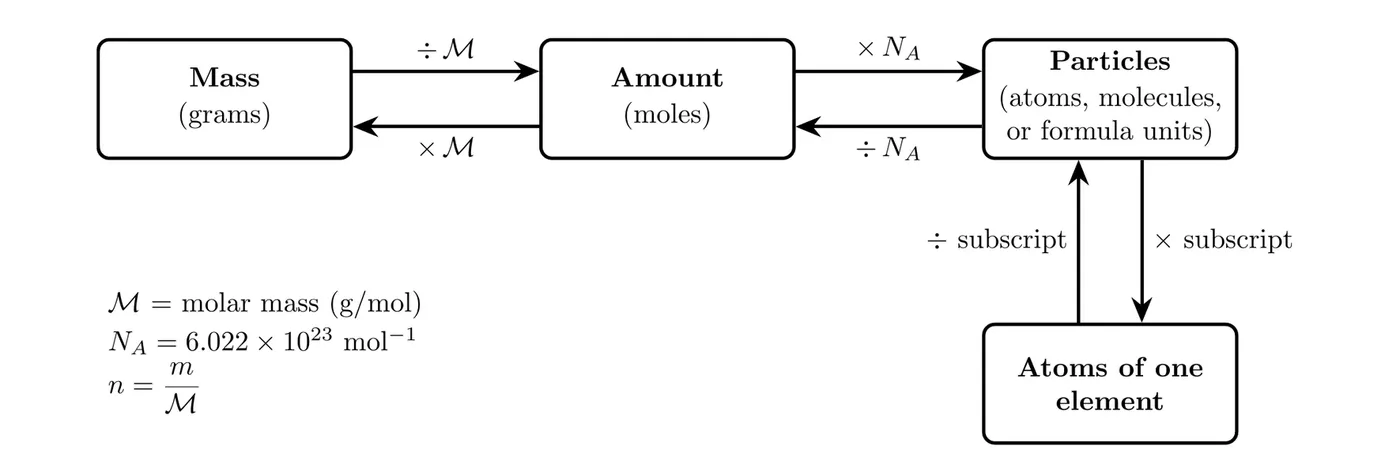
Two relationships do all the work. The first is on the reference sheet, and the second just uses Avogadro's number, which is also there:
Here is the amount in moles, is the mass in grams, and is the molar mass in g/mol.
Dimensional analysis
Dimensional analysis means writing each conversion as a fraction equal to 1 and lining up the units so they cancel. Since 18.02 g of water is 1 mol of water, you can multiply by or by , whichever cancels the unit you have. If the units cancel down to the unit you want, the setup is right.
Significant figures
- Multiplying or dividing: the answer has as many significant figures as the measurement with the fewest.
- Adding or subtracting (like summing a molar mass): the answer has as many decimal places as the value with the fewest.
- Exact numbers don't limit you. Subscripts, counted numbers, and the 1 in "1 mol" are exact. Avogadro's number as given () has four significant figures, which is usually more than your data.
- Round only at the end. Keep at least one extra digit in the middle steps.
Example 1: Grams to moles
How many moles of water are in a 45.0 g sample of water?
The molar mass of water is 18.02 g/mol (from above). Divide by it, so grams cancel:
The mass has three significant figures, so the answer does too. Answer: 2.50 mol of water.
Example 2: Moles to grams
What is the mass of 0.150 mol of calcium nitrate, ?
From above, g/mol. Multiply, so moles cancel:
Answer: 24.6 g of calcium nitrate (three significant figures, from 0.150 mol).
Example 3: Grams to molecules to atoms
A sample of carbon dioxide has a mass of 11.0 g. How many molecules does it contain, and how many oxygen atoms?
The molar mass is g/mol. Go from grams to moles to molecules in one chain:
Each molecule has exactly 2 O atoms, so:
We multiplied the unrounded , not . Rounding first gives , which is off in the last digit. Answer: molecules of and oxygen atoms.
Example 4: Ranking three samples (AP-style)
Consider these three samples:
- Sample A: 0.500 mol of
- Sample B: 15.0 g of
- Sample C: molecules of
(a) Rank the samples from fewest to most molecules. (b) Rank them from fewest to most total atoms. (c) Rank them from smallest to largest mass.
Convert everything to moles first. The number of particles is proportional to moles, so comparing moles is the same as comparing counts. The molar mass of is g/mol.
(a) Molecules: C (0.299 mol) < A (0.500 mol) < B (0.935 mol).
(b) Multiply the moles of molecules by the number of atoms in each molecule: has 2, has 5, and has 4.
Sample | Moles of molecules | Atoms per molecule | Moles of atoms |
A () | 0.500 | 2 | 1.00 |
B () | 0.935 | 5 | 4.68 |
C () | 0.299 | 4 | 1.20 |
Atoms: A < C < B. Sample C has the fewest molecules but not the fewest atoms, because each molecule has 4 atoms.
(c) Use . Sample A is g, sample B is 15.0 g (given), and sample C is g. Mass: C < B < A.
Notice that A has more mass than B, but B has almost twice as many molecules. A methane molecule (16.04 amu) is about half as heavy as an oxygen molecule (32.00 amu). Equal masses don't mean equal numbers of particles.
Common mistakes
- Atoms vs. molecules. "Moles of oxygen" could mean O atoms or molecules. One mole of has a mass of 32.00 g and contains 2 mol of O atoms. Read the question carefully.
- Dropping parentheses. has 6 oxygen atoms per formula unit, not 3.
- Multiplying when you should divide. Going from grams to moles, divide by the molar mass. Check that the units cancel, then check the size: particle counts are huge, and the mass of one particle is tiny.
- Rounding too early. Rounding a middle step can change the last digit of the answer. Keep an extra digit until the end.
- Mixing up amu and g/mol. amu is the mass of one particle, and g/mol is the mass of a mole of particles. The numbers match, but the units tell you the scale.