

1.2 - Mass Spectra of Elements
Overview
Most elements exist as a mix of isotopes, atoms of the same element with different masses. A mass spectrometer sorts atoms by mass and shows how much of each isotope is present. In this topic you'll read a mass spectrum and use it to calculate an element's average atomic mass, the number on the periodic table.
Isotopes
Every atom of an element has the same number of protons, called its atomic number (). The number of neutrons can vary. Atoms of the same element with different numbers of neutrons are isotopes.
An isotope is identified by its mass number (), the total number of protons and neutrons. You'll see it written as a name (chlorine-35, or Cl-35) or as a symbol:
Both chlorine isotopes have 17 protons. Chlorine-35 has neutrons, and chlorine-37 has 20. Protons and neutrons each have a mass of about 1 amu, and electrons are far lighter, so an isotope's mass in amu is close to its mass number. Chlorine-35 has a mass of 34.969 amu, for example.
Isotopes of an element behave the same way chemically, because chemistry depends on electrons, and the number of electrons is the same. What differs is the mass, and that's what a mass spectrometer measures.
How a mass spectrometer works
A mass spectrometer separates particles by mass. For a sample of one element, it works in four steps:
- Ionize. The sample is turned into a gas and hit with high-energy electrons, which knock one electron off each atom. This makes ions with a +1 charge.
- Accelerate. An electric field speeds the ions up into a beam.
- Deflect. A magnetic field bends the beam. Lighter ions bend more and heavier ions bend less, so each isotope follows its own path.
- Detect. A detector counts how many ions arrive along each path.
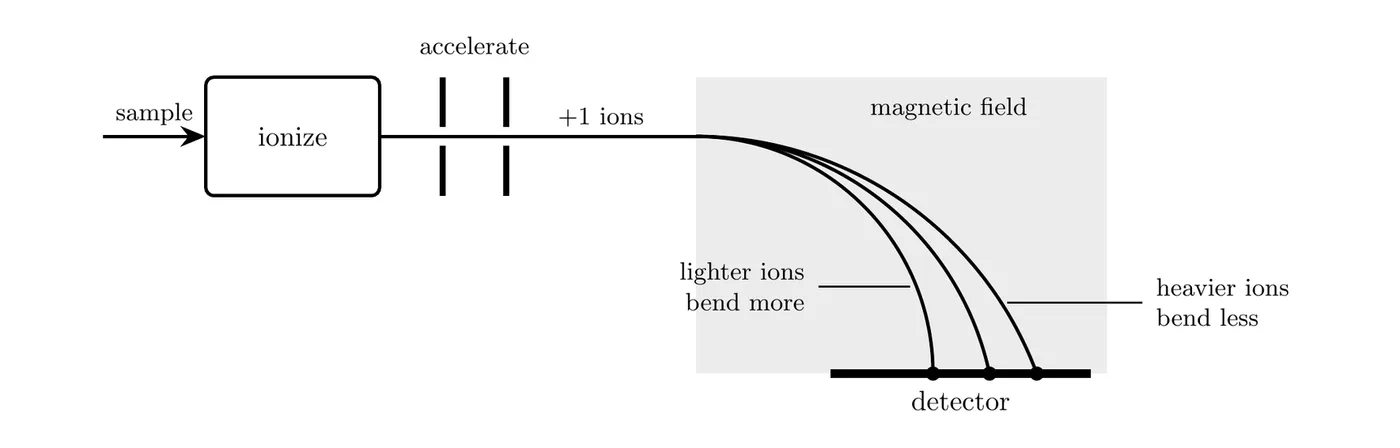
How much an ion bends depends on its mass-to-charge ratio, written . On the AP exam every ion has a +1 charge (), so is just the mass of the isotope in amu.
The AP exam only uses spectra of a single element made of +1 ions of single atoms. Real spectra can also show peaks from ions with a +2 charge or from molecules like , but you won't be asked to interpret those. Outside the classroom, mass spectrometry is used in forensics, drug testing, and dating old materials from their isotope ratios.
Reading a mass spectrum
A mass spectrum is a graph of what the detector counted. Here is the mass spectrum of magnesium:
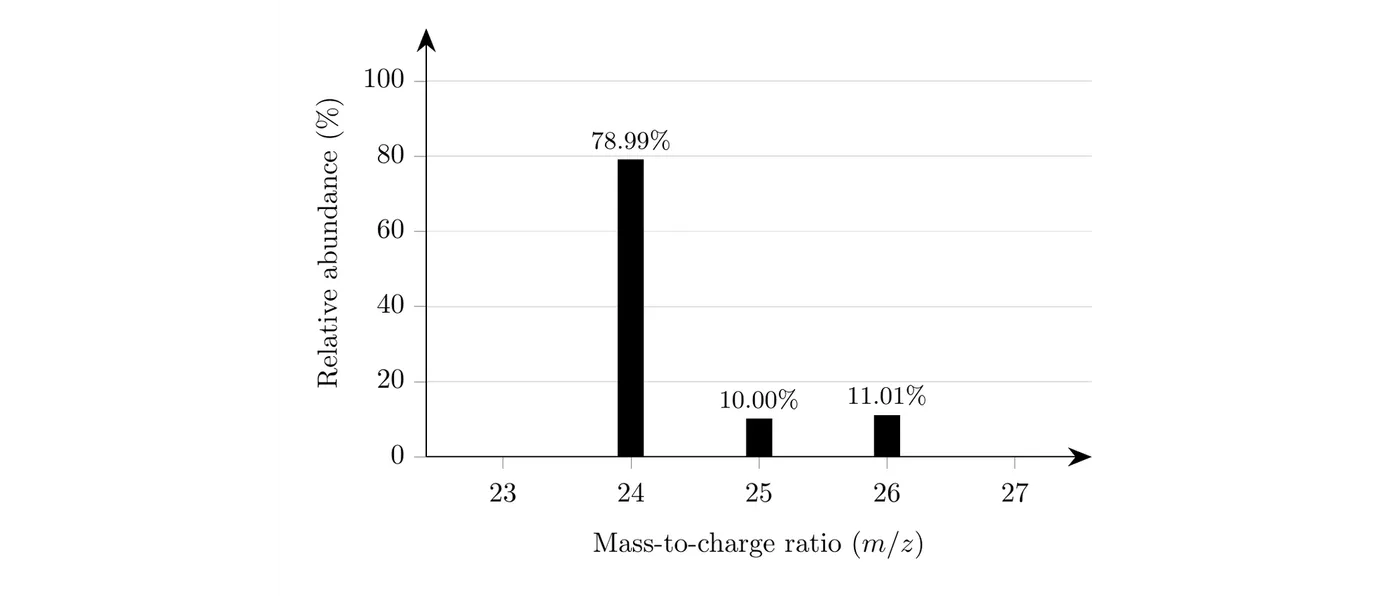
- Each peak is one isotope. A peak's position on the -axis is its , which is the isotope's mass. Magnesium has three peaks, so it has three naturally occurring isotopes: Mg-24, Mg-25, and Mg-26.
- Peak height shows abundance. The taller the peak, the more atoms of that isotope. About 79% of magnesium atoms are Mg-24.
- The -axis can be scaled two ways. In percent abundance (like this one), the heights add up to 100%. In relative intensity, the tallest peak is set to 100 and the others are scaled to it, so the heights don't add to 100. You'll see both, and they need different handling (see Example 3).
So a mass spectrum gives you exactly what you need: the mass of each isotope and how common it is.
Average atomic mass
The atomic mass on the periodic table is a weighted average of the isotope masses. Each isotope counts in proportion to how common it is:
The fractional abundance is the percent abundance divided by 100, so 78.99% becomes 0.7899. The fractional abundances of all the isotopes add up to 1.
A weighted average works like a class grade where the final exam counts more than a quiz. Here the common isotopes count more, so the average always lands closest to the mass of the most abundant isotope. Two facts follow:
- The average falls between the lightest and heaviest isotope masses. Use this to check every answer.
- No single atom has the average mass. Every chlorine atom has a mass of about 35 amu or about 37 amu. None has a mass of 35.45 amu. The periodic table value describes a huge collection of atoms, which is what you actually weigh in the lab.
Example 1: Chlorine from isotope data
Chlorine has two naturally occurring isotopes. Calculate its average atomic mass.
Isotope | Mass (amu) | Percent abundance |
Cl-35 | 34.969 | 75.76% |
Cl-37 | 36.966 | 24.24% |
Convert each percent to a decimal, multiply by the mass, and add:
Answer: 35.45 amu, which matches the periodic table. The average sits much closer to 35 than to 37 because Cl-35 is about 3 times as common as Cl-37 ().
Example 2: Estimating from a spectrum
Use the magnesium spectrum above to estimate the average atomic mass of magnesium.
Read each peak's and percent, and use the values as the isotope masses:
Answer: about 24.32 amu, close to the periodic table's 24.30. The small difference comes from using whole numbers: the real isotope masses aren't exactly 24, 25, and 26 (Mg-24 is 23.985 amu, for example). Using the values from a spectrum gives an estimate, and that's usually all the exam asks for. It's plenty to identify the element.
Example 3: Identifying an element from its spectrum (AP-style)
The mass spectrum of a pure sample of element X is shown below. The tallest peak is set to 100.
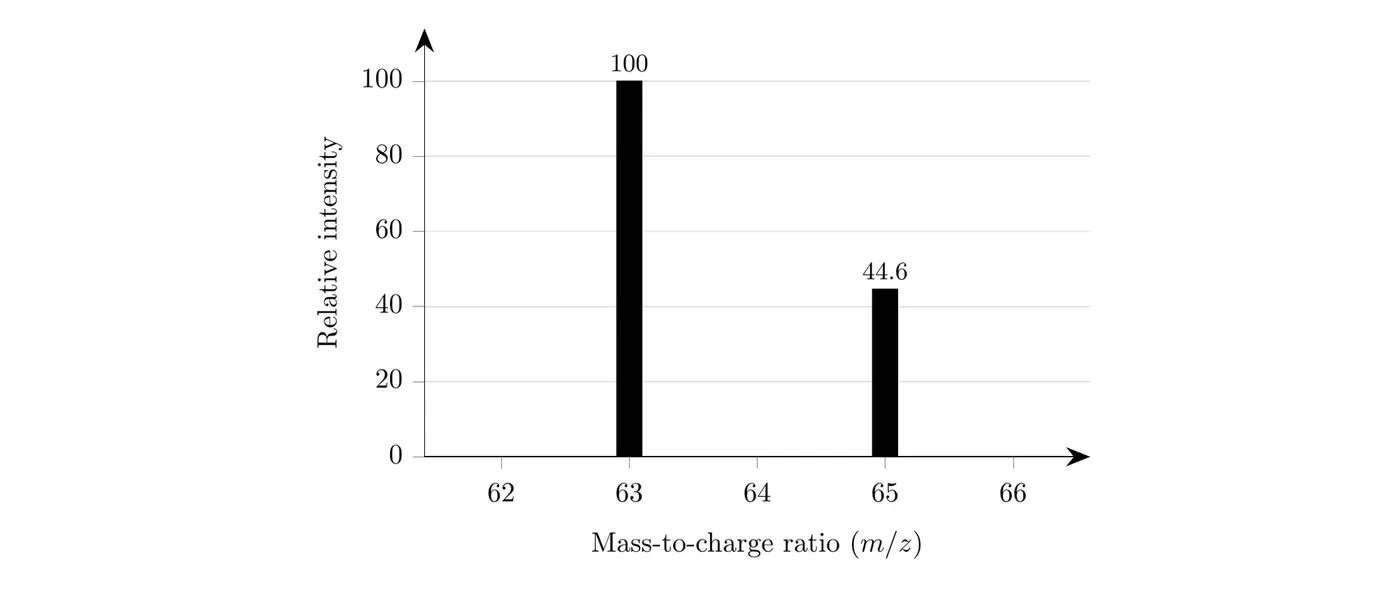
(a) Calculate the percent abundance of each isotope of X.
This spectrum shows relative intensity, so the heights don't add to 100. Divide each height by the total of the heights:
(b) Estimate the average atomic mass of X and identify the element.
The element with an atomic mass closest to 63.6 is copper (63.55). Nickel (58.69) and zinc (65.38) are too far off. Answer: X is copper.
(c) A student claims that each atom of X has a mass of 63.6 amu. Explain why the claim is wrong.
The spectrum shows only two kinds of X atoms, with masses of about 63 amu and about 65 amu. There is no peak at 63.6. The value 63.6 amu is a weighted average over a huge number of atoms, so it describes the sample, not any single atom.
Example 4: Working backward to abundances
Gallium has two isotopes, Ga-69 (68.9256 amu) and Ga-71 (70.9247 amu). Its average atomic mass is 69.723 amu. Find the percent abundance of each isotope.
Let be the fractional abundance of Ga-69. The fractions must add to 1, so the fraction of Ga-71 is :
Answer: Ga-69 is 60.11% and Ga-71 is . Check: the average (69.723) is closer to 69 than to 71, so Ga-69 should be the more common isotope, and it is.
Common mistakes
- Taking a plain average. Averaging 35 and 37 gives 36, but chlorine is 35.45. Always weight each mass by its abundance.
- Using percents as whole numbers. Multiply by 0.7576, not 75.76 (or divide the total by 100 at the end).
- Reading relative intensity as percent. If the tallest peak is 100, the heights don't add to 100. Divide each height by the total first.
- Miscounting isotopes. Each peak is one isotope of the same element. Two peaks means two isotopes, not two elements.
- Skipping the check. The average has to fall between the smallest and largest isotope mass, closest to the tallest peak.
- Thinking isotopes react differently. Isotopes have the same number of protons and electrons, so they behave the same chemically. Only their masses differ.