

1.7 - Periodic Trends
Overview
The periodic table repeats its patterns because electron configurations repeat. This topic covers the four trends the AP exam tests: ionization energy, atomic and ionic radius, electron affinity, and electronegativity. Memorizing the arrows isn't enough. The exam asks you to explain each trend with Coulomb's law, the shell model, shielding, and effective nuclear charge, and to estimate values you aren't given.
Why the table has the shape it does
- Elements in the same column (group) have the same arrangement of valence electrons, so they behave alike. Every group 1 element ends in and every group 17 element ends in . Mendeleev arranged the table in 1869 by recurring properties, long before anyone knew about electrons; electron configurations explain why his pattern works.
- A new period (row) starts each time electrons begin a new shell.
- Completely filled shells and subshells are especially stable. The noble gases, with filled and subshells, almost never react. Filled and half-filled subshells also explain the small bumps in the trends below.
A few elements (chromium and copper, for example) are exceptions to the Aufbau principle. You won't be asked to write their configurations on the AP exam.
The tools: Coulomb's law, shielding, and effective nuclear charge
Every trend comes from how strongly the nucleus attracts the outer electrons. By Coulomb's law, that attraction gets stronger with more charge and weaker with distance. Topic 1.5 set up the tools: valence electrons in a higher shell are farther from the nucleus, core electrons shield them from part of the nuclear charge (electrons in the same shell shield each other only a little), and the net charge a valence electron feels is the effective nuclear charge, . A simple estimate (sometimes called the core charge) is protons minus core electrons.
Element | Protons | Core electrons | estimate | Valence shell |
Li | 3 | 2 | ||
Na | 11 | 10 | ||
K | 19 | 18 | ||
Mg | 12 | 10 | ||
Cl | 17 | 10 |
That table holds the two big patterns:
- Across a period (left to right): each step adds a proton, but the core stays the same, so climbs (Na up to Cl ). The valence electrons stay in the same shell, so they get pulled in closer and held more tightly.
- Down a group (top to bottom): stays about the same (Li, Na, and K are all about ), but each step adds a shell, so the valence electrons are farther away and held less tightly.
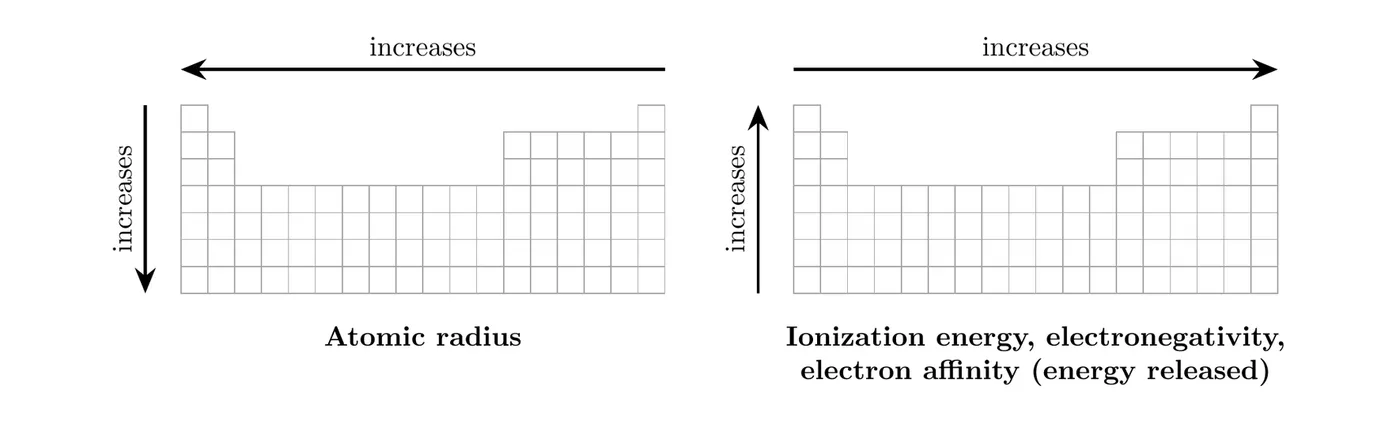
Atomic radius
Atomic radius is the size of an atom, measured as half the distance between the nuclei of two bonded atoms of the element.
- Decreases across a period: same shell, larger , so the electron cloud is pulled in tighter.
- Increases down a group: each row adds a shell, so the valence electrons are farther from the nucleus.
Period 3 | Na | Mg | Al | Si | P | S | Cl |
Atomic radius (pm) | 186 | 160 | 143 | 117 | 110 | 104 | 99 |
Going down group 1, the radius grows from Li (152 pm) to Cs (265 pm). (These are typical values; metal radii come from the metal's crystal and nonmetal radii from covalent bonds. Different tables differ by a few pm, but the trends are the same.)
Example 1: Ranking atomic radii
Rank Mg, Cl, and K from largest to smallest atomic radius, and explain.
Step 1: Locate them. Mg and Cl are both in period 3 (valence shell ). K is in period 4 ().
Step 2: Compare. K has its valence electron in a fourth shell, so it is the largest. Mg and Cl have the same valence shell, but Cl has more protons with the same 10 core electrons ( versus ), so it pulls its electrons in closer.
Answer: K > Mg > Cl. (Typical values: 227 pm, 160 pm, and 99 pm.)
Ionic radius
- Cations are smaller than their atoms. Losing the valence electrons usually empties the outer shell. A sodium atom has a radius of about 186 pm, but () is about 102 pm: its remaining electrons are all in shell 2, and 11 protons now pull on only 10 electrons.
- Anions are larger than their atoms. The added electrons go into the same shell, and the extra electron-electron repulsion spreads the cloud out while the nuclear charge stays the same. Chlorine's radius is about 99 pm, but is about 181 pm.
- Isoelectronic series: for ions with the same number of electrons, more protons means a smaller ion.
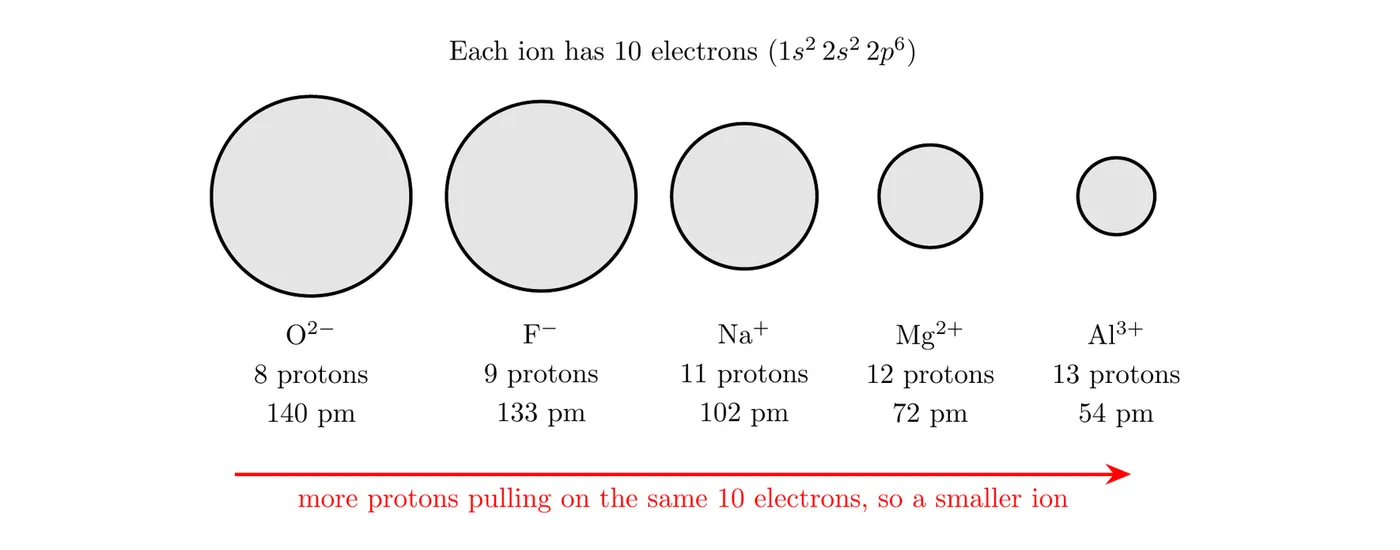
(Ionic radii are measured in crystals, so they come from a different kind of measurement than atomic radii. Compare ions with ions and atoms with atoms when you can.)
Example 2: Ranking an isoelectronic series
Rank , , , and from largest to smallest.
Step 1: Count electrons. S has 16 protons, so has 18 electrons. Likewise has , has , and has . They are isoelectronic, all .
Step 2: Compare protons. With the same 18 electrons, the ion with the most protons pulls them in the most: 16, 17, 19, and 20 protons.
Answer: (measured radii: 184, 181, 138, and 100 pm).
Ionization energy
The first ionization energy is the energy needed to remove the most loosely held electron from a gas-phase atom:
- Increases across a period: larger and a smaller atom hold the valence electrons more tightly.
- Decreases down a group: the valence electron is farther from the nucleus with about the same .
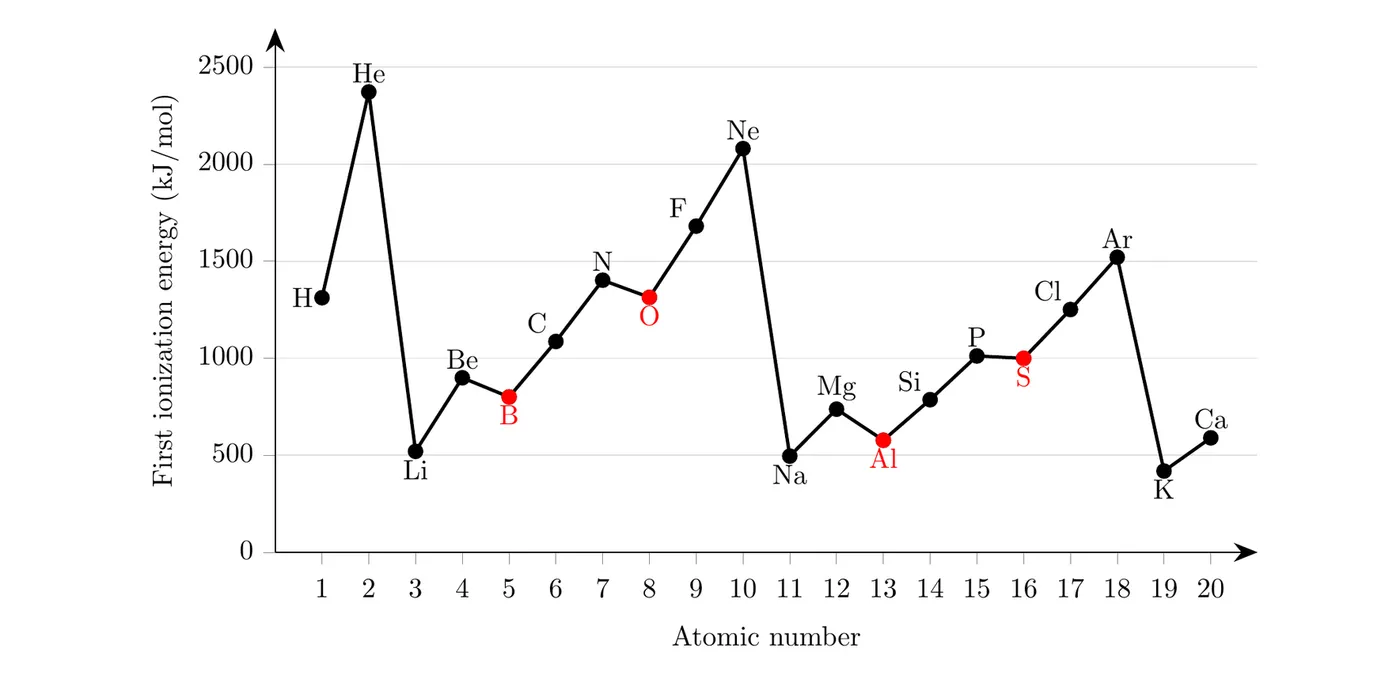
The graph shows the pattern repeating every period. The noble gases (He, Ne, Ar) sit at the peaks because their electrons are in filled shells with the largest in their row. The alkali metals (Li, Na, K) sit at the bottoms, because each one's only valence electron starts a new, farther shell with .
Two dips you need to explain
The rise across a period isn't perfectly smooth. Two dips show up in both period 2 and period 3, marked in red on the graph:
- Group 2 to group 13 (Be 900 to B 801 kJ/mol; Mg 738 to Al 578 kJ/mol). Boron's first electron comes out of , but beryllium's comes out of . A electron is higher in energy and slightly farther from the nucleus on average, and the electrons partly shield it, so it is easier to remove even though boron has one more proton.
- Group 15 to group 16 (N 1402 to O 1314 kJ/mol; P 1012 to S 1000 kJ/mol). Nitrogen's three electrons each have their own orbital. Oxygen's fourth electron has to share an orbital, and the repulsion between the two electrons in that orbital makes one of them easier to remove.

Topic 1.8 picks up successive ionization energies (removing a second, third, and fourth electron) and uses them to explain ion charges.
Example 3: Explaining an exception (AP-style)
The first ionization energy of phosphorus is 1012 kJ/mol, and that of sulfur is 1000 kJ/mol. Sulfur has more protons. Explain why its first ionization energy is lower.
Step 1: Write the valence configurations with orbital boxes in mind. Phosphorus is : one electron in each of the three orbitals. Sulfur is : one orbital holds a pair.
Step 2: Identify the electron removed. In sulfur, the first electron removed is one of the paired electrons.
Answer: The two electrons sharing a orbital in sulfur repel each other. That added electron-electron repulsion makes one of them easier to remove, which outweighs sulfur's slightly larger nuclear charge. Phosphorus has no paired electrons, so its first ionization energy is a little higher.
Electron affinity
Electron affinity is the energy change when a gas-phase atom gains an electron:
For most nonmetals, energy is released, because the nucleus attracts the incoming electron. The more energy released, the more strongly the atom attracts an extra electron. Tables use different signs for this. This page gives the amount of energy released as a positive number (349 kJ/mol for chlorine). Written as an enthalpy change from the system's point of view, the way Unit 6 writes it, the same electron-gain process has kJ/mol: negative because the system releases energy. The two descriptions agree; one gives the amount released, the other the sign of the change.
- Generally more energy is released across a period (up to the halogens): a larger pulls harder on the incoming electron.
- Generally less energy is released down a group: the incoming electron lands in a shell farther from the nucleus.
- The halogens release the most energy, since one electron completes their subshell. The noble gases don't form stable anions, because an added electron would have to start a new, farther shell where it is well shielded.
- Exceptions: group 2 atoms (filled subshell) and nitrogen (half-filled ) have little or no tendency to gain an electron. And chlorine releases more energy than fluorine: fluorine is so small that the incoming electron is crowded by repulsion from fluorine's other electrons.
Halogen | F | Cl | Br | I |
Energy released on gaining an electron (kJ/mol) | 328 | 349 | 325 | 295 |
Electronegativity
Electronegativity is the ability of an atom in a chemical bond to attract the shared electrons toward itself. It is a relative scale with no units (the Pauling scale), and fluorine is the highest at 3.98.
- Increases across a period: larger pulls the bonding electrons harder.
- Decreases down a group: the bonding electrons are farther from the nucleus.
- Noble gases usually aren't given values, since they rarely form bonds.
Across period 2, electronegativity climbs from Li (0.98) to F (3.98). Down group 17 it falls from F (3.98) to I (2.66). Topic 2.1 charts these values and uses them to classify bonds.
Electron affinity and electronegativity sound alike but aren't the same thing. Electron affinity is a measured energy for a single, isolated atom gaining an electron. Electronegativity describes an atom pulling on electrons it shares in a bond. In Unit 2, the difference in electronegativity between two bonded atoms tells you how polar the bond is.
Summary of the trends
Property | Across a period (left to right) | Down a group | Main reason |
Atomic radius | Decreases | Increases | Across: rises in the same shell. Down: more shells. |
First ionization energy | Increases (dips at groups 13 and 16) | Decreases | Stronger attraction to a closer electron with more charge |
Electron affinity (energy released) | Generally increases | Generally decreases | Same as ionization energy, for an incoming electron |
Electronegativity | Increases | Decreases | Same as ionization energy, for shared electrons |
Ionic radius follows its own rules: cations are smaller than their atoms, anions are larger, and in an isoelectronic series more protons means a smaller ion.
Using trends to estimate missing values
Because properties change gradually within a group or period, you can estimate a value you haven't been given from its neighbors. The estimate usually falls between the values of the elements on either side.
Example 4: Estimating values from neighbors
(a) The first ionization energies of sulfur and tellurium are 999.6 kJ/mol and 869.3 kJ/mol. Selenium is between them in group 16. Estimate selenium's first ionization energy. (b) The electronegativities of chlorine and iodine are 3.16 and 2.66. Estimate bromine's.
(a) Selenium sits between sulfur and tellurium, so its value should be between theirs. Averaging the neighbors gives a reasonable estimate:
The measured value is 941 kJ/mol, within 1% of the estimate.
(b) Bromine sits between chlorine and iodine in group 17:
Answer: about 934 kJ/mol for selenium and about 2.91 for bromine (the measured values are 941 kJ/mol and 2.96). On the exam, any estimate between the neighbors with the reasoning “it lies between them in the group” is the point; the exact average isn't required.
Common mistakes
- Saying atoms get smaller across a period “because they have more electrons”. The added electrons go into the same shell; the growing nuclear charge () is what pulls them in.
- Writing “it has a stable noble gas configuration” as a whole explanation. AP answers need the Coulomb's law reasoning: charge, shielding, and distance.
- Forgetting the dips (Be to B and N to O) when ranking ionization energies across a period.
- Mixing up atoms and ions: is smaller than Na, and is larger than Cl.
- Mixing up the sign of electron affinity. Check whether the table lists energy released as positive or negative.
- Using electron affinity and electronegativity as if they were the same property.