

1.5 - Atomic Structure and Electron Configuration
Overview
Almost everything in chemistry comes down to how electrons are arranged around a nucleus. This topic covers what an atom is made of, how Coulomb's law describes the pull between charged particles, and how to write the electron configuration of an atom or ion with the Aufbau principle. Those configurations are the key to photoelectron spectra (1.6), periodic trends (1.7), and the charges ions form (1.8).
What an atom is made of
An atom has a tiny, dense nucleus made of protons (positive) and neutrons (no charge). Electrons (negative) occupy the space around the nucleus.
Particle | Charge | Relative mass | Where it is |
Proton | 1 | Nucleus | |
Neutron | 1 | Nucleus | |
Electron | about (almost nothing) | Around the nucleus |
- Atomic number (): the number of protons. It identifies the element. Every sodium atom has 11 protons.
- Mass number: protons plus neutrons. Sodium-23 has neutrons.
- In a neutral atom, the number of electrons equals the number of protons. An ion has gained or lost electrons: a cation lost electrons (positive), and an anion gained electrons (negative). has 11 protons but only 10 electrons.
Almost all of the mass is in the nucleus, but almost all of the volume belongs to the electrons: a nucleus is roughly 100,000 times smaller across than its atom. The positive nucleus attracts the negative electrons, and the electrons repel each other. Those two pushes and pulls explain the rest of this unit.
Coulomb's law
Coulomb's law gives the force between two charged particles:
Here and are the charges and is the distance between them. The symbol means “is proportional to”.
- Opposite charges attract and like charges repel.
- Bigger charges mean a stronger force. Doubling one charge doubles the force.
- Greater distance means a weaker force, and it drops off fast because is squared. Doubling the distance cuts the force to .
In an atom, the nucleus (charge ) pulls on every electron. Electrons closer to the nucleus are held more tightly, and a nucleus with more protons pulls harder. That one idea is behind ionization energy, atomic size, and every other trend in this unit. The AP exam uses Coulomb's law qualitatively or with ratios, which is why the reference sheet gives it as a proportion with no constant.
Example 1: Using Coulomb's law with ratios
Two charged particles attract each other with a force . Find the new force, in terms of , if (a) the distance between them is cut in half, (b) both charges are doubled, (c) one charge is tripled and the distance is doubled.
Compare the new force to the old one by putting the changes into the formula:
(a) The charges don't change and :
(b) The distance doesn't change, and the charge product grows by :
(c) The charge product triples and the distance doubles:
Answer: (a) , (b) , (c) . In (c) the bigger charge helps, but the doubled distance hurts more because distance is squared.
Topic 2.2 uses the same ratio method on ions, to explain why holds together far more strongly than .
Shells and subshells
Electrons in an atom are organized into shells (energy levels), numbered A larger means the electron is, on average, farther from the nucleus and higher in energy.
Each shell is split into subshells (sublevels) labeled , , , and . Shell has subshells: shell 1 has only , shell 2 has and , shell 3 has , , and , and so on. Each subshell is made of orbitals, and each orbital holds at most 2 electrons.
Subshell | Number of orbitals | Maximum electrons |
1 | 2 | |
3 | 6 | |
5 | 10 | |
7 | 14 |
So shell holds up to electrons: 2 in shell 1, 8 in shell 2, 18 in shell 3. You don't need to assign quantum numbers to electrons; that isn't tested on the AP exam.
Core and valence electrons
- Valence electrons are the electrons in the outermost shell (the highest ). They are the ones involved in bonding and reactions.
- Core electrons are all the inner electrons. For a main-group element, the core matches the noble gas at the end of the previous row.
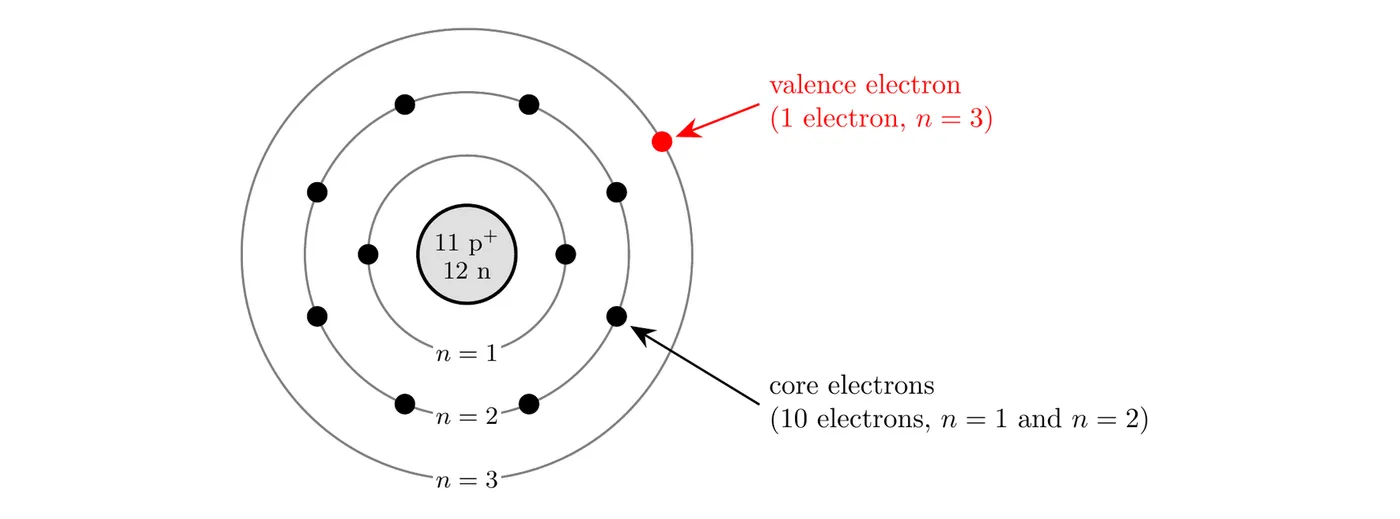
Sodium has 11 electrons: 2 in shell 1 and 8 in shell 2 (10 core electrons), plus 1 in shell 3 (its single valence electron). The circles are a bookkeeping picture, not real orbits. For main-group elements, the number of valence electrons matches the last digit of the group number: group 1 has 1, group 2 has 2, and groups 13 to 18 have 3 to 8 (helium has 2).
Electron configurations and the Aufbau principle
An electron configuration lists how many electrons are in each subshell. Sodium is : the big number is the shell, the letter is the subshell, and the superscript is the number of electrons in it. The superscripts add up to the total number of electrons.
The Aufbau principle (German for “building up”) says that in the ground state, electrons fill the lowest-energy subshells first. The approximate order is:
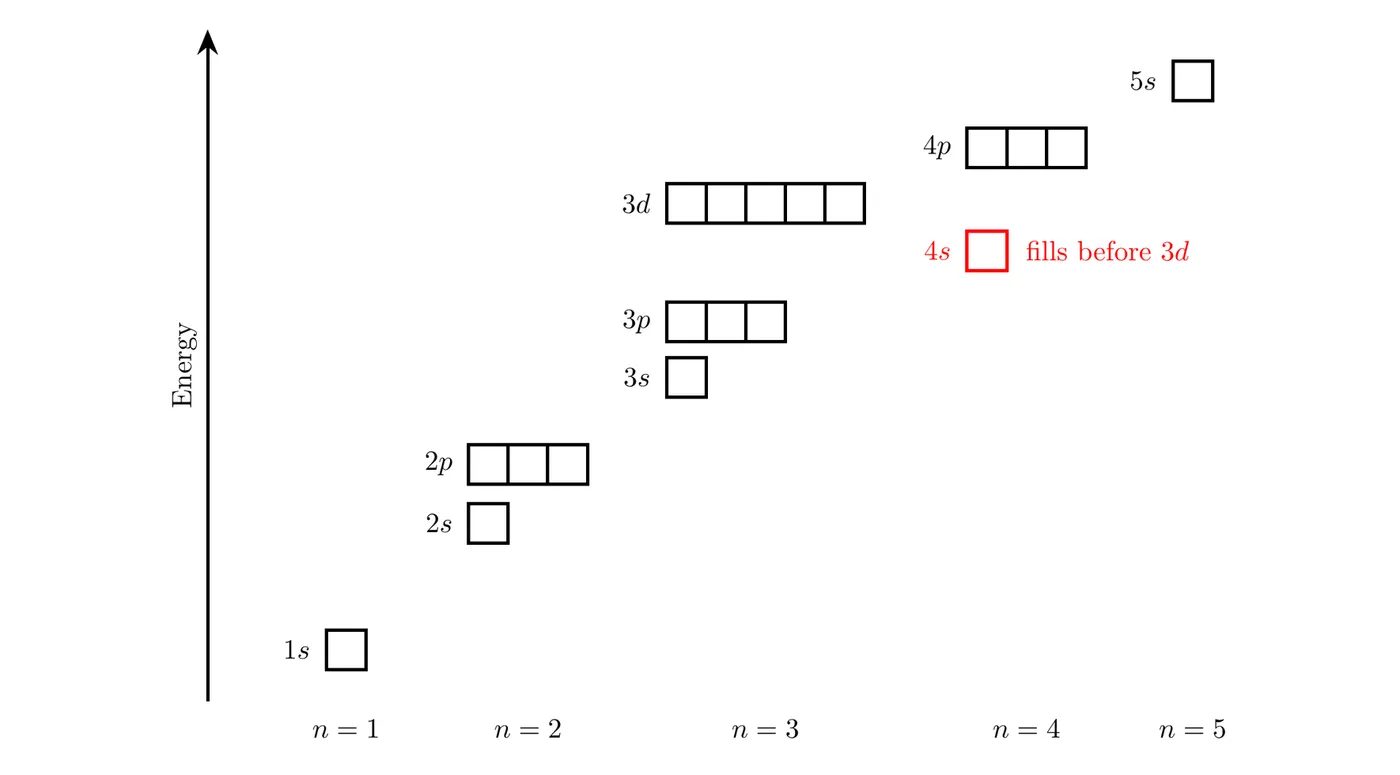
Notice that fills before . In potassium and calcium, the subshell is lower in energy, so the 19th and 20th electrons go there. The subshell starts filling at scandium.
Two more rules matter when you draw orbital diagrams (one box per orbital, one arrow per electron):
- Pauli exclusion principle: an orbital holds at most two electrons, and they must have opposite spins (one up arrow, one down arrow).
- Hund's rule: within a subshell, electrons spread out one per orbital before any of them pair up.

Oxygen's four electrons fill all three orbitals singly, and then the fourth pairs up. That paired electron matters in 1.7, where it explains a dip in ionization energy.
Reading configurations from the periodic table
You don't have to memorize the filling order. The periodic table is built from it: each row fills one shell, and each block tells you which subshell is filling.
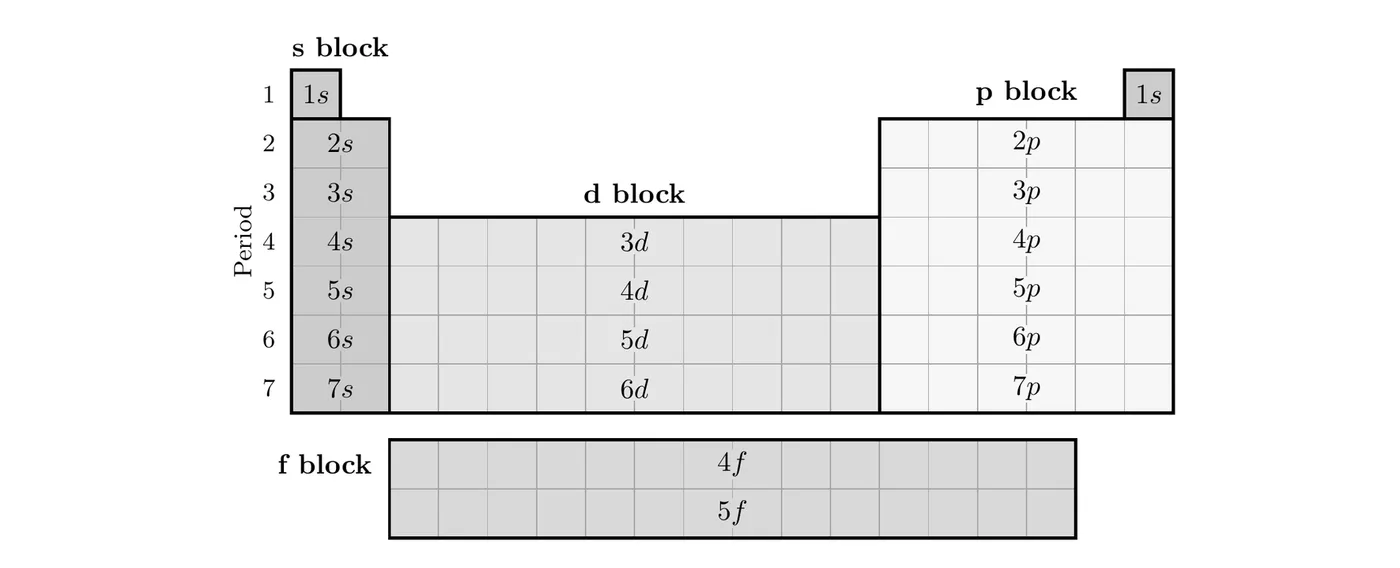
- The block is 2 columns wide, the block 6, the block 10, and the block 14, matching the subshell capacities.
- The block in period 4 is the subshell (one less than the period number). The block in period 6 is (two less).
- Helium sits above the block, but its electrons are .
To write a configuration, start at hydrogen and read across the rows until you reach your element, writing each block you pass through. Noble-gas notation saves time: write the previous noble gas in brackets for the core, then add the rest. Sodium becomes .
A few elements, such as chromium and copper, don't follow the Aufbau order exactly. Writing configurations for those exceptions isn't assessed on the AP exam.
Example 2: Writing electron configurations
Write the full and noble-gas configurations for (a) phosphorus and (b) selenium, and give the number of valence electrons in each.
(a) Phosphorus, . Fill in order until 15 electrons are placed:
Check: . The outer shell is , with valence electrons, which fits group 15.
(b) Selenium, . Selenium is in period 4, so pass through and before reaching :
Check: . The outer shell is , so selenium has valence electrons (group 16). The filled subshell belongs to shell 3, inside the outer shell, so it isn't counted as valence.
Electron configurations of ions
- Anions: add electrons in the next open spots. Chlorine, , gains one electron to become , .
- Cations: remove electrons from the outermost shell (highest ) first. Sodium, , loses its electron to become , .
- Transition metals lose their electrons before their electrons, even though filled first. The electrons are in shell 4, the outermost shell. Iron, , forms , , and , .
Species with the same electron configuration are isoelectronic. , , Ar, , and all have 18 electrons arranged as .
Example 3: Configurations of ions
Write the ground-state configurations of (a) , (b) , and (c) .
(a) Sulfur () is . The charge means two extra electrons, which finish the subshell: is , the same as (18 electrons).
(b) Calcium () is . Remove both electrons: is (18 electrons).
(c) Zinc () is . The two electrons come out of , the outermost shell, not :
Answer: and are both , so they are isoelectronic with argon, and is (28 electrons).
Ionization energy and Coulomb's law
Ionization energy is the energy needed to remove an electron from an atom or ion in the gas phase. Coulomb's law lets you predict which electrons take more energy to remove, without any numbers. Two things matter:
- Distance from the nucleus. Electrons in a higher shell (larger ) are farther from the nucleus, so they are attracted less strongly and are easier to remove.
- Effective nuclear charge (). Core electrons sit between the nucleus and the outer electrons and cancel part of the nuclear charge. This is called shielding. The net charge an outer electron actually feels is . A simple estimate is protons minus core electrons. For sodium's electron, .
The CED asks you to compare two kinds of electrons:
- Different subshells in the same atom. In lithium, removing a electron takes about 6.26 MJ/mol, but removing the electron takes only about 0.52 MJ/mol, roughly 12 times less. The electrons are much closer to the nucleus and have no inner electrons shielding them.
- The same subshell in different atoms. Sodium and magnesium both lose a electron first, and both have 10 core electrons shielding it. Magnesium has 12 protons instead of 11, so its electrons feel instead of , and it takes more energy to remove one: 738 kJ/mol for Mg compared with 496 kJ/mol for Na.
(1 MJ/mol = 1000 kJ/mol. Photoelectron spectra usually use MJ/mol, and tables of ionization energies usually use kJ/mol.)
Example 4: Explaining ionization energy with Coulomb's law (AP-style)
Which takes more energy: removing a electron from a neon atom or removing the electron from a sodium atom? Justify your answer using Coulomb's law.
Step 1: Write the configurations. Ne is and Na is .
Step 2: Compare distance. Neon's electron is in shell 2. Sodium's electron is in shell 3, farther from the nucleus.
Step 3: Compare the charge each electron feels. Neon's electrons are shielded only by the two electrons, so . Sodium's electron is shielded by 10 core electrons, so .
Answer: Removing a electron from neon takes more energy. By Coulomb's law, that electron is attracted more strongly because it feels a much larger effective nuclear charge and is closer to the nucleus. (The measured values are about 2.08 MJ/mol for Ne's and 0.50 MJ/mol for Na's .) A full-credit answer names both the charge and the distance, not just one.
Common mistakes
- Filling before , or removing electrons before when a transition metal forms a cation. The subshell fills first and empties first.
- Forgetting to add or remove electrons for an ion. The superscripts must add up to the number of electrons, not the number of protons.
- Counting a filled subshell as valence electrons for a main-group element. Selenium has 6 valence electrons, not 16.
- Treating Coulomb's law as linear in distance. Doubling the distance gives one fourth of the force, not half.
- Explaining ionization energy with only one factor. Say how the nuclear charge (protons and shielding) and the distance (which shell) each affect the attraction.