

1.3 - Elemental Composition of Pure Substances
Overview
Every pure compound has a fixed recipe: the same elements in the same proportions by mass, no matter where the sample came from. This topic connects that mass recipe to the empirical formula, the simplest whole-number ratio of atoms in a compound. You'll calculate percent composition from a formula and work backward from mass data to a formula, which is how chemists identify an unknown substance.
Molecules and formula units
A pure substance has a fixed composition. It's either an element (one kind of atom) or a compound (two or more elements chemically combined). Pure substances are built from particles in one of two ways:
- Molecular substances are made of separate molecules. Water, carbon dioxide, and glucose are examples. The formula describes one actual molecule: 2 H atoms bonded to 1 O atom.
- Ionic compounds and network solids have no separate molecules. They are huge, repeating arrangements of ions or atoms held together in a fixed ratio. The formula gives that ratio, called a formula unit. In sodium chloride, NaCl means one for every . In magnesium chloride, means two for every . Quartz, , is a network of atoms with two O for every Si.
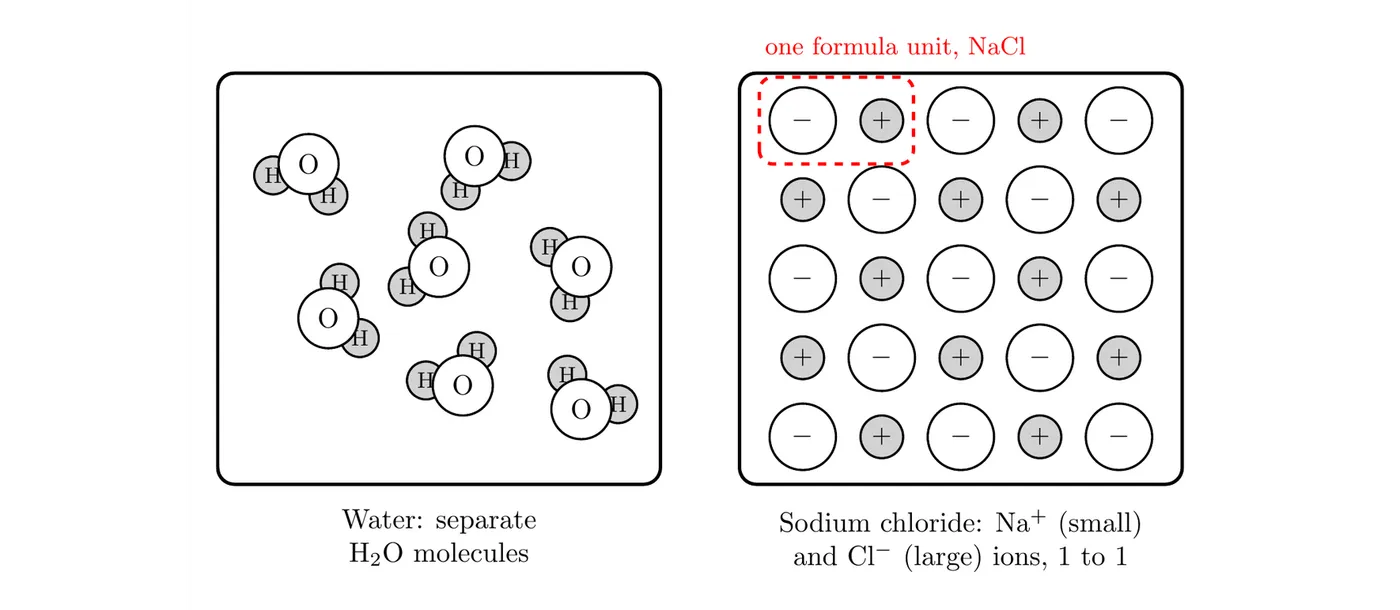
Either way, the formula fixes how many atoms of each element there are relative to each other. That's why every pure sample of a compound has the same composition.
The law of definite proportions
The law of definite proportions says that in any pure sample of a compound, the ratio of the masses of its elements is always the same. Water from a glacier, a lab, or a puddle always has 7.94 g of oxygen for every 1.00 g of hydrogen.
The reason is the formula. Every water molecule has 2 H atoms ( amu) and 1 O atom (16.00 amu). A sample is just many copies of the same molecule, so the mass ratio of the whole sample equals the ratio in one molecule:
Double the sample and both masses double, so the ratio doesn't change. On a graph of oxygen mass against hydrogen mass, every water sample falls on the same straight line through the origin.
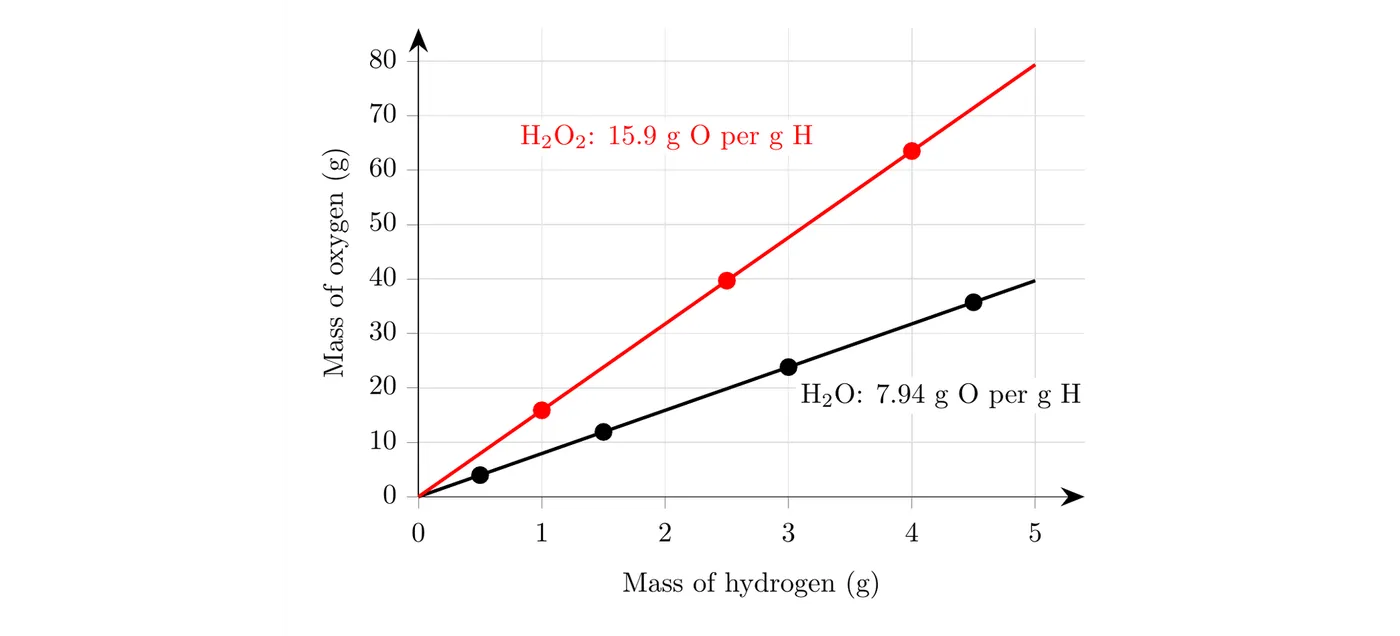
Hydrogen peroxide, , is made of the same two elements in a different ratio (2 O atoms for every 2 H atoms), so its samples fall on a different, steeper line: 15.9 g of O per gram of H. A different mass ratio means a different compound. That makes the mass ratio a tool for identifying a substance or testing whether a sample is pure.
Percent composition by mass
The percent composition of a compound is the percent of its mass that comes from each element. Use one mole of the compound:
Example 1: Percent composition of ethanol
Find the percent composition by mass of ethanol, (often written ).
The molar mass is g/mol. One mole contains 24.02 g of C, 6.048 g of H, and 16.00 g of O.
Answer: 52.14% C, 13.13% H, and 34.73% O. Check: the percents add up to 100.00%.
Empirical formulas
The empirical formula of a compound lists the lowest whole-number ratio of atoms of its elements. The molecular formula gives the actual number of each atom in one molecule. The molecular formula is always a whole-number multiple of the empirical formula.
Compound | Molecular formula | Empirical formula |
Glucose | ||
Hydrogen peroxide | HO | |
Benzene | CH | |
Water | ||
Sodium chloride | none (no molecules) | NaCl |
Different compounds can share an empirical formula. Formaldehyde (), acetic acid (), and glucose all reduce to , so all three have the same percent composition. Formulas of ionic compounds are always empirical formulas, because a formula unit is already the lowest ratio.
Finding an empirical formula from mass data
Mass data gives you grams of each element, but formulas count atoms. So you have to convert to moles:
- Get grams of each element. If you're given percents, assume a 100 g sample, so 40.91% becomes 40.91 g.
- Convert grams to moles by dividing by each element's molar mass.
- Divide every mole amount by the smallest one. This gives the ratio.
- Make the ratio whole numbers. If a value is within about 0.1 of a whole number, round it. If it ends in about .5, multiply every value by 2. If it ends in about .33 or .67, multiply by 3. If it ends in about .25 or .75, multiply by 4.
Never round 1.33 down to 1 or 1.5 up to 2. Those decimals are real fractions telling you to multiply.
Example 2: Empirical and molecular formulas of vitamin C
Vitamin C is 40.91% C, 4.58% H, and 54.51% O by mass, and its molar mass is 176.12 g/mol. Find its empirical and molecular formulas.
Assume 100 g, then convert each mass to moles:
Divide by the smallest amount (3.406 mol, carbon):
The H value, 1.33, is , so multiply everything by 3: C = 3, H = 4, O = 3. The empirical formula is .
To get the molecular formula, compare the molar mass to the mass of one empirical formula unit:
Answer: the empirical formula is . The molecular formula has twice as many of each atom: .
Asking testable questions with composition data
Composition data lets you ask questions an experiment can actually answer. A testable question names something you can measure and compare. For example:
- Not testable: "Is this copper oxide any good?"
- Testable: "Does this black copper oxide have the same mass percent of copper as pure CuO (79.89%)?"
The law of definite proportions is what makes the second question useful. If the sample is pure CuO, its copper percent must be 79.89%. A different value means it's a different compound or it isn't pure (Topic 1.4).
Example 3: Same compound or not?
A chemist analyzes three samples of copper oxide:
Sample | Color | Mass of sample | Mass of copper |
1 | black | 3.18 g | 2.54 g |
2 | black | 7.95 g | 6.35 g |
3 | red | 5.00 g | 4.44 g |
(a) Which samples could be the same compound? Justify your answer.
Compare the mass percent of copper in each sample:
Samples 1 and 2 have the same composition even though their masses are very different, so they could be the same compound (and 79.9% matches CuO). Sample 3 has a different composition, so it must be a different compound. By the law of definite proportions, one compound can't have two different compositions.
(b) Find the empirical formula of sample 3.
Sample 3 contains g of oxygen.
Dividing by the smaller amount gives Cu : O = 2.0 : 1. The oxygen mass has only two significant figures (from the subtraction), but that's plenty to see a 2 to 1 ratio. Answer: , which is 88.82% copper, matching the data.
Example 4: Magnesium oxide lab (AP-style)
A student heats a strip of magnesium in a crucible until it reacts completely with oxygen from the air, forming a white solid. The data are below.
Measurement | Mass (g) |
Crucible and lid | 28.415 |
Crucible, lid, and magnesium | 28.861 |
Crucible, lid, and product after heating | 29.155 |
(a) Calculate the mass of oxygen that combined with the magnesium.
Magnesium: g. Product: g. The extra mass is oxygen: g of O.
(b) Determine the empirical formula of the product.
The mole ratio is 1 : 1, so the empirical formula is MgO.
(c) Write a testable question that this experiment answers.
"Does magnesium combine with oxygen in a 1 to 1 ratio of atoms?" Any question that names a measured quantity, like the mass ratio of magnesium to oxygen in the product, works.
(d) When the student lifted the lid to let air in, some white smoke (the product) escaped. How does this affect the calculated ratio of Mg to O? Explain.
Losing product makes the final mass too small, so the calculated mass of oxygen is too small. The moles of O come out too low while the moles of Mg (from the mass measured before heating) don't change. So the calculated Mg : O ratio is too high, and the formula would look like it has more than one Mg for every O.
Common mistakes
- Using mass ratios as subscripts. Subscripts count atoms, not grams. Always convert grams to moles before finding a ratio.
- Rounding the ratio too much. A ratio of 1 : 1.33 means multiply by 3, not round to 1 : 1. A value of 1.5 means multiply by 2.
- Dividing by the wrong number. Divide every mole amount by the smallest one, so the smallest becomes 1.
- Mixing up empirical and molecular formulas. is glucose's molecular formula, and its empirical formula is . For ionic compounds, the formula unit is the empirical formula.
- Thinking a bigger sample changes the composition. A 1 g sample and a 1 kg sample of pure water have the same percent oxygen. Only the masses change, not the ratio.