

1.4 - Composition of Mixtures
Overview
Most real samples aren't pure. Air, seawater, a vitamin tablet, and a bag of road salt are all mixtures. This topic covers how pure substances and mixtures differ at the particle level, and how chemists use elemental analysis (measuring how much of an element a sample contains) to work out what's in a mixture and how pure a sample is.
Pure substances vs. mixtures
The difference comes down to the particles:
- A pure substance contains particles of only one type: one kind of atom, molecule, or formula unit. Its composition is fixed. Every sample of pure water is and nothing else.
- A mixture contains particles of two or more types, and their relative amounts can vary. Salt water can be 1% salt or 20% salt, and it's still salt water.
In a mixture, the substances aren't chemically bonded to each other. Each keeps its own identity, which is why mixtures can be separated by physical methods like filtering, evaporating, or distilling (Unit 3). A mixture can be homogeneous, the same throughout (a solution, like salt water or air), or heterogeneous, with parts you can tell apart (like sand in water).
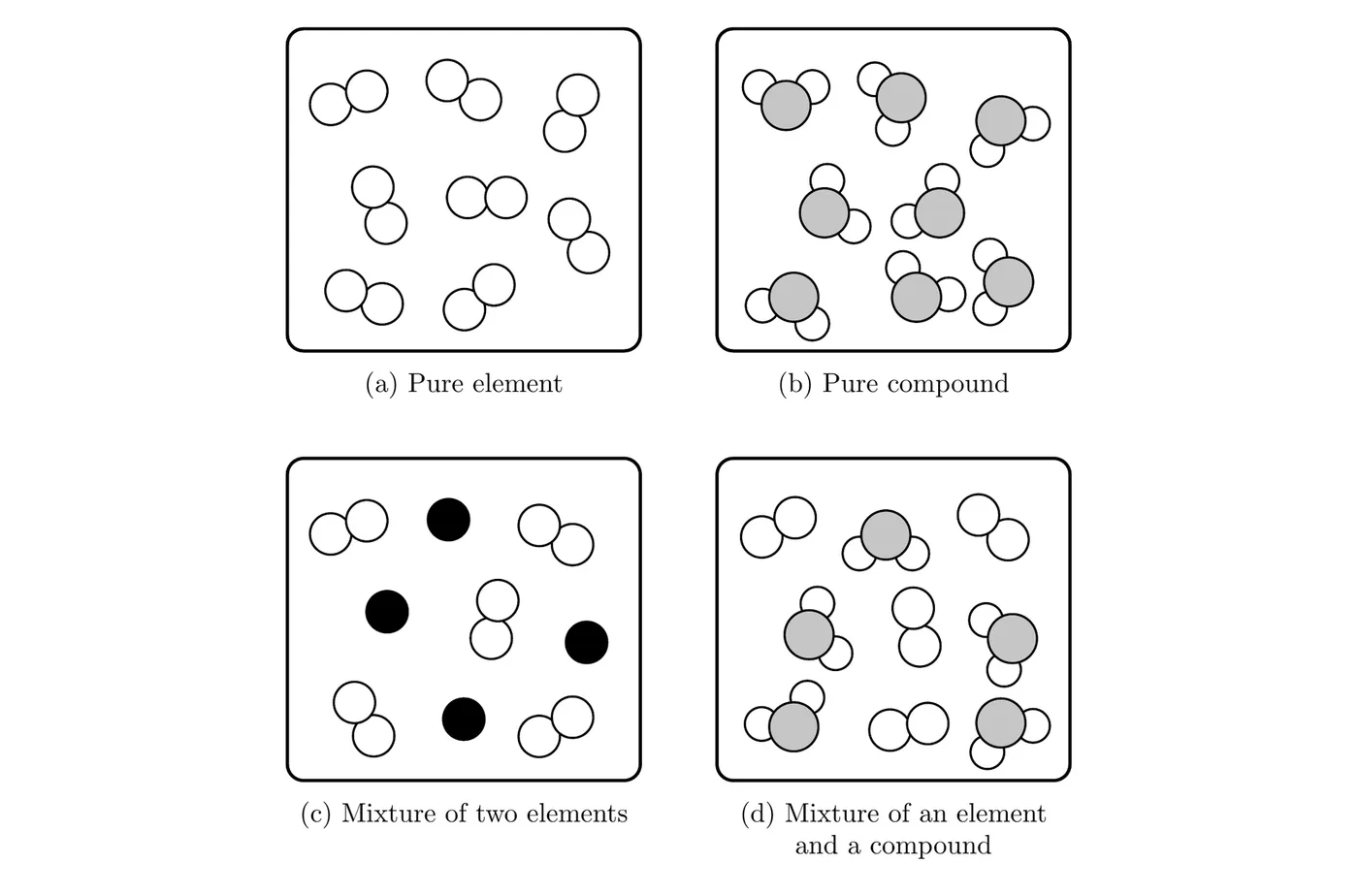
How to read particle diagrams like these:
- (a) Pure element: every particle is the same, and each has only one kind of atom. Here the particles are diatomic molecules, like or .
- (b) Pure compound: every particle is the same, and each has two or more kinds of atoms bonded together.
- (c) Mixture of two elements: two kinds of particles, each made of only one kind of atom.
- (d) Mixture of an element and a compound: two kinds of particles, and one of them is a compound.
The test: if every particle is identical, it's a pure substance. If there's more than one kind of particle, it's a mixture. Diagram (b) has two kinds of atoms but only one kind of particle, so it's pure.
Property | Pure substance | Mixture |
Kinds of particles | One | Two or more |
Composition | Fixed | Can vary |
Chemical formula? | Yes | No |
Separated by physical methods? | No | Yes |
Examples | water, NaCl, , copper | air, salt water, brass, a vitamin tablet |
Describing the composition of a mixture
A mixture's composition can vary, so you can't read it from a formula. You have to measure it. The usual way to report it is mass percent:
For example, a 50.0 g mixture that contains 12.0 g of sugar is sugar by mass.
Elemental analysis
Elemental analysis measures the mass of one element in a sample. A common way to do it is to turn that element into a compound you can collect and weigh. In gravimetric analysis, for example, the chloride ions in a dissolved sample are made to form solid silver chloride, AgCl, which is filtered, dried, and weighed. Since AgCl has a known formula, its mass tells you the mass of chlorine. The gravimetric version of the AP hard water lab works the same way: the calcium ions are precipitated as calcium carbonate or calcium oxalate, and the precipitate is filtered, dried, and weighed.
Elemental analysis answers two kinds of questions.
How many atoms of each element?
If you know the mass of each element in a pure substance, you can convert to moles and find the ratio of atoms, exactly as in Topic 1.3. This is how the empirical formula of a new compound is found.
How pure is the sample?
For a pure compound, the mass percent of each element is fixed by its formula. Pure sodium chloride is always 60.66% chlorine by mass:
If a sample's measured percent doesn't match, the sample isn't pure. The direction of the mismatch tells you something about the impurity:
- The impurity has none of the element (like sand in salt): the measured percent comes out lower than the pure value.
- The impurity has a smaller percent of the element: the measured percent is also lower.
- The impurity has a larger percent of the element: the measured percent comes out higher.
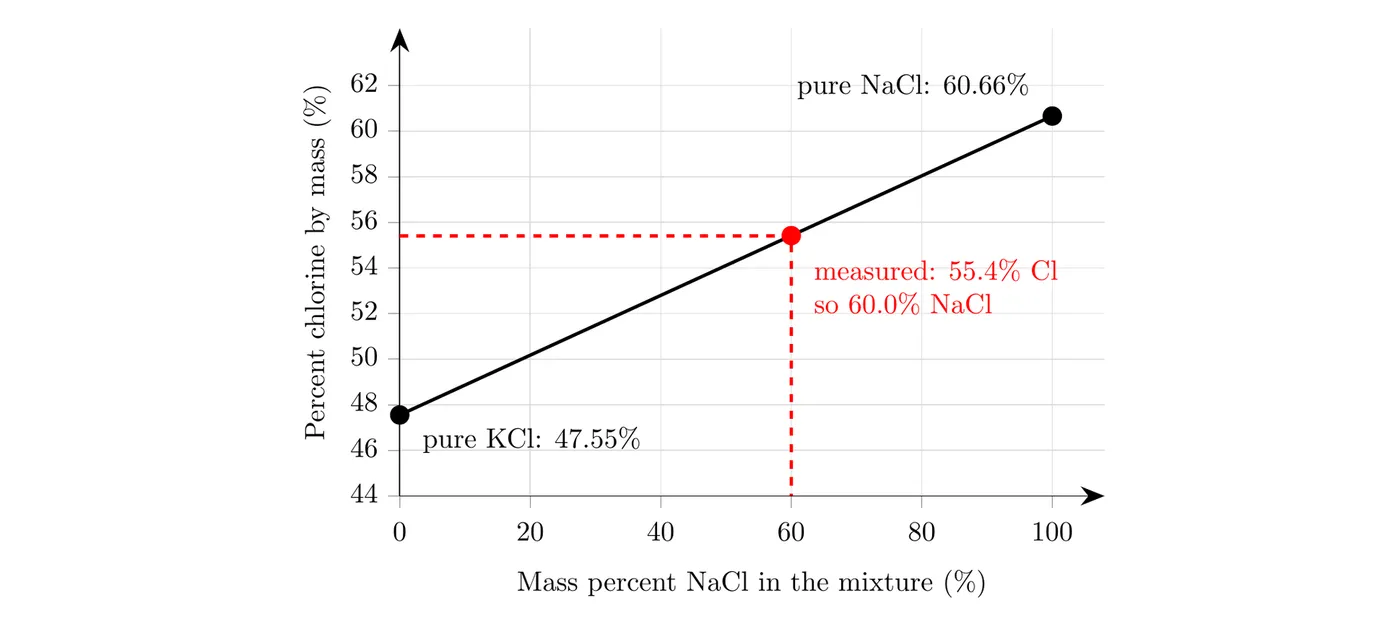
The percent of an element in a mixture of two substances always falls between the percents in the two pure substances, closer to whichever one makes up more of the mass. It's a weighted average, just like average atomic mass in Topic 1.2:
The graph shows this for mixtures of NaCl and KCl. Pure KCl is 47.55% chlorine and pure NaCl is 60.66% chlorine. Every possible mixture of the two lies on the line between them, so measuring the percent chlorine tells you the mixture's composition. A result outside that range would mean something else is in the sample.
When the impurity contains none of the element being measured, the purity follows directly:
Example 1: Purity of a calcium supplement
A calcium supplement tablet has a mass of 1.250 g. Analysis shows it contains 0.452 g of calcium. All of the calcium is in the form of calcium carbonate, , and the other ingredients contain no calcium. What is the mass percent of in the tablet?
First, find the mass percent of Ca in pure . Its molar mass is g/mol:
Next, find the mass of that contains 0.452 g of Ca:
Answer: the tablet is 90.3% by mass. The other 9.7% is ingredients like the binder that holds the tablet together.
Example 2: Composition of a salt mixture (AP-style)
A 1.5000 g sample is a mixture of NaCl and KCl only. The sample is dissolved in water, and excess silver nitrate is added so that all of the chloride ions form solid AgCl. The dried AgCl has a mass of 3.3607 g.
(a) Calculate the mass of chlorine in the sample.
First identify what you need: the AgCl mass, the sample mass, and molar masses. Each AgCl contains one Cl, and the molar mass of AgCl is g/mol.
(b) Calculate the percent chlorine by mass in the sample.
(c) Is the sample pure NaCl? Justify your answer.
No. Pure NaCl is 60.66% Cl, but the sample is only 55.42% Cl. That value falls between KCl (47.55%) and NaCl (60.66%), as a mixture of the two should.
(d) Calculate the mass percent of NaCl in the mixture.
Let be the mass of NaCl, so the mass of KCl is . Each formula unit of either salt has one Cl, so the moles of NaCl and KCl add up to the moles of Cl:
Both sides came from subtracting two nearly equal numbers, which wipes out precision: the fourth digit of depends on how the middle steps were rounded (0.8999 g from the rounded values shown, 0.9001 g with no rounding). So report three significant figures, g. Answer: NaCl (and 40.0% KCl) by mass. You can check this on the graph above: 55.42% Cl lands at 60% NaCl.
Example 3: Which impurity? (AP-style)
A sample labeled "sodium chloride" is found to be 62.4% chlorine by mass. Which one of these impurities could explain the result: KCl, LiCl, NaBr, or sand ()? Justify your answer.
The measured value (62.4%) is higher than pure NaCl (60.66%). A mixture's percent falls between the percents of its parts, so the impurity must have a percent chlorine higher than 62.4%.
Possible impurity | Percent Cl by mass |
KCl | |
LiCl | |
NaBr | 0% (no chlorine) |
0% (no chlorine) |
Answer: LiCl. It's the only choice with a higher percent chlorine than NaCl. Each of the others would pull the percent below 60.66%. LiCl is richer in chlorine because lithium is much lighter than sodium, so chlorine makes up more of the mass.
Common mistakes
- Writing a formula for a mixture. Mixtures don't have chemical formulas, because their composition varies. Describe them with mass percents.
- Calling anything with two kinds of atoms a mixture. A compound has two or more kinds of atoms, but if every particle is identical, it's a pure substance.
- Assuming an impurity always lowers the percent. An impurity that's richer in the element raises it. Compare the impurity's percent to the pure compound's.
- Treating the precipitate's mass as the element's mass. 3.3607 g of AgCl is not 3.3607 g of Cl. Convert through moles.
- Rounding before subtracting. Subtracting two close numbers loses significant figures, so keep extra digits until the very end.