

1.6 - Photoelectron Spectroscopy
Overview
Photoelectron spectroscopy (PES) is the experiment that shows electron configurations are real. It measures how much energy it takes to remove electrons from each subshell of an atom. On the AP exam you'll read PES spectra to find electron configurations and explain the position and height of each peak with Coulomb's law.
How PES works
- A sample of gas-phase atoms is hit with high-energy photons (ultraviolet or X-ray) that all have the same known energy.
- A photon can knock out one electron. Across the whole sample, electrons are knocked out of every subshell.
- The instrument measures the kinetic energy of each ejected electron.
- The energy that went into freeing the electron, its binding energy, is the photon's energy minus the kinetic energy the electron left with.
A loosely held electron flies off fast with lots of kinetic energy, so its binding energy is small. A tightly held electron comes out slowly, so its binding energy is large. The binding energy is the ionization energy for that subshell. On the exam you're usually given the binding energies; the skill is reading them.
Reading a PES spectrum
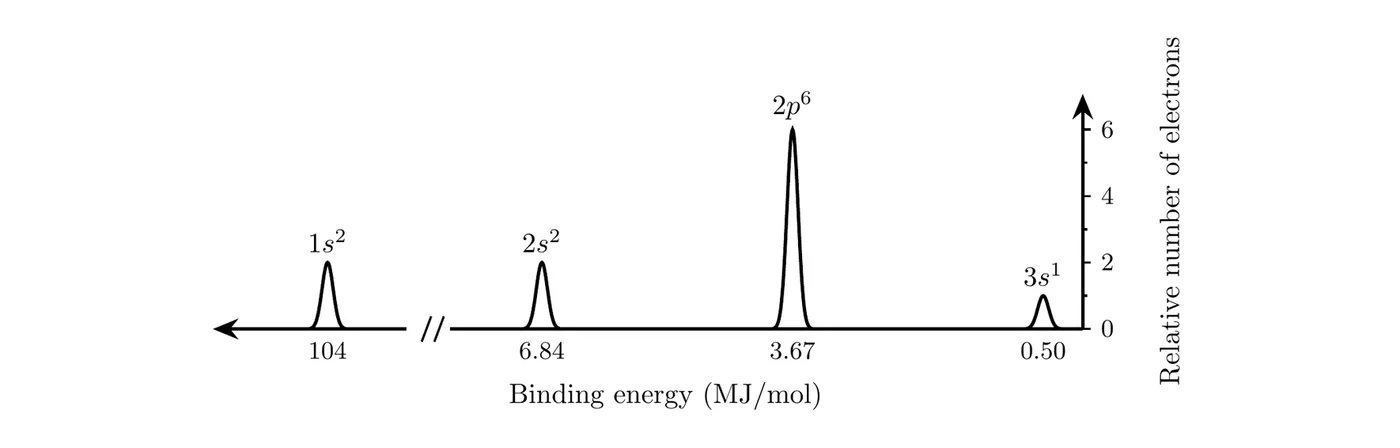
- Horizontal axis: binding energy, usually in MJ/mol. Most AP spectra put higher energy on the left, so always check the axis. The break marks (//) mean part of the axis is skipped, because inner electrons need far more energy than outer ones.
- Vertical axis: relative number of electrons (the strength of the signal).
- Each peak is one subshell.
- The position of a peak is the energy needed to remove an electron from that subshell. The farther left, the more tightly the electrons are held.
- The height of a peak is (ideally) proportional to the number of electrons in that subshell.
For sodium, four peaks mean four occupied subshells. Reading from the highest binding energy to the lowest gives the configuration in order:
Binding energy (MJ/mol) | Relative height | Subshell |
104 | 2 | |
6.84 | 2 | |
3.67 | 6 | |
0.50 | 1 |
So the spectrum shows . The peak at 0.50 MJ/mol is sodium's first ionization energy (about 496 kJ/mol), since that is the easiest electron to remove.
The binding energies on this page are rounded values of the kind AP questions give, and inner-shell values differ a little from one source to another. Read them as approximate: what matters is the order of the peaks and their relative heights, not the exact numbers.
Going the other way works too. To predict a spectrum from a configuration, draw one peak per subshell, make each height proportional to its electrons, and put farthest left. The order from left to right is , , , , , and so on. For transition metals, the peak sits to the left of the peak, which fits the fact that electrons are removed first when those metals form ions (1.5).
What the peaks say about electrons and the nucleus
Within one atom
- Inner electrons are held far more tightly. Sodium's electrons need 104 MJ/mol, while its electron needs only 0.50 MJ/mol: the electrons take 208 times as much energy. The electrons are close to the nucleus and feel almost all of its +11 charge. The electron is far away and shielded by 10 core electrons.
- Within a shell, electrons are held a bit more tightly than electrons. In sodium, is at 6.84 MJ/mol and at 3.67 MJ/mol. The electrons spend more time close to the nucleus, so they feel more of its charge.
- PES is evidence for subshells. The second shell gives two separate peaks, not one. A model in which every electron in a shell has the same energy can't explain that, but the shell and subshell model can.
Between different atoms
More protons pull harder on every electron. Neon has 10 protons and sodium has 11, and both have inside. Each of sodium's , , and peaks sits to the left of neon's (the dashed lines mark neon's peak positions).
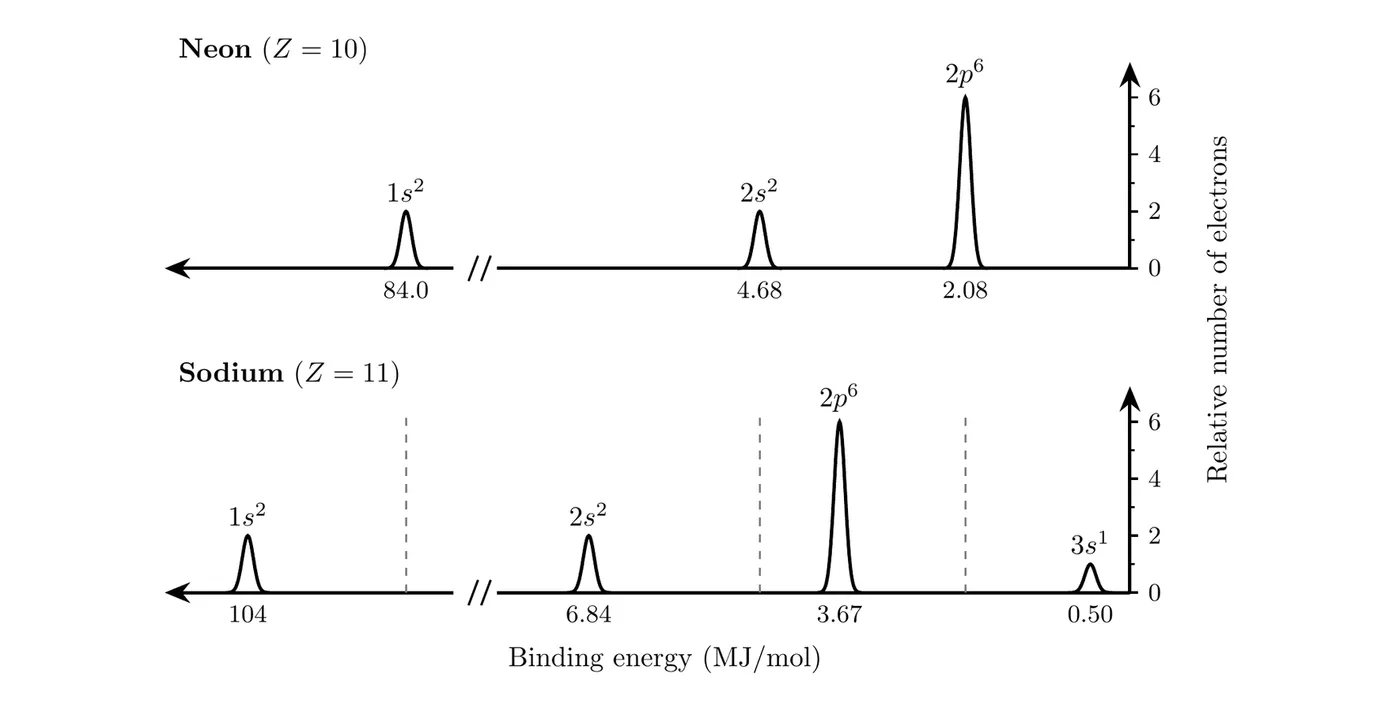
Subshell | Neon, (MJ/mol) | Sodium, (MJ/mol) |
84.0 | 104 | |
4.68 | 6.84 | |
2.08 | 3.67 | |
none | 0.50 |
Sodium's new peak is small (1 electron) and far to the right, because it is the first electron in a new, farther shell, with 10 core electrons shielding it.
Ions
The same rules apply to ions. and Ne both have , so their spectra have three peaks with the same heights (2, 2, and 6). But has only 9 protons, so each of its peaks is at a lower binding energy (farther right) than neon's. A spectrum of has no peak at all.
Example 1: Identifying an element from its spectrum
The photoelectron spectrum of a neutral atom is shown. Identify the element and write its electron configuration.
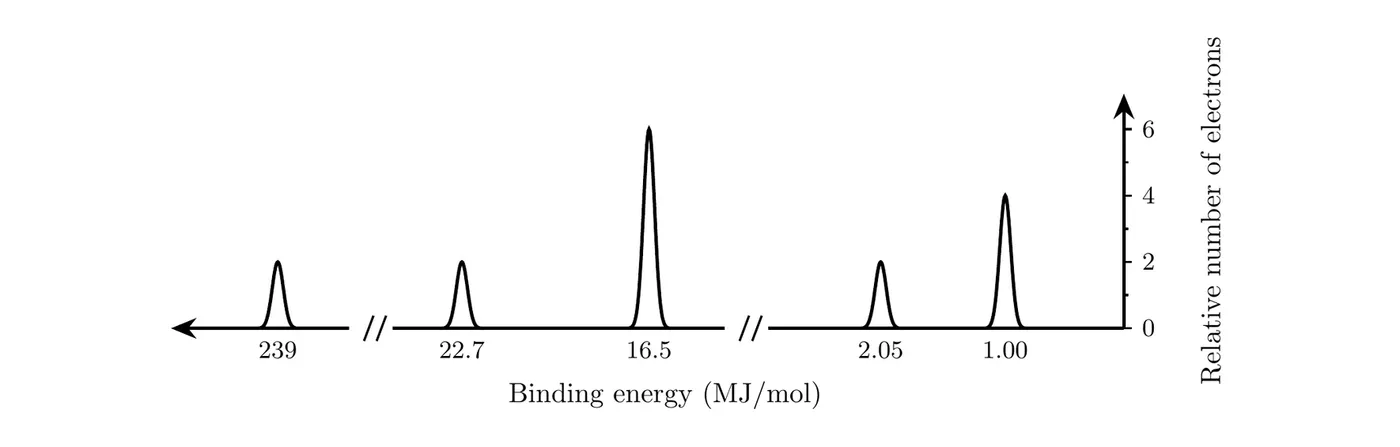
Step 1: Count the peaks. There are five peaks, so five subshells: from left to right, , , , , and .
Step 2: Read the heights. The relative heights are 2, 2, 6, 2, and 4.
Step 3: Build the configuration and count.
A neutral atom with 16 electrons has 16 protons, so .
Answer: The element is sulfur, . As a check, the rightmost peak (1.00 MJ/mol, or 1000 kJ/mol) matches sulfur's first ionization energy.
Example 2: Comparing sodium and magnesium (AP-style)
The binding energies in the photoelectron spectrum of magnesium are 126, 9.07, 5.31, and 0.74 MJ/mol. Sodium's are 104, 6.84, 3.67, and 0.50 MJ/mol. (a) Which peak in magnesium's spectrum is twice as tall as the matching peak in sodium's? (b) Explain why magnesium's peak is at a higher binding energy than sodium's. (c) Explain why magnesium's peak is at a higher binding energy than sodium's, even though both are in shell 3.
(a) Magnesium is and sodium is . The peak (0.74 MJ/mol) is twice as tall as sodium's peak, because it represents 2 electrons instead of 1.
(b) Magnesium has 12 protons and sodium has 11. The electrons in both atoms are in the first shell, about the same distance from the nucleus, so the larger nuclear charge in magnesium attracts them more strongly (Coulomb's law). More energy is needed to remove them: 126 MJ/mol versus 104 MJ/mol.
(c) In both atoms the electrons are shielded by the same 10 core electrons, so for magnesium and for sodium. Same shell, larger effective nuclear charge, stronger attraction: magnesium's electrons need more energy to remove (0.74 MJ/mol versus 0.50 MJ/mol).
Example 3: Predicting the spectrum of an ion
How would the photoelectron spectrum of compare with the spectrum of an argon atom?
Same peaks: has electrons, the same as argon, and both are . Both spectra have five peaks with relative heights 2, 2, 6, 2, and 6.
Different positions: has 17 protons and argon has 18. Each electron is attracted by a smaller nuclear charge, so every peak in the spectrum is at a lower binding energy (shifted right) compared with the matching argon peak.
Example 4: Does the evidence support the model? (AP-style)
A student claims that all electrons in the same shell have the same energy. Use neon's photoelectron spectrum (binding energies 84.0, 4.68, and 2.08 MJ/mol, with relative heights 2, 2, and 6) to evaluate the claim.
Evidence: Neon has 8 electrons in shell 2, but they show up as two peaks at different energies, 4.68 MJ/mol (height 2) and 2.08 MJ/mol (height 6).
Answer: The spectrum does not support the claim. If all eight electrons had the same energy, there would be one peak 4 times as tall as the peak. Instead, the two peaks with a 2 to 6 height ratio match a subshell with 2 electrons and a subshell with 6 electrons, so the subshell model is consistent with the data.
Common mistakes
- Reading the axis backward. Check whether binding energy increases to the left or to the right before you start.
- Mixing up height and position. Height tells you how many electrons; position tells you how much energy it takes to remove one.
- Measuring distances between peaks across an axis break (//). The axis isn't to scale there.
- Confusing binding energy with the electron's energy. A peak with a low binding energy belongs to an electron that is easy to remove: an outer electron, not an inner one.
- Explaining a peak shift with only “more protons” or only “farther away”. Say which one changes (or both) and connect it to Coulomb's law.