

1.10 - Energy Flow and the 10% Rule
Learning Objectives
The objective is determining how the amount of available energy decreases as it flows through an ecosystem. The associated skill is calculating accurate answers with appropriate units.
The Second Law of Thermodynamics: Energy Loss
The Conservation of Energy (First Law of Thermodynamics) says energy is never destroyed, but the flow of energy through ecosystems is governed by the Second Law of Thermodynamics.
The Second Law says that every time energy is transferred from one form to another, such as from chemical energy in a plant to chemical energy in an animal, a significant portion of that energy is lost as unusable heat to the surrounding environment.
When an organism consumes another:
- The consumed organism has already used the majority of the original energy for its own survival and maintenance.
- That “used” energy went toward necessary processes like movement, development, and cellular respiration (metabolism).
- The energy used for those processes is given off as heat, which makes it unavailable to the organism at the next trophic level.
The 10% Rule
The 10% Rule is a guiding principle in ecology that quantifies the energy efficiency of ecosystems.
- Only about 10% of the energy from one trophic level transfers to the next.
- The remaining 90% is lost as heat while the original organism uses it to fuel its survival processes.
- Where the 90% goes: most is used for cellular respiration and given off as heat. The rest is never eaten (roots, bones, fur) or passes through as waste (feces). That unused energy goes to decomposers, which also release it as heat in the end. Either way, it doesn't reach the next level.
- 10% is an average: real transfer efficiencies range from about 5% to 20%. Cold-blooded animals like insects and fish pass on more of their energy than birds and mammals, which burn a lot of energy keeping their bodies warm.
Because available energy decreases sharply with each upward step, energy flow is typically drawn as a pyramid.
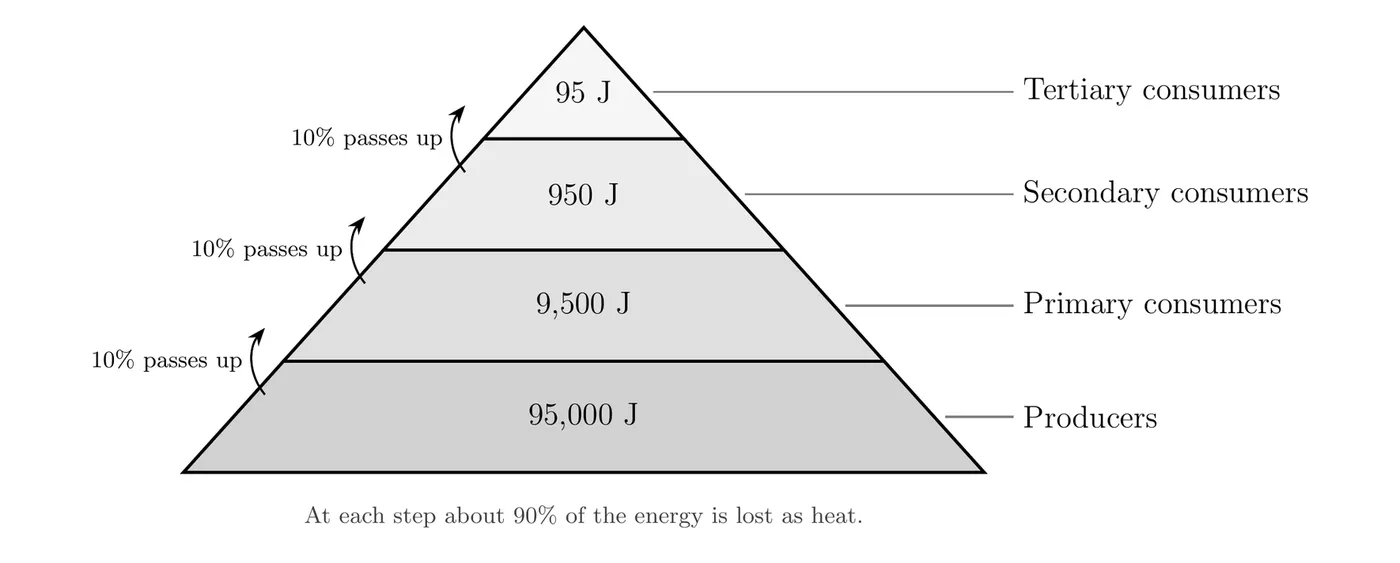
- The producer level (the base) is the widest because it contains the maximum amount of energy available.
- Each level above narrows as the usable energy decreases.
Applying the 10% Rule to Biomass
The 10% rule also determines the total mass of organisms an ecosystem can support.
- Biomass is the total mass of all living things at a specific trophic level.
- Since energy is required for growth and development, the total biomass that can be supported at the next level is directly limited by the energy transferred.
- So only about 10% of the biomass can be supported at each successive trophic level.
This is why, in any given ecosystem, there are significantly more plants (producers) than any type of consumer. For instance, 1,000 kilograms of producers can only support about 100 kg of primary consumers.
Energy pyramids are never upside down, but biomass pyramids can be. In the open ocean, phytoplankton reproduce so fast and get eaten so quickly that, at any one moment, the total mass of zooplankton can be larger than the mass of phytoplankton. The biomass pyramid is inverted, but the energy pyramid is still right side up, because over a year the phytoplankton still produce far more energy than the zooplankton take in.
Calculations Using the 10% Rule
Applying the 10% rule is straightforward when calculating energy flow up the pyramid.
To find the energy available to the next trophic level up, move the decimal place one spot to the left, or divide the current energy value by ten.
- If producers have , primary consumers receive .
- Secondary consumers would then receive .
- Tertiary consumers would receive .
The same calculation applies when determining biomass up the pyramid.
To calculate the energy or biomass supported at a lower trophic level, you do the reverse: move the decimal place one spot to the right, or multiply the current value by ten.
- If a secondary consumer level supports , the primary consumer level must support .
- The producer level must support .
Exam-Style Calculations With Units
On the FRQ, show your setup, carry the units through every step, and give the final answer with units.
Example 1 (from NPP to a higher level): a 3 ha prairie has an NPP of 2,400 (the worked example in 1.8). About how much energy per year reaches the secondary consumers?
Producers to primary consumers is one 10% step, and primary to secondary consumers is a second, so multiply by 0.10 twice.
Example 2 (finding the transfer efficiency): in a pond, the primary consumers take in 12,000 and the secondary consumers take in 900 . What percent of the energy was transferred?
That's a little below 10%, which is normal, since real transfer efficiencies vary.
Example 3 (why eating lower on the food chain feeds more people): a field grows corn with 1,000,000 kcal of food energy. If people eat the corn, they get all 1,000,000 kcal. If the corn is fed to cattle and people eat the beef, the 10% rule gives about kcal, so the same land feeds only about a tenth as many people. Real cattle do even worse, since only a few percent of feed calories end up as beef (see 5.7).