

1.7 - The Hydrologic (Water) Cycle
Learning Objectives
The main objective is explaining the steps and interactions between reservoirs in the hydrologic cycle. We’ll also examine the relationships between environmental concepts using visual models.
Overview and Driving Force
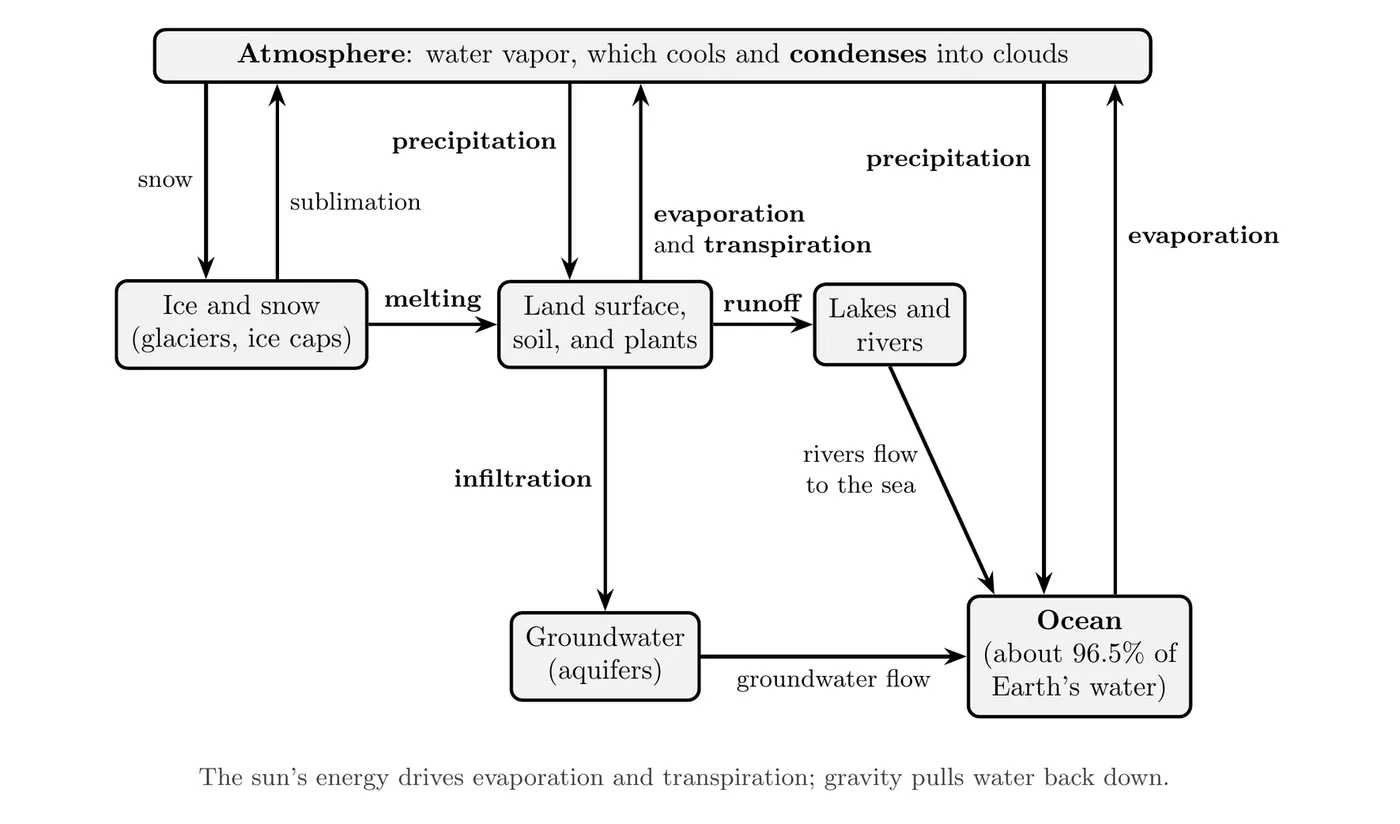
The hydrologic cycle describes how water moves in different states (solid, liquid, or gas) between sources and reservoirs.
The Driving Force
The entire hydrologic cycle is fundamentally driven by energy from the sun.
- Solar energy warms bodies of water, which causes water at the surface to heat up and turn into a gas.
- The sun also drives evaporation from the soil and transpiration from plants.
Key Water Reservoirs
When analyzing water movement, it’s essential to identify the state of the water and the reservoir it’s leaving versus the reservoir it’s entering.
- The largest reservoir of water on Earth is the ocean.
- However, the ocean contains salt water, which humans can’t use for drinking or agriculture.
- The key freshwater sources are much smaller reservoirs, including polar ice caps, glaciers on mountains, and groundwater (aquifers). These are crucial for human consumption and agricultural use.
- By the numbers: about 96.5% of Earth's water is in the oceans. Only about 2.5% is fresh water, and most of that is hard to reach: about 69% of fresh water is frozen in ice caps and glaciers and about 30% is groundwater. Lakes, rivers, and other surface fresh water are only about 1.2% of all fresh water (USGS).
Reservoirs also differ in how long water stays in them, called its residence time. Bigger, slower reservoirs hold water much longer (these are rough averages, and estimates vary):
Reservoir | Typical residence time |
Atmosphere | About 9 days |
Rivers | Days to months |
Lakes | Months to centuries |
Groundwater | Days to more than 10,000 years (deeper is older) |
Oceans | About 3,000 years |
Antarctic ice sheet | Thousands to hundreds of thousands of years |
So water pumped from a deep well can be thousands of years old, while rain is water that evaporated only a week or two earlier.
Key Processes of the Water Cycle
1. Evaporation and Evapotranspiration (Liquid to Gas)
These processes transform water from liquid form on Earth’s surface into vapor (gas) that enters the atmosphere.
- Evaporation: Liquid water changes directly into gas vapor, typically from the surface of soil or bodies of water.
- Transpiration: This specialized process happens when plants draw water up from the ground through their roots.
- Plants use small pores in their leaves, called stomata, to open and let water vapor evaporate thanks to the sun’s energy.
- That loss of water from the leaf creates a low pressure system, which pulls more water up from the roots and stem to replace what evaporated.
- Evapotranspiration: This term represents the total amount of water leaving an entire ecosystem, adding up water lost through both transpiration and surface evaporation.
2. Precipitation (Gas to Liquid)
Precipitation is where water moves from gas form in the atmosphere, condensed in clouds, and falls back to Earth’s surface as a liquid (rain).
- The reservoir being left is the atmosphere.
- The reservoir being entered is Earth’s surface, where the water becomes either surface water or groundwater.
- Condensation comes first: as water vapor rises, it cools. Cooler air can't hold as much vapor, so the vapor condenses onto tiny particles of dust, salt, or smoke and forms the droplets that make up clouds. When droplets or ice crystals grow heavy enough, they fall as rain, snow, sleet, or hail.
3. Runoff and Infiltration (Movement on the Ground)
When precipitation hits the surface, it follows one of two critical paths.
Process | Definition / Movement | Reservoir Outcome | Drawbacks and Factors |
Runoff (surface runoff) | Water flows across Earth’s surface until it reaches a body of water. | Recharges surface bodies of water like lakes, rivers, and ponds, which are vital for human use. | This water gathers pollutants along the way and carries them into surface waters. |
Infiltration | Water slowly trickles or soaks into the ground to recharge underground water stores called aquifers. | Recharges groundwater, which is especially important in dry regions where wells are used. | Requires permeable ground cover like grass and soil to let water soak through. Impermeable surfaces like pavement restrict infiltration and increase runoff. |
4. Ice and Snow (The Solid Phase)
Water also spends time as a solid, which works like a slow release reservoir.
- Storage: snow and ice lock water up for months (seasonal snowpack) to thousands of years (glaciers and ice sheets).
- Melting: snowmelt in spring and summer feeds rivers right when farms and cities need water. California's Sierra Nevada snowpack supplies about 30% of the state's water in an average year (California Department of Water Resources).
- Sublimation: ice and snow can turn straight into water vapor without melting first, especially in dry, sunny, windy places like high mountains.
Human Impacts on the Water Cycle
- Pavement and development: impermeable surfaces cut infiltration and increase runoff, which means more flooding, more polluted runoff, and less groundwater recharge (see the table above and 5.10).
- Deforestation: cutting forests reduces transpiration, so less water vapor goes back into the air and less rain falls downwind. A large share of the Amazon's rain is water its own trees transpired, so clearing the forest can dry out the region.
- Pumping groundwater: when wells pull water out faster than infiltration refills an aquifer, the water table drops. Parts of the Ogallala Aquifer under the Great Plains have dropped more than 100 feet since heavy irrigation began.
- Warming: warmer air holds about 7% more water vapor for each 1°C of warming, so climate change speeds up evaporation and makes heavy downpours and droughts more intense.
Big picture: The sun acts as the powerful external engine driving the water cycle. It powers the lift mechanism (evaporation and transpiration) that carries water vapor up to the clouds, and gravity then controls the return journey (precipitation). Once the water lands, the quality of the soil determines whether it flows quickly back to the surface tanks (runoff) or slowly filters into the deep storage accounts (infiltration into aquifers).