

1.5 - The Nitrogen Cycle
Learning Objectives
The main focus is explaining the steps and reservoir interactions within the nitrogen cycle. The associated skill is explaining relationships between different characteristics of environmental concepts, often using visual models.
Overview and Key Differences
The nitrogen cycle involves the continuous movement of nitrogen molecules through sources, sinks, and reservoirs.
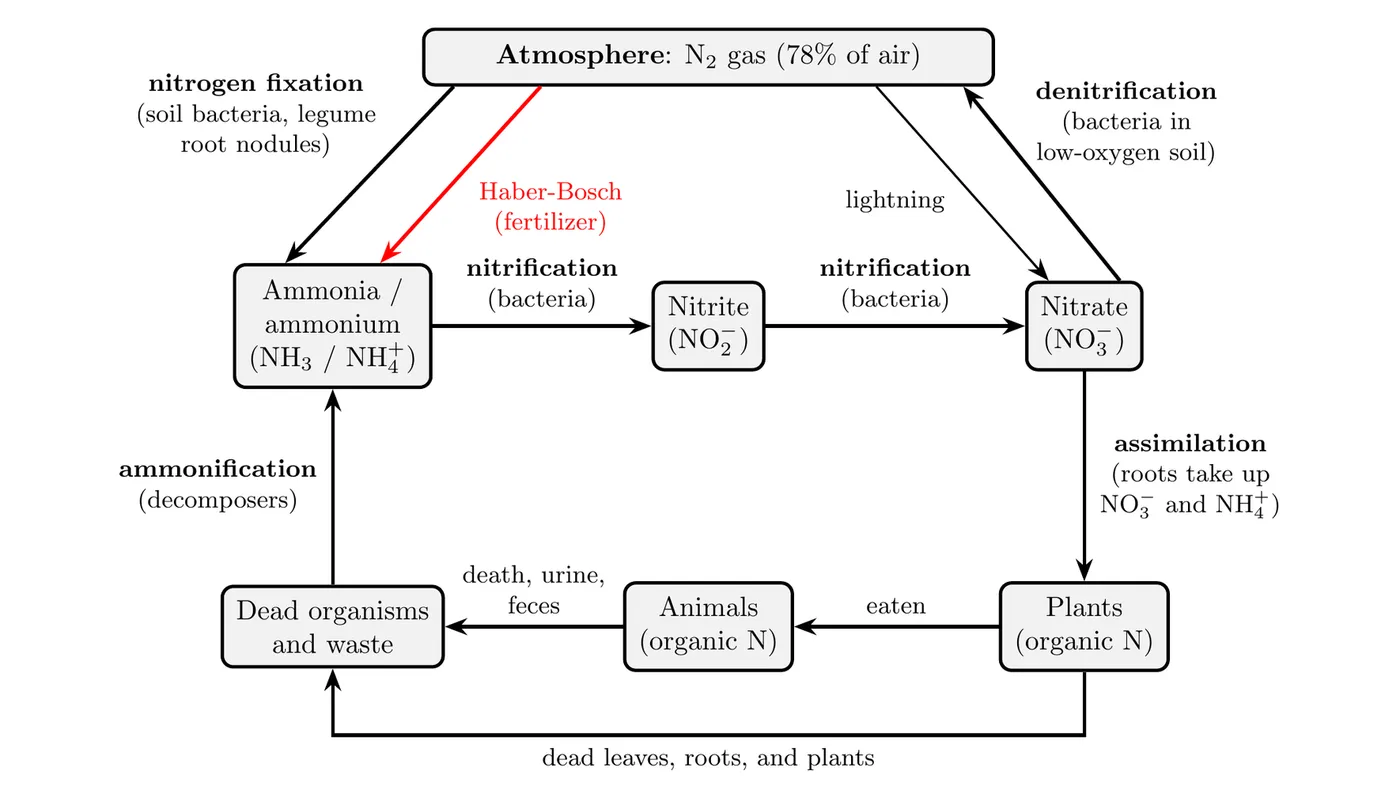
A Short Term Cycle
A major distinction between the nitrogen cycle and the carbon cycle is how long storage lasts.
- Carbon cycle: Reservoirs like sedimentary rocks and fossil fuels can hold carbon for millions of years.
- Nitrogen cycle: Nitrogen reservoirs, such as the soil or living plants, hold nitrogen for a relatively short period. Plants only store nitrogen while they’re alive. Once they die, the nitrogen is quickly returned to the soil and taken up again by other plants for growth.
Reservoirs and the Usability Problem
- Atmosphere: The atmosphere is the biggest reservoir of nitrogen, making up about 78% of its composition.
- The problem: Almost all atmospheric nitrogen exists as gas, which plants and animals can’t use.
- Limiting nutrient: Nitrogen is a key limiting nutrient because all living organisms need it to create DNA and the amino acids that build structural proteins. Since it’s crucial for life but largely unusable in its atmospheric form, specialized processes have to occur to make it available.
- Fixation sets the limit: the main natural way new usable nitrogen enters an ecosystem is fixation (mostly by bacteria), and fixation is slow, so the soil holds little ammonium and nitrate. That makes nitrogen the factor that limits how fast producers can grow (primary productivity, 1.8) in many ecosystems. A limiting nutrient is the one in shortest supply compared to what organisms need, so adding more of it boosts growth, while adding other nutrients doesn't. That's why farmers add nitrogen fertilizer, or rotate corn with soybeans, a legume whose bacteria add nitrogen to the soil.
The Steps of the Nitrogen Cycle
1. Nitrogen Fixation (The Most Critical Step)
Nitrogen fixation is the conversion of unusable gas from the atmosphere into a biologically usable form. Nitrogen-fixing bacteria turn into ammonia (). In the soil, ammonia quickly picks up a hydrogen ion and becomes ammonium (), which plants can absorb. This is the first and most critical step for supporting life on Earth.
Fixation can happen naturally or synthetically.
- Natural fixation:
- Nitrogen fixing bacteria: The primary natural method. Some bacteria live freely in the soil, while others, like Rhizobium, live in a mutualistic symbiotic relationship () in the root nodules of certain plants called legumes, like peas, beans, soybeans, clover, and alfalfa. The bacteria fix nitrogen for the plant, and in return the plant gives the bacteria sugars from photosynthesis and a protected place to live. In water, cyanobacteria fix nitrogen too.
- Lightning storms: The energy in lightning splits and forms nitrogen oxides, which dissolve in rain and reach the soil as nitrate (). This adds only a small amount compared to bacteria.
- Synthetic fixation (industrial process): The Haber-Bosch process combines from the air with hydrogen (usually from natural gas) at high temperature and pressure to make ammonia: . It takes a lot of energy, mostly from burning fossil fuels. The ammonia is made into synthetic fertilizers (like urea and ammonium nitrate) that increase agricultural yields. Human activity, mostly fertilizer, has roughly doubled the amount of fixed nitrogen entering land ecosystems each year.
2. Assimilation
Assimilation is the process where nitrogen is taken in and incorporated into the body structure of living organisms.
- Plants: Plants directly assimilate nitrogen by using their roots to take in nitrates or ammonium from the soil. Plants are the key assimilators.
- Animals: Animals get their nitrogen by eating plants, or by eating other animals that have eaten plants.
3. Ammonification
Ammonification is carried out by soil bacteria, microbes, and decomposers. They convert waste products like animal urine and feces, plus dead organisms (dead biomass), back into ammonia (), which returns to the soil. This step recycles nitrogen from biological matter back into the soil.
4. Nitrification
Soil bacteria convert ammonium () into nitrite (), and then into the plant usable form, nitrate (). Bacteria are critical to almost every step of the nitrogen cycle.
5. Denitrification
Denitrification is the conversion of soil nitrogen, specifically nitrate, back into a gas form. Denitrifying bacteria carry this out in low-oxygen places like waterlogged soils, wetlands, and lake bottoms, where they use nitrate in place of oxygen. Most of the nitrogen leaves as gas, completing the cycle, but some leaves as nitrous oxide (), a greenhouse gas.
Human Impacts on the Nitrogen Cycle
Human activities, mostly driven by agriculture, significantly disrupt the balance of the nitrogen cycle.
- Greenhouse gas contribution: The release of nitrous oxide through denitrification has a climate impact, because is a greenhouse gas that traps heat in the atmosphere. This release is especially common in agricultural soils that are tilled or over irrigated and waterlogged.
- Each kilogram of traps about 270 times as much heat as a kilogram of over 100 years (IPCC, 2021), and agriculture is the largest human source.
- Ammonia volatilization and acid rain: When farmers apply too much synthetic fertilizer, the excess can lead to ammonia gas entering the atmosphere.
- That ammonia comes back down in rain and dust (nitrogen deposition). In the soil, bacteria turn the ammonium into nitrate (nitrification), a step that releases acid, so ammonia pollution acidifies soil and over-fertilizes nearby forests and waters. Ammonia itself is a base; the nitrogen in acid rain mostly comes from nitrogen oxides released by burning fossil fuels (see 7.7).
- Ammonia gas can also combine with other pollutants and irritate human respiratory tracts. This loss of nitrogen also means lost profits for farmers.
- Leaching and eutrophication:
- Leaching: Excessive application of nitrates from synthetic fertilizers leaves more nitrates in the soil than it can hold. Rainwater or irrigation water then carries the excess nitrates right out of the soil.
- Eutrophication: That agricultural runoff, loaded with excess nitrogen, enters local water bodies like streams and lakes. The extra nitrogen acts as a massive fuel source for aggressive algae growth, causing algae to cover the water’s surface. The algae layer blocks sunlight from reaching aquatic plants below, which eventually kills them.
Big picture: The nitrogen cycle is often seen as Earth’s natural purification plant. The atmosphere holds all the raw material (), but specialized bacterial “engineers” have to fix and process it into usable forms. When humans override this system by dumping excessive synthetic fertilizers, it’s like overwhelming the purification plant with raw sewage. The system breaks down, leading to pollution (leaching and eutrophication) and damaging emissions ( greenhouse gas release).