

1.9 - Trophic Levels
Learning Objectives
The central objective is explaining how both energy and matter flow through different organizational ranks within an ecosystem, meaning trophic levels. The accompanying skill is explaining an environmental concept or process.
Foundational Laws of Ecosystem Flow
Before tracking energy through trophic levels, two essential conservation laws need to be understood.
- Conservation of Matter: Matter is never created or destroyed, it only changes form. This principle shows up across all biogeochemical cycles: water, carbon, nitrogen, and phosphorus. When a tree dies, its carbon, nitrogen, and other materials are conserved. They return to the atmosphere, soil, or decomposers, just transforming into different chemical states.
- Conservation of Energy (First Law of Thermodynamics): Energy is never created or destroyed, it’s only transformed into a new form. You can see this when sunlight (light energy) is converted into sugar (chemical energy) during photosynthesis. When an animal consumes a plant, the chemical energy in the glucose transfers to the animal, where it fuels growth (muscle and fat tissue) or movement.
Energy flows, matter cycles. These two laws lead to the key difference between energy and matter in an ecosystem:
- Matter cycles: the same carbon, nitrogen, phosphorus, and water atoms get used over and over. Decomposers return them to the soil, water, and air, where producers take them up again (1.4 to 1.7).
- Energy flows one way: energy enters as sunlight, moves up through the trophic levels, and leaves as heat. Heat can't be turned back into food energy, so energy is never recycled. Every ecosystem needs a continuous inflow of high-quality energy (concentrated, usable energy like sunlight or the chemical energy in food) to keep running. That energy powers the work that moves matter through the biogeochemical cycles: plants growing, animals eating, and decomposers breaking things down. If the sunlight stopped, the cycles would stop too.
Defining Trophic Levels
The term “trophic” means growth or nourishment. Trophic levels represent the feeding hierarchy within an ecosystem, showing the sequential flow of energy from the source (sunlight) to various organisms.
Since the amount of usable energy decreases at each upward step, this hierarchy is typically drawn as a pyramid. The base is the widest because it contains the most energy, and each level above gets narrower.
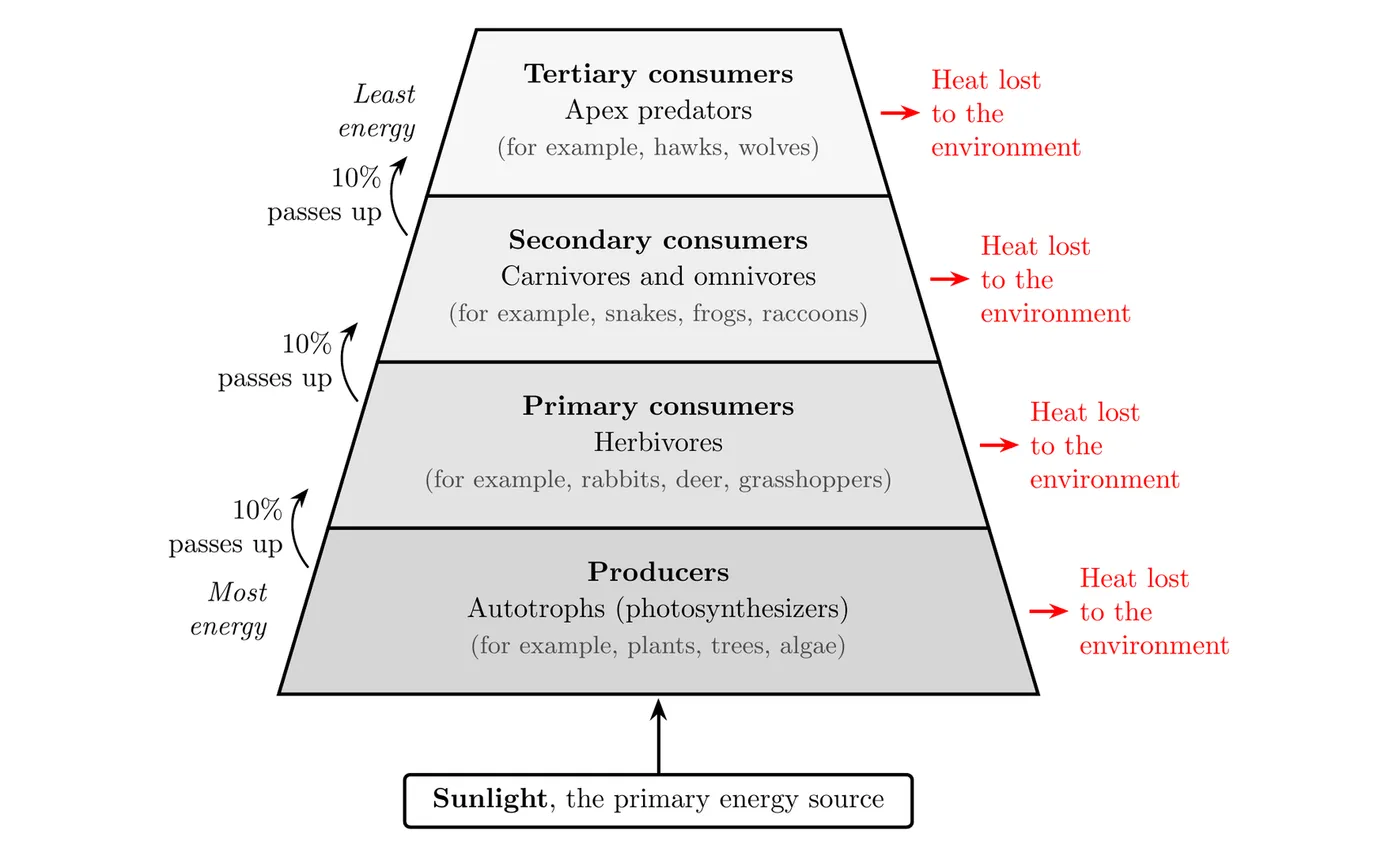
The Trophic Hierarchy
There are four primary levels in the trophic pyramid.
Trophic Level | Organism Role / Definition | Primary Energy Source |
Producers (base) | The plants that form the foundation of the ecosystem. They convert light energy into chemical energy (glucose) through photosynthesis, creating the usable energy supply. | Sunlight (light energy) |
Primary Consumers | Animals that consume producers to gain energy. Also known as herbivores. | Producers (plants) |
Secondary Consumers | Animals that consume primary consumers. They’re categorized as carnivores (meat eaters) or omnivores (eaters of both plants and meat). An omnivore like a raccoon or blue jay can belong to multiple trophic levels because it feeds on both producers and primary consumers. | Primary consumers, and sometimes producers |
Tertiary Consumers | The top or apex predators in the ecosystem. They get their energy by feeding on secondary consumers. | Secondary consumers |
Where the sun isn't the source: energy flows from the sun to producers in terrestrial and near-surface marine communities. The deep ocean gets no sunlight. At hydrothermal vents (first found in 1977 on the Galápagos Rift), bacteria use the chemical energy in hydrogen sulfide from the vents to make food, a process called chemosynthesis. These bacteria are the producers, and giant tube worms, clams, and crabs depend on them.
Energy Transfer Between Levels
When energy transfers from one organism to the next, say from a leaf to a rabbit, not all of it is conserved as usable biomass in the next level.
- The organism that was eaten already used a majority of the stored energy for its own survival, including movement, cellular respiration (metabolism), and development.
- The Second Law of Thermodynamics explains this energy loss. Every time energy is converted from one form to another, some of it is released as unusable heat to the surrounding environment. That heat isn’t destroyed, but it’s no longer helpful energy that the next organism in the chain can capture and use.
Big picture: You can visualize trophic levels like a pyramid shaped corporate structure dedicated to gathering and processing energy. The vast base (producers) are the primary workers converting raw solar resources into products (glucose). The managers (primary consumers) and executives (secondary and tertiary consumers) rely on the level below them, but each higher level is smaller because the energy is partially spent, or lost as heat, before it ever makes it up the chain.