

1.11 - Food Chains and Food Webs
Learning Objectives
The primary objective is describing food chains and food webs and identifying the members of these systems based on their trophic levels. The corresponding skill is describing a characteristic of an environmental concept using a visual model.
Energy and Matter Flow
Food webs and food chains are models used to illustrate how both matter and energy flow through an ecosystem from one organism to another.
Direction of Flow
- Energy and matter consistently flow from the prey to the predator.
- Even when an herbivore consumes a plant, that counts as a form of predation, because the herbivore is using the plant as its energy source.
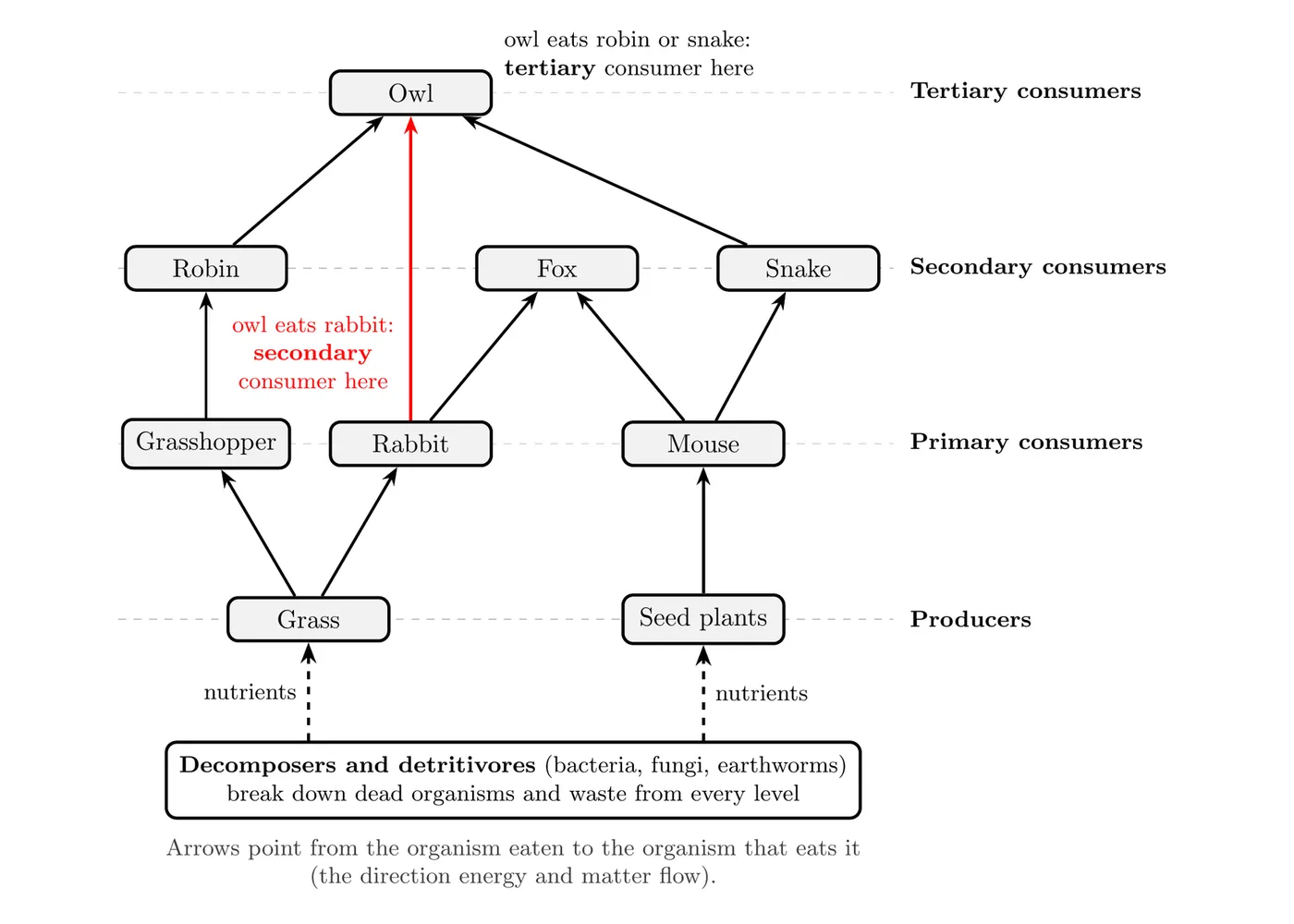
- Arrows in a food chain or web show the direction of this flow. The arrow points at the organism that is taking in the energy and matter (like nitrogen and phosphorus), which it uses for movement or growth.
Distinguishing Chains from Webs
Concept | Definition | Key Characteristics |
Food Chain | A simple, linear, single pathway showing the flow of matter and energy from one organism to the next. | Example: Grass → Rabbit → Fox. |
Food Web | A more complex structure made of at least two connected food chains. | The chains have to be connected by one common organism. Food webs don’t have to be incredibly complex. |
Who's Who in a Food Chain
- Producers (autotrophs): make their own food, usually by photosynthesis. Grass, trees, and phytoplankton.
- Primary consumers (herbivores): eat producers. Rabbits, grasshoppers, zooplankton.
- Secondary and tertiary consumers (carnivores and omnivores): eat other consumers. Snakes, foxes, and hawks, plus omnivores like bears and humans, which eat both plants and animals.
- Heterotrophs: all consumers are heterotrophs. They can't make their own food, so they get energy and matter by eating other organisms.
Detritivores and Decomposers
Every food chain ends with organisms that break down the dead. Without them, nutrients would stay locked in dead bodies and waste, and producers would run out.
- Detritivores: animals that eat detritus (dead organic matter like fallen leaves, dead animals, and waste) and break it into smaller pieces. Earthworms, millipedes, and dung beetles.
- Decomposers: mostly bacteria and fungi. They release enzymes that break organic matter down chemically into simple inorganic nutrients like ammonium and phosphate (ammonification in 1.5 is their work).
- Why they matter: detritivores and decomposers return nutrients to the soil, where producers take them up again. That's how matter cycles while energy flows one way. They feed on dead matter from every trophic level, so food web diagrams often show them off to the side, with arrows coming in from every level.
Trophic Level Flexibility
Food webs are especially helpful because they let us visualize how a single organism can occupy two different trophic levels in the same ecosystem.
- An owl is a secondary consumer if it eats a rabbit, which is a primary consumer.
- That same owl would be a tertiary consumer if it eats a robin, which is a secondary consumer.
Trophic Cascades
Food webs are excellent tools for understanding interactions between species and how a change in the population size of one species can impact others.
A trophic cascade describes the ripple effect that moves down through the trophic levels below a top predator when there’s a dramatic increase or decrease in that predator’s population size.
Example of a trophic cascade after the loss of a top predator:
- A top predator, like the wolf, is lost.
- That leads to a dramatic increase in the prey population, like deer, because they have no predator keeping their numbers in check.
- The increase in herbivores then leads to a dramatic decrease in the plants they eat.
- This loss of vegetation is often called defoliation.
- The resulting ecosystem may have much less ground cover, trees with fewer leaves, or trees that die off, which impacts many other organisms that rely on those plants for habitat or food.
Feedback Loops in Food Webs
When a population changes, the effect travels through the food web and can come back around to affect the original population. That's a feedback loop.
- Negative feedback (stabilizing): the response pushes the population back toward where it started. Predators and prey are the classic case: more snowshoe hares lead to more lynx, more lynx eat more hares, fewer hares lead to fewer lynx, and fewer lynx let the hares recover (3.4 walks through this cycle). Negative feedback keeps both populations within a range instead of exploding or crashing for good.
- Positive feedback (amplifying): the response pushes the change even further in the same direction. When grazing animals overgraze a dry grassland, the bare soil erodes and dries out, so even fewer plants grow back. The grazers crowd onto the plants that are left and eat those down too, and the land can turn to desert. The dead zone loop in 1.6 (more dead algae, more decomposers, less oxygen, more deaths) is another example.
Real Examples: Removing or Adding a Species
- Removing a species, then adding it back (Yellowstone wolves): by 1926, wolves had been wiped out of Yellowstone National Park. Without them, elk browsed heavily on young willows and aspen along streams. In 1995 and 1996, 31 wolves from Canada were released in the park. Elk numbers fell, willows began recovering in some areas, and beavers gained habitat. Scientists still debate how much of the plant recovery came from wolves versus other causes (like human hunting of elk, more bears, and drought), so on an FRQ, describe wolves as one cause that contributed to the change.
- Adding a species (brown tree snakes on Guam): brown tree snakes reached Guam in the late 1940s or early 1950s, probably as stowaways in military cargo. With few natural predators there, they wiped out 10 of the island's 12 native forest bird species. Without birds eating them, spiders boomed: one study found about 40 times more spiders in Guam's forests in the wet season than on nearby islands that still have birds. Losing the birds also means fewer seeds get spread, which slows forest regrowth.
Big picture: A food web acts like a complex roadmap showing all the paths energy can take in an environment. A food chain is just one straight street on that map, and a trophic cascade is what happens when one major traffic light (a top predator) fails, creating a chain reaction of jams and shortages all the way down the smaller side streets (the lower trophic levels).