

1.6 - The Phosphorus Cycle
Learning Objectives
The main goal is explaining the steps and the interactions between reservoirs in the phosphorus cycle. The accompanying skill is explaining relationships between different characteristics of environmental concepts using visual models.
Basics and Unique Characteristics
The phosphorus cycle involves the transit of phosphorus containing elements between sources and sinks.
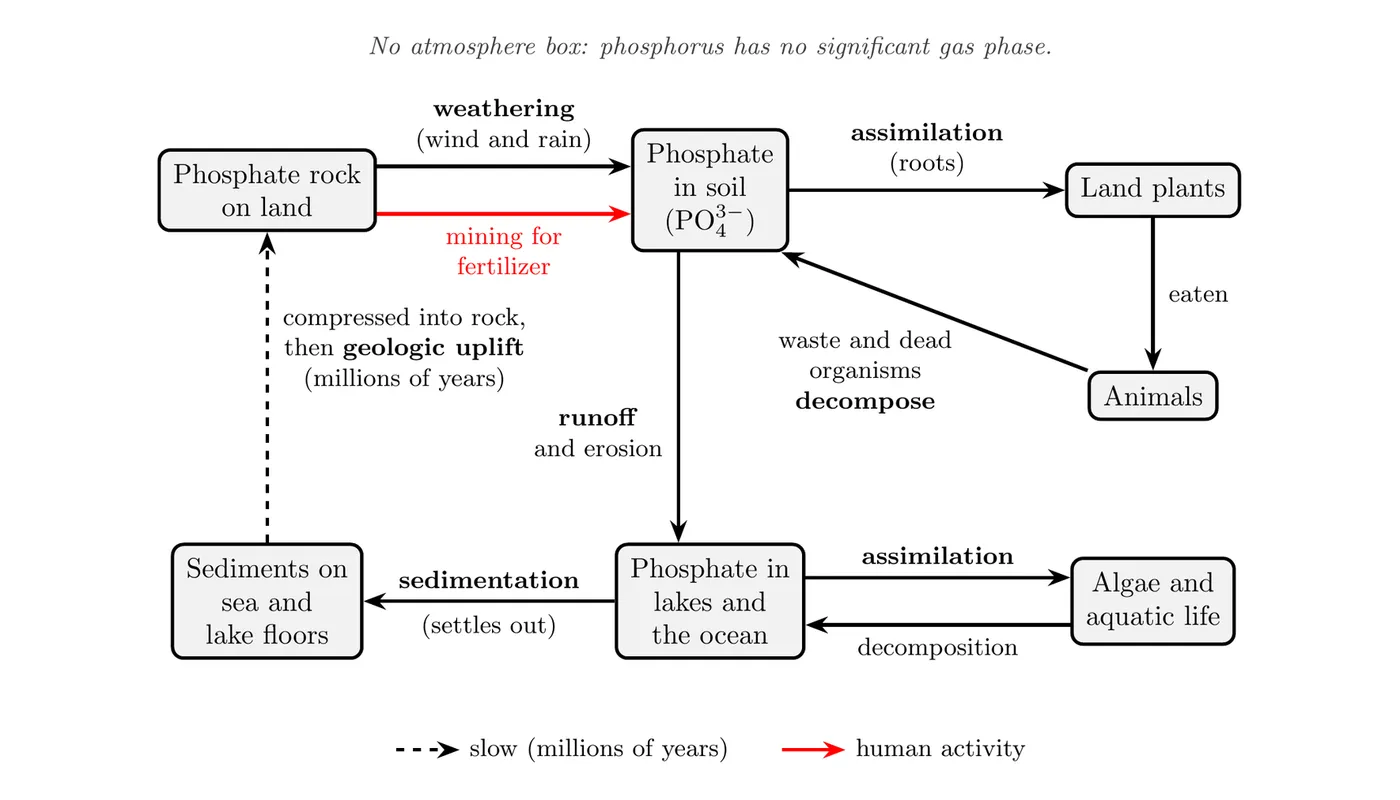
A Geologically Slow Cycle
The phosphorus cycle is distinct because it’s extremely slow compared to both the nitrogen and carbon cycles.
- No gas phase: Phosphorus has no significant gas form, so its cycle lacks a significant atmospheric step. Phosphorus moves as phosphate (), either dissolved in water or stuck to soil particles and sediments, plus a small amount carried as dust by the wind. That movement is far slower than the atmospheric movement of or in the other cycles.
- Real example of dust: wind carries dust from the Sahara across the Atlantic Ocean, and it drops about 22,000 tons of phosphorus on the Amazon rainforest each year, roughly what the Amazon loses to rain and floods (NASA satellite study, 2015). Even this route through the air moves solid particles, not a gas.
- Limiting nutrient: Because phosphorus is released from its main reservoirs so slowly, it’s often a limiting nutrient in ecosystems. Plant growth ends up dependent on the limited amount of phosphorus available.
- Freshwater proof (Lake 226): in 1973, scientists at Canada's Experimental Lakes Area divided Lake 226 in Ontario in half with a plastic curtain. Both halves got carbon and nitrogen, but only one got phosphorus. By the end of that summer, the half with phosphorus was covered in an algal bloom and the other half wasn't. This showed phosphorus was the limiting nutrient in that lake and helped lead to limits on phosphorus in sewage and detergents.
Importance of Phosphorus
Phosphorus is essential for all life. It’s a key element required for:
- ATP: It forms part of adenosine triphosphate (ATP), the primary energy source for every living thing.
- DNA: It’s a key structural component of DNA.
- Bones and teeth: For many animals, phosphorus provides strength to bones and the enamel in teeth.
Major Reservoirs and Sources
The two main reservoirs of phosphorus are rocks and phosphorus containing sediments. These reservoirs release phosphorus very slowly.
Source Type | Process | Details |
Natural Source | Weathering | The primary natural source is the breakdown of phosphorus containing rocks by wind and rain, which releases phosphate. The phosphate dissolves in rainwater and washes into soil (terrestrial ecosystems) or water bodies (aquatic ecosystems). |
Synthetic / Human Source | Mining and Manufacturing | Humans mine phosphate containing rocks. Phosphates then get added to products like synthetic fertilizers, or household items like detergents and cleaners. |
In the US, phosphates were removed from laundry detergents by the mid-1990s and from most dishwasher detergents in 2010 because they were feeding algae blooms. Today fertilizer, manure, and sewage are the main sources of phosphorus pollution.
Short Term Biological Cycling
Like the nitrogen cycle, there’s a mini loop between living organisms and the soil.
- Assimilation: Plants take in phosphorus by absorbing phosphates from the soil through their roots and incorporating it into plant tissues. Animals then assimilate phosphorus by eating those plants or by eating other animals.
- Excretion and decomposition: Phosphorus returns to the soil when animals excrete waste, or when dead organic matter is broken down by soil bacteria and decomposers. That completes the short term loop.
Long Term Geological Cycling
The slowest parts of the cycle involve the removal and re-exposure of phosphorus from geological formations.
- Sedimentation: Phosphate doesn’t dissolve particularly well in water. If the water holds too much, the excess precipitates out to form solid phosphate sediments at the bottom of the body of water. The formation of these sediments is sedimentation.
- Compression: Over long time scales, the weight of newer sediment layers piled on top compresses these phosphate containing sediments into sedimentary rock. Rock that is rich in phosphate is called phosphate rock, and it's what humans mine for fertilizer.
- Geological uplift: Tectonic plates colliding force these deep, compressed rock layers up to the surface, forming mountains. That uplift exposes the rock to wind and rain, which starts the weathering process and restarts the cycle.
Human Impact: Eutrophication
The greatest impact humans have on the phosphorus cycle, often in combination with the nitrogen cycle, is causing eutrophication.
- Cause: Eutrophication, meaning “excess nutrients,” occurs when water bodies receive too much nitrogen and phosphorus from sources like agricultural runoff (synthetic fertilizers) or contaminated human and animal waste.
- Algae bloom: The sudden availability of these normally limited nutrients causes aggressive algae growth, an algae bloom, that blankets the surface of the water.
- Sunlight blockage: That surface layer of algae prevents sunlight from reaching aquatic plants below, which kills them.
- Oxygen depletion (the dead zone):
- When the algae and dead plants die, bacteria and decomposers break them down.
- Decomposition is an aerobic process, so the bacteria have to consume dissolved oxygen (DO) in the water.
- That loss of oxygen kills other oxygen dependent aquatic organisms, especially larger fish.
- This creates a positive feedback loop. More deaths lead to more decomposition, which uses up more oxygen, which leads to more deaths, accelerating the whole process.
- The final result is a dead zone, a body of water with oxygen levels so low that virtually no life can be supported.
- Real example, Lake Erie: phosphorus washing off farm fields in the Maumee River watershed feeds large algal blooms in western Lake Erie most summers. Some of these cyanobacteria make a liver toxin called microcystin. In August 2014, the toxin got into the water supply of Toledo, Ohio, and about 400,000 people were told not to drink their tap water for about three days.
Big picture: The phosphorus cycle functions like a vast, geological conveyor belt. Weathering of mountains acts as the slow loading dock, gradually releasing solid parcels of phosphate. Once in the water, it cycles quickly between living things, but eventually gravity pulls it to the seafloor, where it waits for tectonic plates (the slow uplift machinery) to shove the rock back to the surface millions of years later. That’s why there’s no rapid, immediate cycling into the atmosphere.