

1.4 - The Carbon Cycle
Learning Objectives
The central objective is explaining the steps and reservoir interactions within the carbon cycle. That means understanding the movement of carbon molecules between sources and sinks. The core skill is explaining relationships between characteristics of environmental concepts, often using visual models.
Carbon Cycle Overview
The carbon cycle describes the movement of carbon containing molecules through Earth’s systems, including , glucose, and methane ().
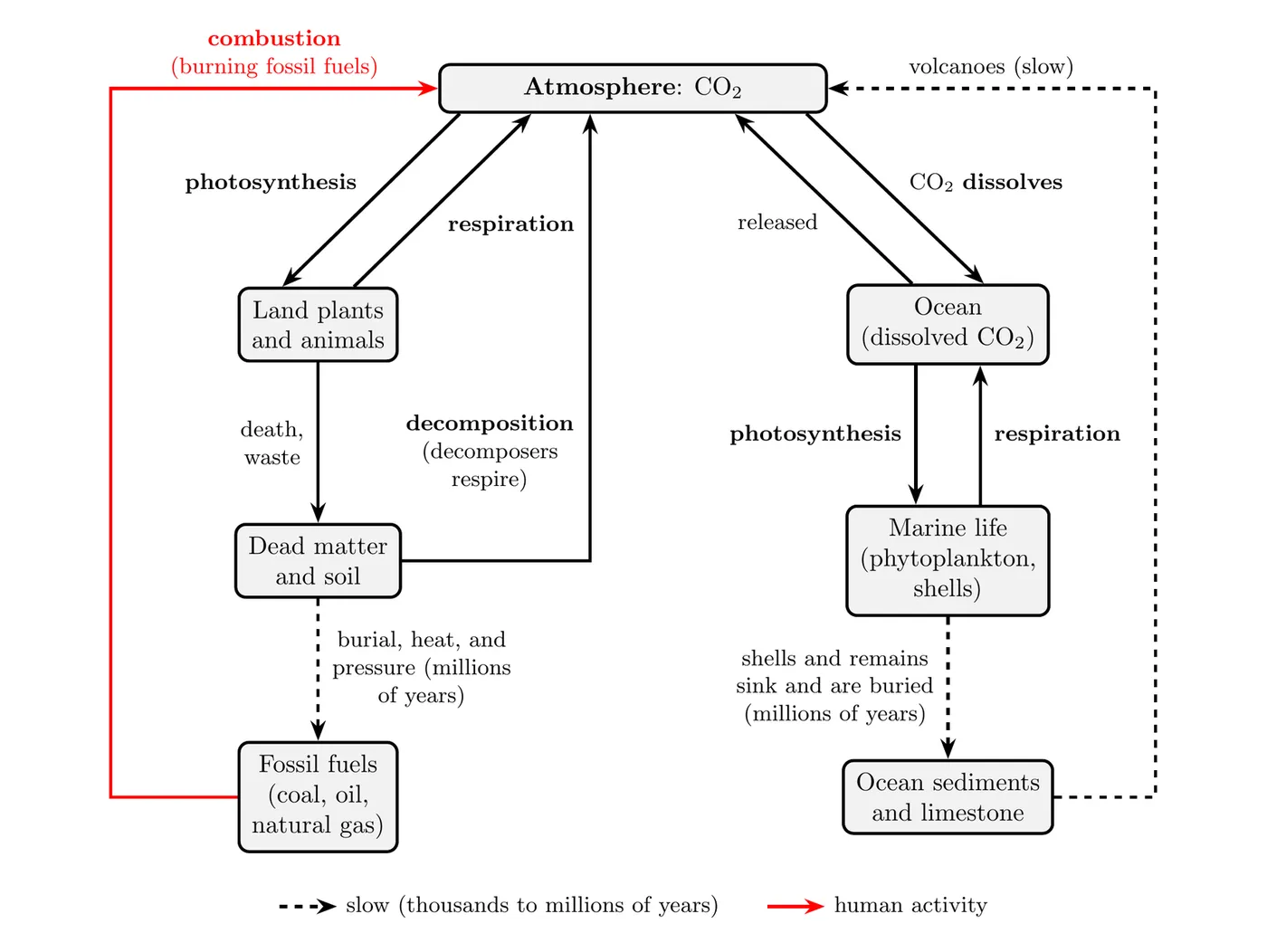
Reservoirs and Time Scales
Carbon is stored in various reservoirs, and the speed at which carbon moves into and out of them matters a lot.
- Quick steps: Processes like the combustion of fossil fuels happen rapidly.
- Slow steps: Processes like sedimentation and burial of organic matter, followed by compression into fossil fuels or sedimentary rock, take a very long time, sometimes millions of years.
- Long term reservoirs: Geological features like sedimentary rock (mainly limestone, made of calcium carbonate from shells and coral) and fossil fuels (coal, oil, natural gas) store carbon for millions of years. Sedimentary rock is the largest carbon reservoir on Earth.
- Reservoir sizes: after rock, the next largest store is the ocean (mostly the deep ocean, as dissolved carbon), which holds roughly 40 to 50 times as much carbon as the atmosphere. Soils hold more carbon than all living plants. The atmosphere is much smaller than the ocean, soil, and rock reservoirs, which is why adding carbon to it changes the climate so quickly.
Carbon Sources vs. Carbon Sinks
Feature | Carbon Sink | Carbon Source |
Definition | A reservoir that stores more carbon than it releases. | A process that releases more carbon than it stores. |
Atmospheric Effect | Removes carbon from the atmosphere, helping reduce the effects of climate change. | Adds carbon to the atmosphere, increasing the concentration of . |
Examples | Plants (photosynthesis), soil (stored organic matter), algae (photosynthesis), ocean sediments, and marine shells (calcium carbonate). | Fossil fuel combustion (oil, coal, natural gas), deforestation, and animal agriculture, which releases methane, a greenhouse gas. |
Short Term Cycling: Photosynthesis and Respiration
Carbon cycles back and forth quickly in a short term loop between living organisms through two biological processes.
Photosynthesis (A Carbon Sink)
- Carried out by plants, algae, and phytoplankton.
- Organisms remove carbon dioxide from the atmosphere and convert it into glucose, an organic, biological form of carbon.
- Glucose stores energy and serves as a storage molecule. As plants like trees grow, they continually incorporate more carbon into their structures, such as roots and bark.
The overall reaction (carbon moves from gas into glucose):
Cellular Respiration (A Carbon Source)
- Performed by all living things.
- Organisms break down glucose using oxygen to release energy, which fuels growth or movement.
- The process releases carbon dioxide into the atmosphere.
- Note that cellular respiration is not the same as breathing. Breathing is just the physical act of pulling air into the lungs.
The overall reaction is photosynthesis run in reverse:
Balance of the Short Term Cycle
Photosynthesis and cellular respiration are very fast and typically balance each other out. The animals produce during respiration is immediately taken back in by plants for photosynthesis. The result is no net increase in atmospheric carbon dioxide from this loop alone.
Real data: you can see this loop in the air. At NOAA's Mauna Loa Observatory in Hawaii, drops each Northern Hemisphere summer, when plants are growing and photosynthesis outpaces respiration, and rises each fall and winter, when leaves drop and respiration and decomposition win out. The yearly average still climbs because of fossil fuel burning: it was 427.35 ppm in 2025, about 53% higher than the roughly 280 ppm before the Industrial Revolution (NOAA data, as of 2026).
Ocean and Atmosphere Exchange
Carbon moves directly between the atmosphere and the ocean through a process called direct exchange. gas can dissolve into the ocean and move back out into the atmosphere.
- This exchange is usually quick and happens in roughly equal directions, so the amounts of in the ocean and atmosphere stay balanced.
- Consequence of imbalance: When human activity increases the concentration in the atmosphere, direct exchange causes levels in the ocean to increase too. That makes the ocean more acidic, a process known as ocean acidification, which harms marine organisms.
- The ocean as a sink: the ocean absorbs roughly a quarter or more of the that humans release each year (Global Carbon Project, 2025). That slows climate change, but it's also what drives ocean acidification.
Long Term Cycling: Burial, Extraction, and Combustion
The movement of carbon into and out of geological sinks dictates the long term balance of the cycle.
- Sedimentation and burial: When marine organisms like coral, shellfish, and plankton die, their shells and remains sink and pile up on the seafloor as sediments. Over thousands to millions of years, more layers pile on top, and their weight compresses the layers below. Calcium carbonate shells become sedimentary rock like limestone. Organic matter that gets buried without oxygen (so it can't fully decompose) is slowly changed by heat and pressure into fossil fuels: coal from ancient swamp plants, and oil and natural gas mostly from marine plankton. Burial is a slow, geological process that stores carbon underground.
- Extraction and combustion: Extraction means digging up fossil fuels through mining. Combustion is burning those fossil fuels for energy, like burning gasoline in a car. This releases large amounts of into the atmosphere very quickly.
The Problem of Imbalance
The fundamental problem facing the carbon cycle is the mismatch in rates between carbon removal and carbon release.
- Fossil fuels take millions of years to form, which is a very slow process.
- Humans are extracting and combusting those fossil fuels, releasing carbon to the atmosphere far faster than slow geological processes can remove and store it.
- Scale: burning fossil fuels released a record of about 38 billion tonnes of in 2025 (Global Carbon Project estimate, November 2025). Land and ocean sinks take up only about half of what humans emit, so the rest builds up in the atmosphere.
- That imbalance increases carbon dioxide concentration in the atmosphere, which raises the global temperature and causes global warming, or climate change.
Big picture: The Earth’s carbon cycle operates like a giant, slow moving savings account (the geological reservoirs), naturally depositing carbon slowly over millions of years. When humans extract and burn fossil fuels, it’s like withdrawing millions of years of savings in a few decades, which causes an immediate, massive cash flow problem (excess ) in the atmospheric bank account.