

4.2 - Soil Formation and Erosion
Learning Objectives
The central objective is to describe the characteristics and formation of soils.
What is Soil?
Soil is a mix of geological (rock-based) and organic components, meaning things that come from living things or things that were once living.
Components of Soil
1. Inorganic (Geological) Components:
- Sand, silt, and clay are the three main rock particles.
- Minerals and nutrients, like nitrates, ammonium, phosphates, potassium, phosphorus, and magnesium.
2. Organic Components:
- Humus: The main organic component. It’s the dark, rich black substance that gives soil its characteristic color and smell. It’s made of broken down organic matter, including dead plants, dead leaves, animal waste, and even dead animals.
3. Air, Water, and Organisms:
- Water and Air: These fill the tiny pore spaces in the soil. Air matters because it contains the oxygen plant roots need.
- Living Organisms: Earthworms, fungi, bacteria, and other decomposers help recycle nutrients.
Four Key Roles of Soil in Ecosystems
- Supports Plant Growth: Soil anchors plant roots and provides the water and nutrients plants need, like nitrogen, potassium, phosphorus, and magnesium.
- Water Filtration: Soil is an important water filtration system. As rain percolates through, the pore spaces trap pollutants so clean water can pass through and recharge groundwater sources and aquifers.
- Nutrient Recycling: Decomposers like fungi and bacteria break down dead organic matter and return vital nutrients to the soil for new growth.
- Habitat: Soil is a valuable habitat for organisms like earthworms, fungi, bacteria, moles, and other mammals.
Soil Formation: Weathering and Erosion
Soil forms when parent material (the rock underlying the soil) is weathered, or broken down, and then the pieces are transported and deposited through erosion.
Weathering (Breakdown)
Weathering is the breakdown of rocks.
- Physical Weathering: Happens through wind and rain. It also includes water seeping into cracks and freezing, which makes it expand and break the rock open.
- Chemical Weathering: Happens through chemicals, like the acids in acid precipitation that break the rock down.
- Example: rainwater picks up from the air and becomes slightly acidic (carbonic acid), which slowly dissolves limestone. That’s how caves form. Oxygen reacting with iron in rock (rusting) also breaks rock down.
- Biological Weathering: Happens through things like tree roots growing into cracks in the rock and physically breaking it apart.
- Example: lichens growing on bare rock release acids that slowly eat into it, one of the first steps of primary succession (2.7).
Erosion (Transport and Deposition)
Erosion is the transport of the weathered pieces of rock.
* Rain or wind detaches the small bits of rock, transports them, and then deposits them somewhere else. Deposition is the final step of erosion.
* The continued weathering and erosion cycle, which deposits smaller and smaller bits of rock, is what ultimately forms soil.
Parent material doesn’t have to be the bedrock right underneath. It can also be sediment carried in from somewhere else and deposited: sand and mud dropped by rivers on floodplains (like the Mississippi River’s), silt blown in by the wind (the loess soils of Iowa and China’s Loess Plateau), or rock ground up and dropped by glaciers (much of the northern US).
Factors Affecting the Rate of Soil Formation
- Parent Material (Bedrock): Determines the soil’s pH and nutrient content. For example, limestone bedrock is helpful because it adds calcium and helps buffer acidic soil.
- Topography (Slope): If the slope is too steep, erosion is high, which hinders soil formation. If the ground is level, it allows for deposition, which speeds up formation.
- Climate:
- Temperature: Warmer areas break organic matter down into humus faster, which increases the formation rate. Colder areas slow biological activity and therefore slow soil formation.
- Precipitation: High rainfall can increase weathering and formation, but too much rain or wind can also increase erosion, which decreases the formation rate.
- Soil Organisms: The more active the decomposers (earthworms, fungi, bacteria), the faster the rate of soil formation, since they rapidly break down organic matter and build deeper humus.
- Time: Soil forms extremely slowly. The UN Food and Agriculture Organization (FAO) estimates it takes about 1,000 years to build just a few centimeters of topsoil. On a human timescale, topsoil that erodes away is basically gone for good.
Soil Horizons (Layers)
A soil profile, or set of horizons, is a cross-section showing the soil layers.
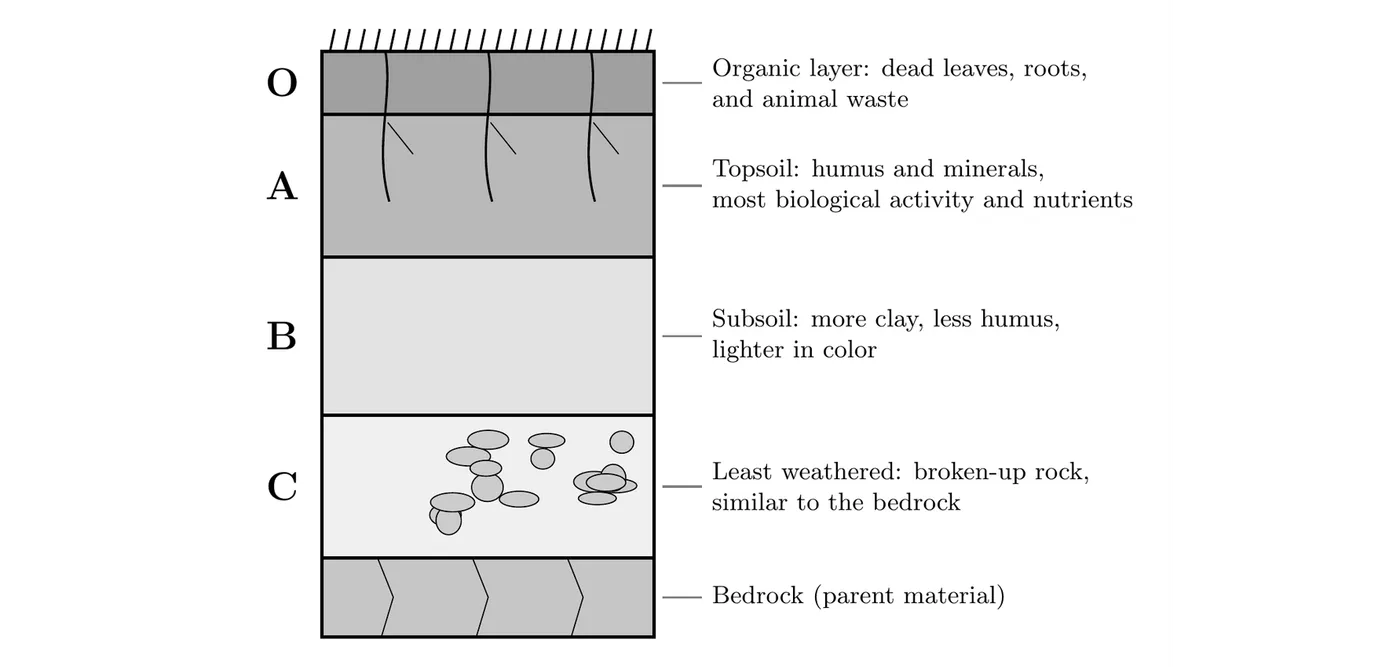
Horizon | Common Name | Composition and Characteristics |
O Horizon | Organic Layer | Shallow layer of dead organic material (leaves, roots, animal waste) sitting on top of the soil. Traps moisture and prevents evaporation. |
A Horizon | Topsoil | Mostly humus and minerals from the parent material. Houses most of the biological activity and holds the majority of the soil’s nutrients. |
B Horizon | Subsoil | Contains more clay and less humus, so it’s lighter in color. Has little to no organic matter, though it may contain some nutrients. |
C Horizon | Least Weathered | The least weathered, most intact rock layer. Similar to the bedrock. |
Some soils have extra layers. An E horizon (the zone of leaching) can sit between A and B, especially in forest soils: water soaking down carries dissolved minerals and clay out of it, leaving a pale, sandy layer. Those minerals pile up in the B horizon, which is why B is also called the zone of accumulation. The solid bedrock under the C horizon is called the R horizon.
So horizons are told apart by their composition and organic material: going down, organic matter, nutrients, and biological activity drop, while the pieces of rock get bigger and less weathered until you reach solid bedrock.
Soil Degradation
Soil degradation is the loss of the soil’s ability to support plant growth.
1. Loss of Topsoil
- Causes: Tilling, which is turning soil for agriculture, makes it easily eroded by wind and rain. Loss of stabilizing plant roots also makes soil prone to erosion.
- Effects: Decreased productivity, soil drying out as it loses the moisturizing organic layer, and the loss of nutrients along with the organisms that recycle them.
2. Compaction
- Causes: Compression of soil by heavy machinery like tractors and bulldozers, grazing livestock, or human foot traffic.
- Effects: Forces soil particles together and eliminates the pore space needed for holding water, like squeezing a sponge. The result is dry soil, which is more prone to erosion and supports less plant growth.
3. Nutrient Depletion: When crops are grown on the same soil year after year, they pull nutrients out. That makes the soil less productive and less able to support plants in the future.
Soil Erosion by Wind and Water
Erosion is part of how soil forms, but when it strips soil away faster than new soil forms, it’s a serious problem. Soils can be eroded by both water and wind.
- Water Erosion: Raindrops splash soil loose, and runoff carries it downhill, first in thin sheets, then in small channels called rills, then in deep gullies. Bare, plowed, or steep land loses the most.
- Wind Erosion: Wind picks up dry, loose, bare soil and blows it away. Example: the Dust Bowl of the 1930s. Farmers had plowed up the native prairie grasses of the Great Plains, and when a severe drought hit, the wind stripped the exposed topsoil and carried it hundreds of miles in giant dust storms.
- Soil Protects Water Quality: Healthy soil is a natural filter. As water soaks through it, soil particles (especially clay and humus) trap sediment, hold onto nutrients like phosphate, and bind some pollutants, while soil bacteria break other pollutants down. The water that reaches groundwater and streams comes out cleaner.
- Eroded Soil Pollutes Water: Once soil washes into a stream, it becomes a pollutant itself. Sediment clouds the water (blocking sunlight for aquatic plants and smothering fish eggs on the bottom), and it carries attached fertilizer and pesticides with it, which can feed algae blooms (eutrophication, 8.5).
- Protecting Soil Protects Water: Keeping the ground covered with plants or crop residue, planting windbreaks and riparian buffers, and farming with no-till, contour plowing, and terracing (5.15) all hold soil in place, so the soil stays on the land and the water stays clean.
Big picture
Soil formation is like a two-part construction project. Weathering is the demolition crew, breaking bedrock down into tiny fragments. Erosion is the transportation and dumping crew, moving those fragments and dead organic matter into place. The final structure is the soil profile, where the top layers (O and A horizons) act like the nutrient-rich penthouse suite, supporting the most life and activity. Compacting the soil is like smashing the foundation, eliminating the space needed to hold life-giving water.