

4.5 - Global Wind Patterns
Learning Objectives
The main objective is to explain the environmental factors that produce atmospheric circulation. Atmospheric circulation is determined by three basic factors: the intensity of energy from the sun, the properties of air (like density), and the spinning of the Earth on its axis, which causes the Coriolis effect. The associated skill is explaining relationships between characteristics of environmental concepts or models presented visually.
Factor 1: Properties of Air
How air’s density changes under different conditions is critical to atmospheric circulation.
Property | Effect | Explanation |
Density | Warm air is less dense than cold air, so warm air rises. | You can see this in homes where the attic is warmer than the basement. |
Moisture | Cold air holds less moisture than warm air. | This is why skin gets dry and cracked in the winter. |
Cooling | As warm air rises, it cools and expands. | Because the air cools, the water vapor in it has to condense into liquid, forming precipitation like rain, snow, or sleet. |
Sinking | After air has risen, cooled, and expanded, it eventually sinks back down to Earth. |
Factor 2: Solar Energy and Hadley Cells
Sunlight is the ultimate driver, making air warm and rise most intensely at the equator. This circulation forms a predictable pattern called a Hadley cell.
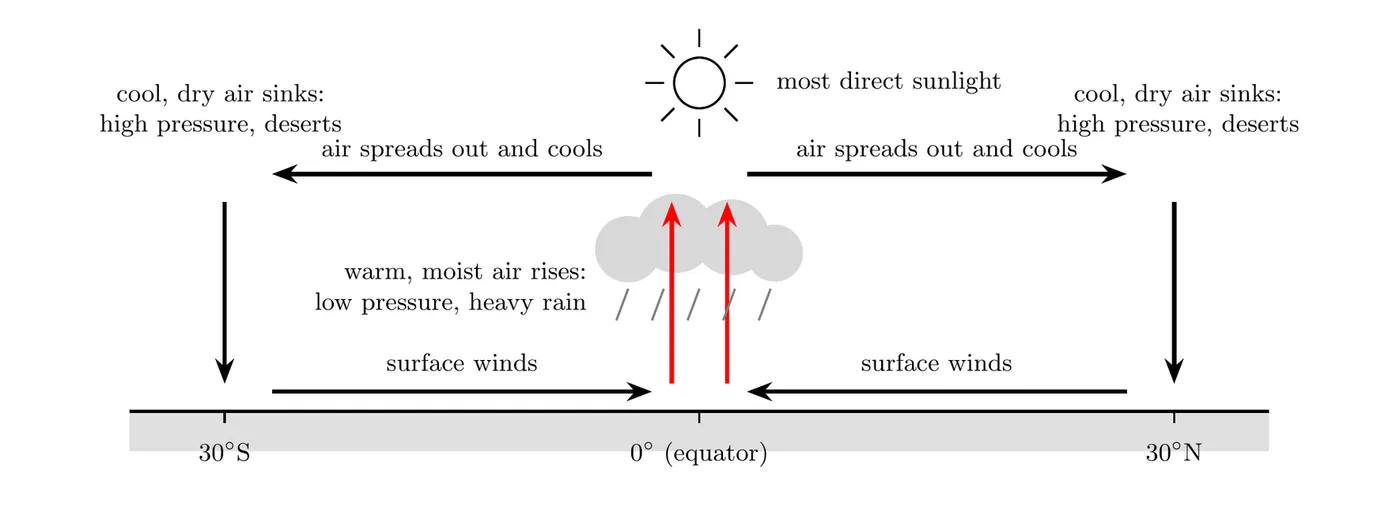
The Hadley Cell Cycle (0° to 30°)
1. Rising Air (Low Pressure): At the equator (0°), direct sunlight makes air warm and rise. That rising air creates an area of low pressure.
2. Intense Precipitation: As the warm air rises, it cools and the water vapor condenses, leading to intense rain at the equator.
3. Sinking Air (High Pressure): The air keeps rising, cooling, and expanding. Eventually the cool, dry air sinks back down to Earth right around 30 degrees North and South. That sinking column creates high pressure at 30 degrees.
4. Surface Wind Flow: Air moves along Earth’s surface from high pressure (30°) to low pressure (0°). This surface movement supplies the replacement air needed to keep the cycle going, filling the gap left by the air rising at the equator.
Result: Desert Formation
The cool, incredibly dry air descending at 30 degrees North and South explains why deserts predictably form globally at those latitudes.
As that air sinks, it gets squeezed by the higher pressure near the ground and warms up. Warmer air can hold more water vapor, so clouds can’t form and it almost never rains. That’s why the Sahara and Arabian deserts sit around 20° to 30°N, and the Kalahari and the Australian Outback sit around 20° to 30°S. Under the rising air at the equator, it’s the opposite: the Amazon, Congo, and Indonesian rainforests.
Factor 3: Earth’s Rotation and the Coriolis Effect
Earth’s rotation is the third factor. If the Earth were still, wind would just move straight north and south.
Deflection of Wind
- Definition: The Coriolis effect describes how Earth’s rotation causes objects traveling through the atmosphere, like wind, to be deflected.
- In the Northern Hemisphere, moving air gets deflected to the right. In the Southern Hemisphere, it gets deflected to the left. The effect is zero at the equator and strongest near the poles.
- Hadley Cell Winds (0° to 30°): Wind moving from 30° toward the equator gets deflected in the opposite direction of Earth’s spin. The result is winds moving from east to west. These are the Eastern trade winds, which historically helped drive trade ships and also drive the circulation of ocean currents.
- Mid-Latitude Winds (30° to 60°): Air also moves out from the high pressure at 30° toward the low pressure at 60°. Because the Earth spins much faster at 30° than at 60°, the air carries high momentum and gets deflected in the same direction as Earth’s spin. The result is winds blowing from west to east.
- Polar Winds (60° to 90°): Cold, dense air sinks at the poles (high pressure) and flows toward 60°, where it gets deflected into winds blowing from east to west, the polar easterlies. Where they meet the westerlies around 60°, the air is forced up (low pressure), which brings clouds, rain, and storms.
- Naming Winds: Winds are named for the direction they come from. The westerlies blow from west to east. The northeast trade winds blow from the northeast toward the southwest.
Putting It Together: Three Cells per Hemisphere
Each hemisphere has three loops of rising and sinking air, called cells. Where air rises, pressure is low and it’s rainy. Where air sinks, pressure is high and it’s dry.
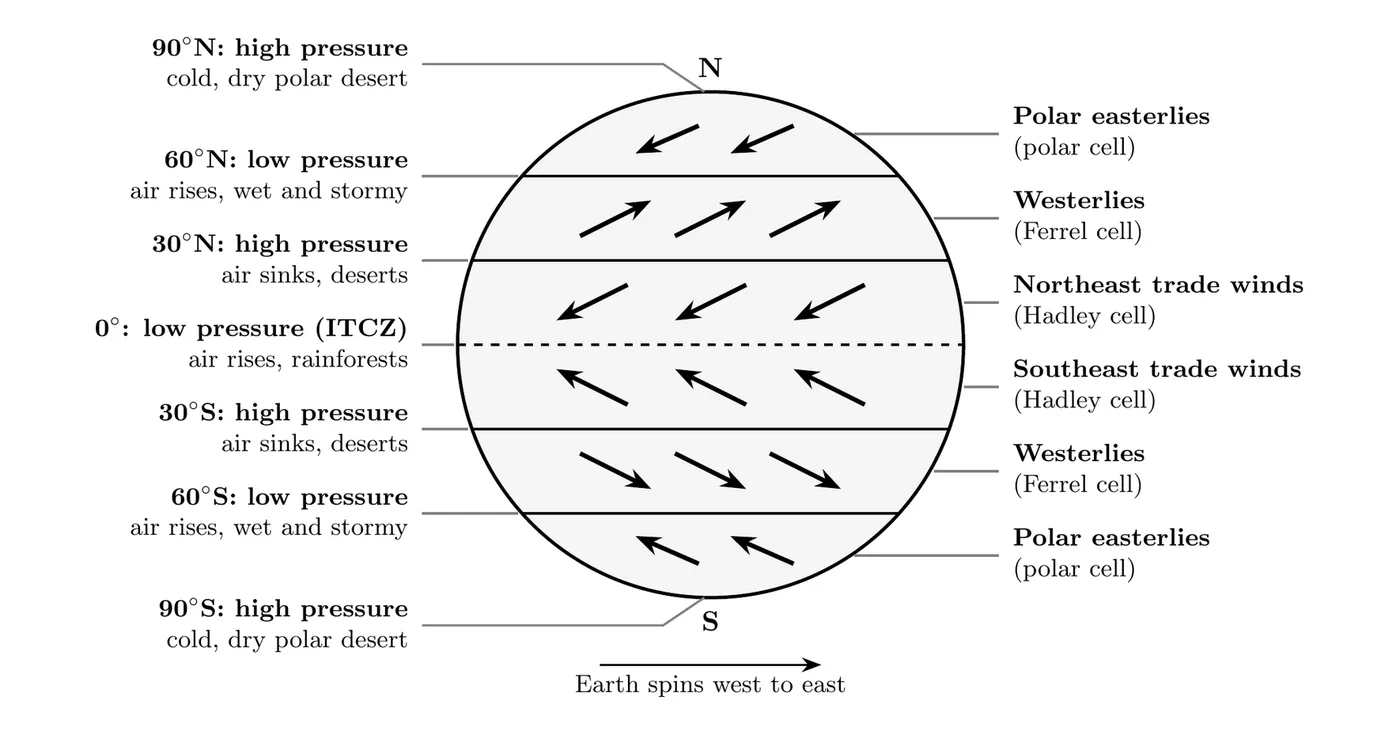
Latitude | Air | Pressure | Climate | Example |
0° (equator) | Rises | Low (the ITCZ, Intertropical Convergence Zone) | Hot and very rainy | Amazon and Congo rainforests |
30° N and S | Sinks | High | Dry | Sahara, Australian Outback |
60° N and S | Rises | Low | Cool, wet, and stormy | Southern Alaska, western Norway |
90° (poles) | Sinks | High | Cold and very dry | Antarctica, the largest desert on Earth |
- Hadley Cells (0° to 30°): The strongest cells, driven directly by heating at the equator. Surface winds: the trade winds.
- Ferrel Cells (30° to 60°): Air sinks at 30° and rises at 60°, turned like a gear between the other two cells. Surface winds: the westerlies.
- Polar Cells (60° to 90°): Air rises at 60°, flows toward the pole, and sinks there. Surface winds: the polar easterlies.
- The ITCZ Moves with the Seasons: The band of rising air follows the most direct sunlight, shifting north in June and south in December (4.7). That’s what gives places like the African savanna a rainy season and a dry season.
Global Wind Patterns and Weather
The deflection of winds in the mid-latitudes (30° to 60°) means North America experiences westerlies, or western prevailing winds.
- That means our weather moves from the western United States over to the eastern United States. To predict snow, for example, you’d look at the radar over places like Chicago and Wisconsin to see if their storms are heading east.