

4.7 - Solar Radiation and Earth’s Seasons
Learning Objectives
The main objective is to explain how the sun’s energy affects Earth’s surface. Key ideas: insolation depends on season and latitude, and the angle at which the sun’s rays strike Earth determines the intensity of solar radiation. The associated skill is describing characteristics of an environmental concept represented visually.
I. Insolation and Measurement
Insolation refers to the amount of solar radiation, or energy from the sun’s rays, that reaches an area.
- Measurement: Insolation is measured in watts per square meter ().
II. Factors Influencing Solar Intensity (Latitude)
Solar intensity is affected by latitude, the distance from the equator measured in degrees. Two main factors drive this.
A. Angle of the Sun’s Rays
1. Equator (0° Latitude): Higher solar intensity.
- Rays strike Earth at a perpendicular, more direct angle.
- The sunlight is concentrated over a smaller area.
2. Higher Latitudes (Poles): Much lower intensity.
- Rays strike Earth at a far more oblique angle.
- The same amount of sunlight is spread over a much larger area.
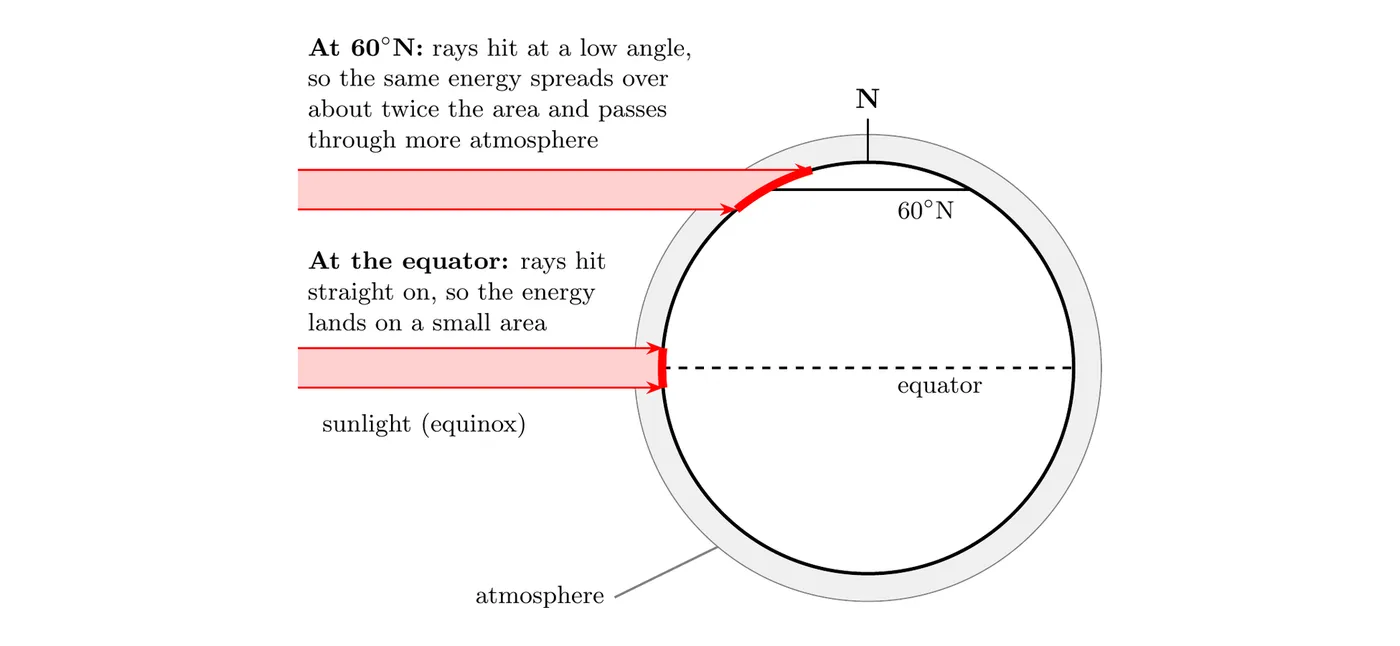
- How much weaker? At noon on an equinox, the sun is straight overhead at the equator, but at 60°N it’s only 30° above the horizon. At that angle, the same beam of sunlight covers twice as much ground, so each square meter gets only half the energy.
B. Amount of Atmosphere
1. Higher Latitudes: The sun’s rays have to pass through a much greater distance of Earth’s atmosphere.
- More energy gets absorbed or reflected by the atmosphere before it reaches the surface.
- Less insolation actually hits the surface.
2. Comparison: Averaged over the whole year, the top of the atmosphere above the equator receives about , while the poles receive only about , less than half as much. The longer path through the atmosphere at high latitudes cuts what reaches the ground even more.
III. Earth’s Tilt and Seasons
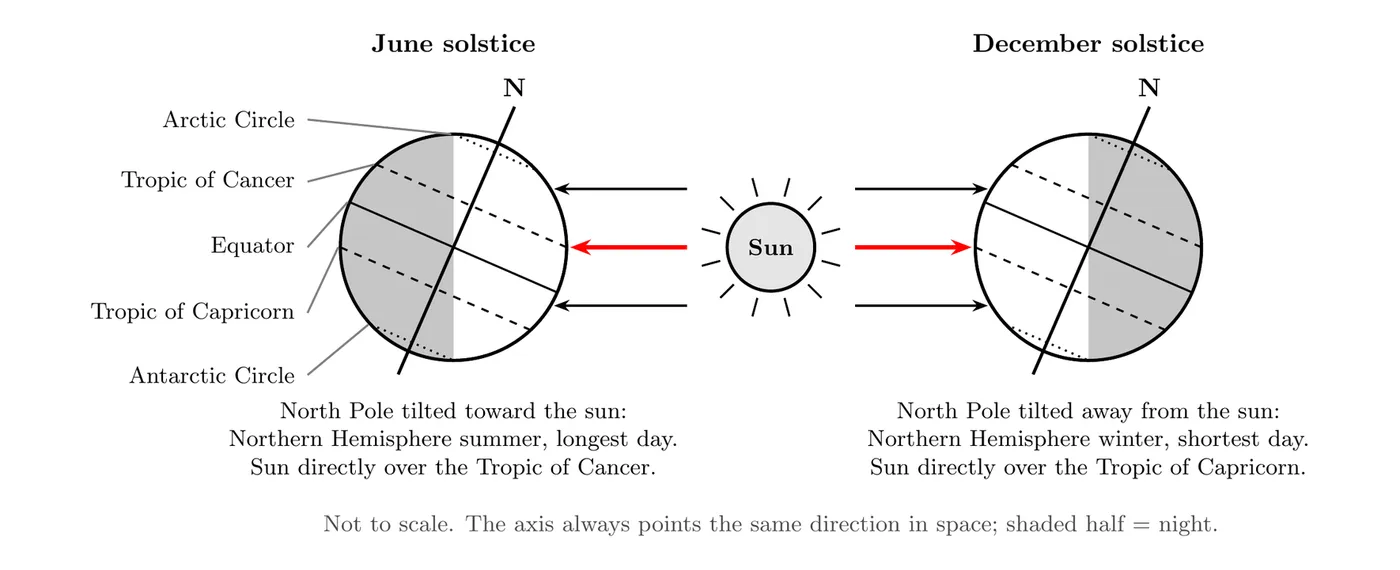
The four seasons are caused by the tilt of the Earth on its axis, about , as it orbits the sun. That tilt changes the angle of the sun’s rays and the length of daylight throughout the year.
- Solstices (June and December):
- June Solstice: The Northern Hemisphere is tilted maximally toward the sun. It gets the most direct insolation, so it’s the longest day of the year and the start of summer. The sun is most direct on the Tropic of Cancer ( North).
- December Solstice: The Northern Hemisphere is tilted maximally away from the sun. It gets less direct insolation, so it’s the shortest day of the year and the start of winter. The sun is most direct on the Tropic of Capricorn ( South).
- Southern Hemisphere: Everything is flipped. December is summer in Australia, Argentina, and South Africa, and the December solstice is their longest day.
- Equinoxes (March and September):
- Neither hemisphere is tilted toward or away from the sun, so the sun is directly over the equator.
- Both get 12 hours of daylight.
- These mark the transition seasons, spring and fall.
- Most and Least Energy: A location gets its most solar radiation on its longest summer day, when the sun climbs highest and stays up longest, and its least on its shortest winter day. Example: New York City (about 41°N) gets about 15 hours of daylight on the June solstice but only about 9 hours on the December solstice.
- Daylight Depends on Latitude: At the equator, days are about 12 hours long all year. The closer you get to a pole, the bigger the swing. North of the Arctic Circle (66.5°N), the sun doesn’t set at all around the June solstice and doesn’t rise around the December solstice.
- Distance Does NOT Cause the Seasons: Earth is actually closest to the sun in early January, during Northern Hemisphere winter. The seasons come from the tilt, which changes the angle of the sun’s rays and the hours of daylight.
IV. Albedo and Surface Temperature
Albedo is the portion or percentage of light reflected by a surface. Albedo determines how much incoming solar radiation gets absorbed by Earth’s surface, and therefore what temperature that surface ends up at.
- High Albedo: These surfaces reflect more light and absorb less heat.
- Example: Snow and ice have high albedo. This is why the North and South Poles are cold. They reflect sunlight instead of absorbing heat.
- Low Albedo: These surfaces absorb most of the incoming sunlight.
- Result: Absorbing sunlight makes surfaces heat up and give off infrared radiation, which is heat.
- Example: Water has a lower albedo than ice. Dark surfaces, like a black shirt, absorb more sunlight and get hotter than white ones.
- Urban Heat Island Effect: Urban areas full of dark surfaces like blacktop and asphalt have very low albedo. Those surfaces absorb almost all incoming solar radiation, so the areas release a lot of infrared radiation and get much warmer than surrounding rural areas, even at the same latitude.
Big picture
Solar radiation reaching Earth’s surface comes down to two steps. First is insolation intensity, which works like a postal service prioritizing delivery: mail (sunlight) sent directly to the equator, at a perpendicular angle through less atmosphere, arrives concentrated and intact, while mail sent far north or south, at an oblique angle through more atmosphere, arrives spread out and diminished. Second is albedo, which determines what the surface does with the delivery: a high-albedo surface like white snow bounces the package right back unopened, while a low-albedo surface like dark asphalt accepts and stores the energy, heating up the area.