

4.4 - Earth’s Atmosphere
Learning Objectives
The main objective is to describe the structure and composition of Earth’s atmosphere. That includes knowing the major gases and their relative abundances, and understanding that the layers are defined by changing temperature gradients. The associated skill is describing characteristics of an environmental concept represented visually.
Atmospheric Composition (Gas Abundance)
The atmosphere is made up mostly of two gases, nitrogen and oxygen, which together make up about 99% of dry air.
Gas | Abundance | Significance |
Nitrogen () | About 78% | Most of this is not reactive or usable by plants. It has to be “fixed” by bacteria in the soil or by humans creating synthetic nitrogen fertilizers. |
Oxygen () | About 21% | Critical for life because animals, humans included, use it for respiration. Respiration is the process of breaking down glucose to form ATP, the main energy source. |
Argon (Ar) | About 0.93% | The third most abundant gas. It’s an inert, non-reactive noble gas. |
Water Vapor () | 0% to 4%, varies by region | Naturally occurring and considered a greenhouse gas because it traps the sun’s energy and warms the planet. It’s not a major concern though, since it cycles quickly and doesn’t stick around for long. |
Carbon Dioxide () | About 0.04% | Despite the tiny percentage, it has a tremendous impact on atmospheric temperature because it traps heat rising from Earth’s surface. Rising levels affect ecosystems globally. |
- Percent vs. ppm: Gases in small amounts are usually measured in parts per million (ppm). Since , divide by 10,000 to convert. In 2025, the yearly average level at Mauna Loa, Hawaii, was about 427 ppm (NOAA):
The Layers of the Atmosphere
The layers are based on changes in temperature. Gas density decreases the further the layers get from Earth.
Layer | Key Characteristics | Importance / Unique Phenomena |
Troposphere | Closest to Earth, extends up to about 16 km (only about 8 km over the poles). Densest layer, holding about 75% of the atmosphere’s mass and the majority of the water vapor. | All of Earth’s weather happens here. Ozone here is an air pollutant that contributes to smog, damages the human respiratory tract, and injures plant stomata. |
Stratosphere | The second layer, from about 16 to 50 km. | Contains the dense ozone layer, which is beneficial because it blocks cancer-causing UV radiation from the sun. |
Mesosphere | The middle layer (M for Middle), from about 50 to 85 km. | Gas molecules are very spread out. Its top, the mesopause, is the coldest place in Earth’s atmosphere, around . Most meteors burn up here. |
Thermosphere | The hottest layer (“therm” refers to heat), from about 85 km to roughly 600 km. | Absorbs highly damaging X-rays and UV rays. Charged particles from the sun (the solar wind) crash into gas molecules here and make them glow, producing the auroras (Northern and Southern Lights). The International Space Station orbits in this layer. |
Exosphere | The outermost layer (“exo” means outside), above roughly 600 km. | Where the atmosphere merges with outer space. |
Temperature Gradients Defining the Layers
The temperature profile flips direction in each layer.
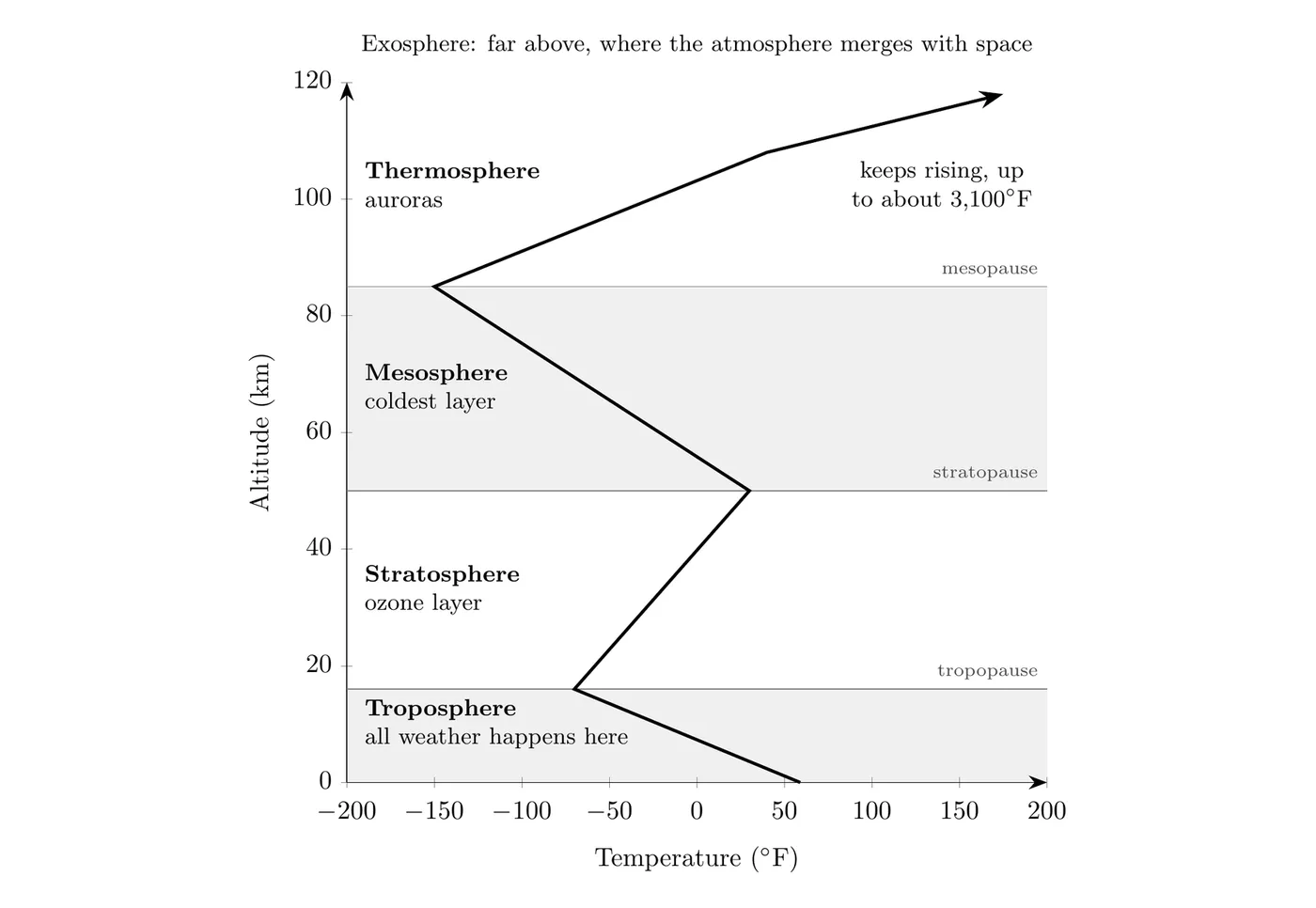
- Troposphere: Temperature decreases as altitude increases. This happens because you’re moving away from the Earth’s surface, which is what the sun warms. It’s an inverse relationship between temperature and altitude.
- On average, the temperature drops about 6.5°C for every 1,000 m you climb (about 3.6°F per 1,000 ft). That’s why mountaintops are cold even near the equator (4.8).
- Stratosphere: Temperature increases as altitude increases. High-energy UV rays strike the top of the stratosphere and warm it up.
- Why: ozone () molecules absorb that UV and turn its energy into heat. The upper stratosphere gets hit by the strongest UV first, so it heats up the most.
- Mesosphere: Temperature decreases as altitude increases. The sparse gas molecules can’t effectively absorb the sun’s energy.
- Thermosphere: Temperature increases dramatically as altitude increases. The heating comes from the layer absorbing very high-energy UV rays and X-rays, reaching temperatures up to .
- The air there is so thin that there are very few molecules to carry that heat, so it wouldn’t feel hot. You’d actually feel cold.
Big picture
The atmospheric layers work like a reverse-stacking heat system. Starting on Earth, temperature drops as you go up (Troposphere, like climbing a mountain). Moving higher, each layer flips the direction of the temperature trend: cold to hot (Stratosphere), hot to cold (Mesosphere), and cold to extremely hot (Thermosphere). The specific gases in each layer, like ozone or the X-ray absorbers, are what cause that temperature shift.