

4.3 - Soil Composition and Properties
Learning Objectives
The main objective is to describe the similarities and differences between the properties of various soil types. Essential knowledge: all soils are made of sand, silt, and clay, and particle size determines how well the soil holds water and nutrients.
Soil Composition: Geological Components
Soil composition focuses on the geological or rock-based portions of soil. When rock is weathered and broken down, it forms particles categorized by size: sand, silt, and clay.
Particle size determines a soil’s texture (what it feels like) and its characteristics.
Particle Type | Size & Feel | Pore Size | Drains Water |
Sand | Largest particles (0.05 to 2 mm), feels gritty | Very large space between particles | Drains water quickly |
Silt | Medium particles (0.002 to 0.05 mm), feels smooth, like flour | Medium-sized space between particles | Drains water at a moderate rate |
Clay | Smallest particles (under 0.002 mm), feels sticky when wet | Very small space between particles | Drains water very slowly |
Porosity, Permeability, and Water Holding Capacity
These three properties are interconnected and critical for plant survival.
- Porosity: The pore space between soil particles.
- Sand has the biggest pores and clay has the tiniest. (Clay soils actually have more pore space in total, but it’s split into millions of tiny pores, so water and air move through them very slowly. Pore size is what controls drainage.)
- Big pores matter because they make it easier for air and water to get into the soil, which plant roots need for both water and oxygen.
- Permeability: Water’s ability to drain through a soil.
- Permeability depends on pore size. Big, connected pores (sand) let water drain quickly, so sandy soils are very permeable. Tiny pores (clay) hold water tightly, so clay soils have low permeability.
- Water Holding Capacity (WHC): The soil’s ability to retain moisture.
- Permeability has an inverse relationship with WHC: the faster water drains through a soil, the less of it stays behind for roots.
- A sandy soil has low water holding capacity because water drains through its big pores before roots can get to it. Clay holds the most water (though it grips some so tightly that roots can’t use it), and silt and loam are in between. Bottom line for the exam: sand drains fastest and holds the least water, and clay drains slowest and holds the most.
- Water retention drives productivity and fertility: plants need a steady water supply for photosynthesis, and nutrients reach roots dissolved in soil water. A soil that dries out fast grows less, and rain washes its dissolved nutrients down past the roots (leaching).
The Ideal Soil: Loam
Plants need a balance between permeability (drainage) and water holding capacity.
- If soil is too clay-dominated, drainage is very slow, which leads to waterlogging and suffocation of plant roots from lack of oxygen.
- The ideal is loam, a nice happy medium that’s roughly a mix of sand, silt, and clay.
- Loam lets water and oxygen enter and drain through at a moderate pace that avoids waterlogging but doesn’t dry the soil out too fast.
- Horizons Differ Too: Each horizon has its own mix of particle sizes and organic matter, so each one drains and holds water differently. The humus-rich A horizon is loose, holds water and nutrients well, and is the most fertile. A clay-rich B horizon below it drains slowly, so after heavy rain, water can back up above it and waterlog roots. The rocky C horizon drains fast but holds almost no nutrients.
The Soil Texture Triangle
A soil texture triangle lets you name a soil type from its percentages of sand, silt, and clay. Each side is a scale from 0% to 100% for one particle type, and the three percentages always add up to 100%.
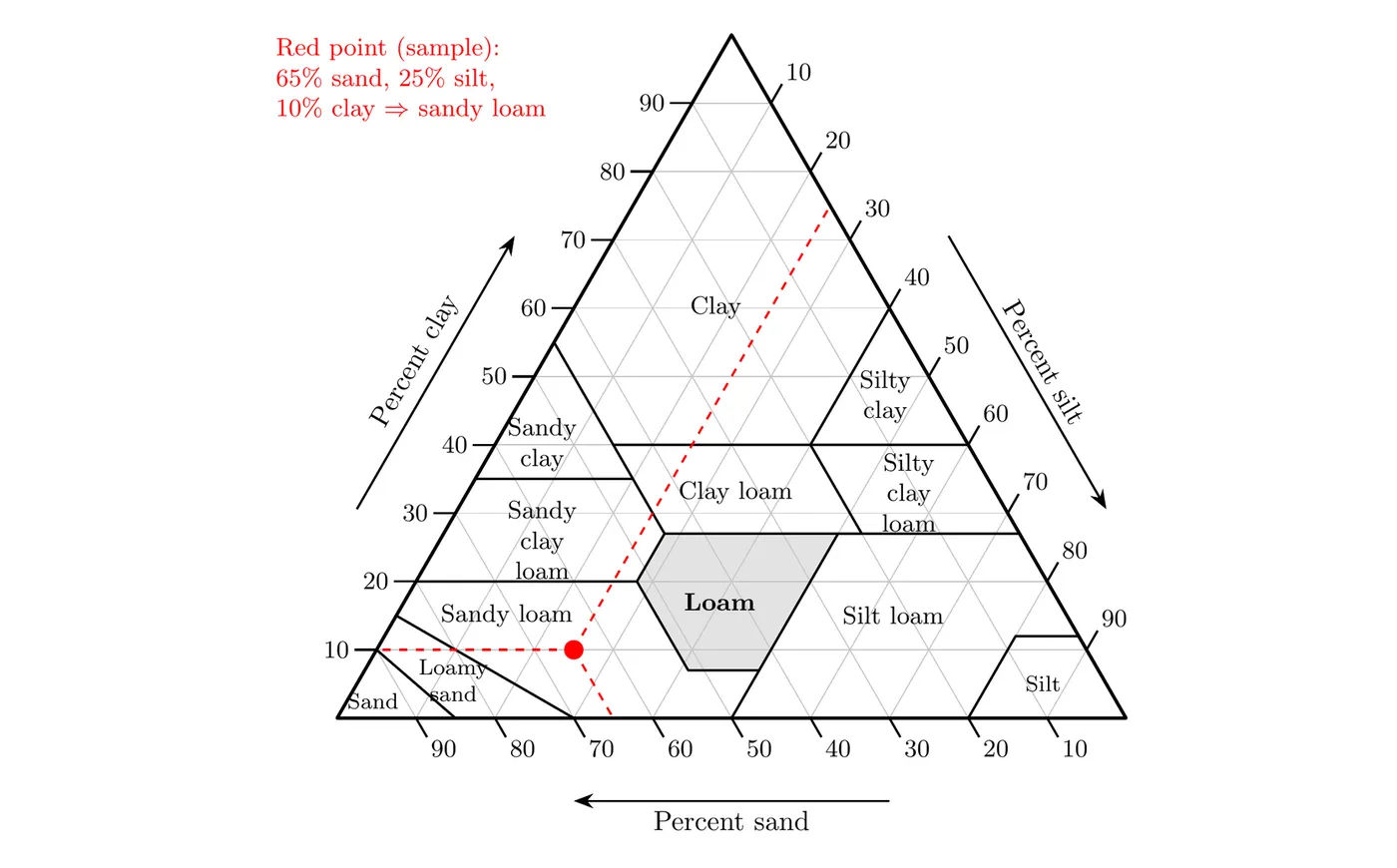
How to read it:
- Clay: Find the clay percentage on the left side and follow that line straight across.
- Silt: Find the silt percentage on the right side and follow that line down and to the left (parallel to the left side).
- Sand: Find the sand percentage on the bottom and follow that line up and to the left (parallel to the right side).
- The point where the lines cross is your soil. Read the name of the region it lands in. Two lines are enough to find the point, and the third is a good check.
Example: After a soil texture (jar) test, a sample settles into a 3.9 cm sand layer, a 1.5 cm silt layer, and a 0.6 cm clay layer. What type of soil is it?
Check: 65% + 25% + 10% = 100%. On the triangle (the red point), 10% clay, 25% silt, and 65% sand land in the sandy loam region. This soil drains faster and holds less water than loam, so it would need more frequent irrigation.
Loam sits near the middle of the triangle: about 7% to 27% clay, 28% to 50% silt, and no more than 52% sand. The 40% sand, 40% silt, 20% clay mix above lands right inside it.
Soil Fertility and Nutrient Factors
Soil fertility is the ability of the soil to support plant growth. Key plant nutrients include nitrogen, phosphorus, magnesium, calcium, and potassium.
Factors that Increase Soil Nutrients:
- Organic Matter (Humus): Decomposers break organic matter down into humus, releasing vital nutrients for plants. Humus also improves the soil’s ability to hold water.
- Clay Particles: Clay is negatively charged. Because many soil nutrients are positively charged, they bind to the clay particles, which keeps them in the soil and available to plants.
- Bases (like Calcium Carbonate): Given off by limestone, these bases help buffer or neutralize the pH of the soil so it doesn’t get too acidic.
Factors that Decrease Soil Nutrients and Water:
Factor | Effect on Nutrients | Effect on Water |
Acidity | Soil that’s too acidic leaches nutrients away easily when rain washes through. | N/A |
Excessive Farming | Repeatedly growing the same crops depletes the soil of nutrients. | N/A |
Topsoil Erosion / Compaction | Nutrients are lost from the soil. | Compaction reduces pore space, making it harder to hold moisture. Erosion strips the organic layer, which leads to evaporation. |
Poor Aeration | N/A | Lack of channels reduces how much water and air the soil can hold. |
Soil Quality Tests
Farmers and researchers use simple tests to measure soil quality.
The tests fall into three groups: physical properties (texture, permeability, color), chemical properties (pH, nutrient levels), and biological properties (the living things in the soil).
- Soil Texture Test: A sample settles in a jar of water overnight. The distinct layers of sand, silt, and clay get measured to find their percentages, which lets you classify the soil (as loam or sandy loam, for example).
- Permeability Test: Measures how long it takes a given volume of water to drain through a soil sample in a plastic column. This tells you if the soil is too permeable or if it retains water well.
- pH Test: A simple chemical test where a test strip is dipped into a soil and water mixture to measure hydrogen ion () concentration. It matters because acidic soils are generally less optimal for plant growth.
- Color Test: Comparing a soil sample to a chart gives you an idea of humus content. The darker the soil, the more humus, which generally means it holds nutrients and water better.
- Nutrient Level Tests: Chemical tests that directly measure levels of key limiting nutrients like nitrogen sources (ammonium or nitrates) and phosphorus sources (phosphates).
- Biological Tests: Measure how much life is in the soil, like counting the earthworms in a shovelful of soil, or measuring how much a moist sample gives off over a day. More means more active decomposers breaking down organic matter and recycling nutrients.
- Using the Results: Tests guide real decisions. A sandy, very permeable soil needs smaller, more frequent irrigation, while a slow-draining clay soil needs less frequent watering so it doesn’t waterlog. A nutrient test tells a farmer how much nitrogen or phosphorus fertilizer to add, so they don’t pay for extra fertilizer that just runs off into streams. A low pH result tells them to add lime (calcium carbonate) to neutralize the acidity.
Practice calculation (permeability test): 200 mL of water takes 8.0 minutes to drain through a soil sample in a column. A sand sample in the same column drains 200 mL in 2.0 minutes. Compare the rates.
The sand drains times faster, so it’s more permeable but holds less water for plants.
Big picture
Soil composition is a tug-of-war between the two extreme ends of particle size. Sand provides the essential air channels (porosity) but sacrifices water retention because it’s so permeable. Clay provides excellent nutrient and water retention but sacrifices air flow because it’s barely permeable. The perfect mixture, loam, is the balanced mediator, offering enough drainage to keep the roots from drowning while still holding onto enough nutrients and water for growth.