

4.1 - Plate Tectonics
Learning Objectives
The main objective is to describe the geological changes and events that happen at plate boundaries. The associated skill is explaining how visual representations like diagrams and maps relate to broader environmental issues.
Introduction: Earth’s Structure
The entire world, land and oceans included, sits on a really thin, rigid shell of rock that’s broken into pieces. Those pieces ride on the mantle, a thick layer of extremely hot rock that’s mostly solid but flows very slowly, like very stiff putty.
- Lithosphere: The thin, brittle outermost layer of rock. This is the layer that gets broken up into chunks called tectonic plates.
- Crust: The very top of the lithosphere, where soil, plants, and all life on Earth exist.
- Mantle and Core: At the center of the Earth is the core, made mostly of iron and nickel: a solid inner core surrounded by a liquid outer core. The inside of the Earth stays extremely hot from heat left over from when the planet formed, plus heat released by radioactive elements (like uranium and thorium) breaking down, mostly in the mantle and crust. The mantle around the core is hot enough to flow very slowly even though it’s mostly solid rock. Melted rock (magma) forms only in certain places, like under volcanoes and mid-ocean ridges.
- Asthenosphere: The softer upper part of the mantle right below the lithosphere. It flows slowly, and the plates slide around on top of it.
- Oceanic vs. Continental Crust: Oceanic crust is thin and dense (made of basalt). Continental crust is thicker and less dense (mostly granite). This difference decides which plate sinks in a collision: when an oceanic plate meets a continental plate, the denser oceanic plate goes under.
Convection Cycles: The Driving Force
Tectonic plate movement is driven by convection cycles in the mantle.
- Convection cycles move heat from deep inside the Earth toward the surface. Mantle rock near the hot core heats up, expands, becomes less dense, and slowly rises. Near the top of the mantle it spreads out sideways, dragging the plates above it along. As it spreads, it cools, becomes denser, and sinks back down to repeat the process.
- Plates move only a few centimeters per year, about as fast as your fingernails grow. The weight of cold, dense plate sinking into the mantle at subduction zones also helps pull plates along.
- A hot spot is a place where an unusually hot plume of mantle rock rises toward the surface, usually in the middle of a plate, not at a boundary. Near the top, some of the rock melts into magma and erupts, building volcanoes. The hot spot stays in place while the plate slowly moves over it, so it leaves behind a chain of volcanoes that get older the farther they are from the hot spot.
- Example (Hawaii): The Pacific plate moves northwest over the Hawaiian hot spot. The Big Island sits over the hot spot now and has active volcanoes like Kilauea. Kauai, about 530 km to the northwest, is about 5 million years old, and its volcanoes went extinct long ago.
- Example (Yellowstone): A hot spot under the North American plate gives Yellowstone its geysers, hot springs, and huge volcano, far from any plate boundary.
The Three Plate Boundary Types
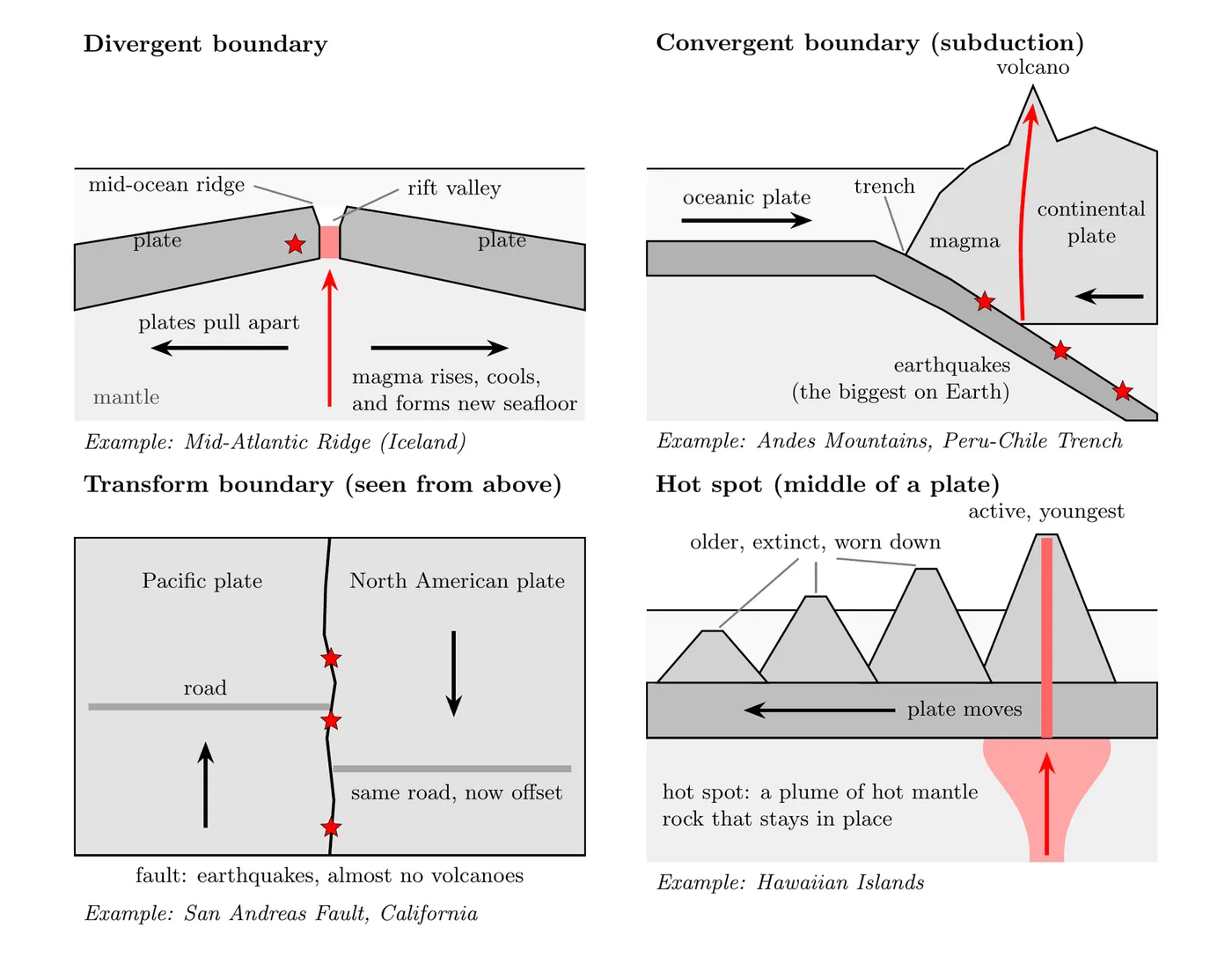
1. Divergent Plate Boundaries
- Movement: Plates move away from each other. This is caused by heated magma from the mantle rising and pushing the plates apart.
- Geological Outcomes:
- Mid-oceanic ridges (underwater mountain ranges)
- Volcanoes, if the magma rises with enough force
- Seafloor spreading
- Rift valleys, on land
- The magma cools and forms new lithosphere to replace the plates being pushed apart
- Earthquakes, usually small and shallow, as the plates crack and pull apart
- Examples: The Mid-Atlantic Ridge runs down the middle of the Atlantic Ocean, so the Atlantic gets a little wider every year. Iceland sits right on top of it (and on a hot spot), which is why it has frequent eruptions and small earthquakes; its Reykjanes Peninsula has erupted many times since 2021. On land, the East African Rift Valley is where Africa is slowly splitting apart, with rift valleys, volcanoes like Mount Kilimanjaro, and earthquakes.
Practice calculation: The Mid-Atlantic Ridge spreads about 2.5 cm per year. How much wider does the Atlantic get in 1 million years?
So the Atlantic widens by about 25 km every million years.
2. Convergent Plate Boundaries (Subduction Zones)
- Movement: Plates collide or move toward one another. When they collide, one is forced underneath the other, a process called subduction.
- Geological Outcomes:
- Oceanic-Continental Collision: The denser oceanic plate subducts beneath the continental plate. The melting oceanic plate forces magma up to the surface on the land side, creating volcanoes on land. This also forms narrow coastal mountain ranges like the Andes in South America.
- Examples: The Andes sit above the Nazca plate sinking under South America along the Peru-Chile Trench. The Cascade Range in the Pacific Northwest, including Mount St. Helens (which erupted in 1980), sits above the Juan de Fuca plate sinking under North America.
- Oceanic-Oceanic Collision: The older, denser plate subducts beneath the other, forming a deep trench. As the sinking plate heats up, it releases water that makes the mantle rock above it partly melt, and that magma rises to build a curved line of volcanoes parallel to the trench. Over time, those volcanoes form a chain of islands called an island arc, like Japan, the Aleutian Islands of Alaska, and the Mariana Islands. The Mariana Trench, next to the Mariana Islands arc, is the deepest spot in the ocean (almost 11 km deep).
- Continental-Continental Collision: The collision pushes crust upward, forming large mid-continental mountain ranges like the Himalayas.
- Neither plate subducts easily because continental crust is thick and buoyant, so there are few volcanoes but many earthquakes. India crashing into Asia built the Himalayas (including Mount Everest), and they’re still rising today.
- Convergent boundaries can also produce trenches and tsunamis.
- Earthquakes: Subduction zones produce the biggest earthquakes on Earth. The sinking plate sticks against the plate above it, stress builds for decades or centuries, and then the plates slip all at once. Examples: Chile in 1960 (magnitude 9.5, the largest ever recorded), the Indian Ocean in 2004 (magnitude 9.1), and Japan in 2011 (about magnitude 9), whose tsunami caused the Fukushima nuclear disaster (6.6).
- Tsunamis: When a subduction earthquake suddenly lifts the seafloor, it shoves the water above it up and sends out huge waves. The 2004 Indian Ocean tsunami killed more than 225,000 people in over a dozen countries.
3. Transform Fault Boundaries
- Movement: Two plates slide alongside each other in opposite directions. This creates a fault, a fracture in the lithosphere’s surface.
- Earthquake Mechanism: The jagged edges of the plates get caught or locked on each other. The plates keep trying to move, which builds up tremendous pressure. When the stress finally overcomes the locked fault, the plates suddenly slip free, releasing a huge amount of energy and shockwaves that make the ground shake violently. That’s an earthquake. Transform boundaries mostly produce earthquakes, not volcanoes, since no plate sinks or pulls apart to let magma rise. But earthquakes happen at all three boundary types, and the very largest happen at convergent boundaries.
- Focus and Epicenter: The focus is the spot underground where the fault slips. The epicenter is the point on the surface directly above it, where shaking is usually strongest.
- Magnitude: Each step up the magnitude scale means about 32 times more energy released. So a magnitude 7 releases about times more energy than a magnitude 5.
- Examples: The San Andreas Fault in California is a transform boundary where the Pacific plate slides northwest past the North American plate. It caused the 1906 San Francisco earthquake (magnitude 7.9). In 2023, a magnitude 7.8 earthquake on the East Anatolian Fault, a transform fault in Turkey, killed more than 50,000 people in Turkey and Syria.
Predicting Geological Events
A map of tectonic plate boundaries helps predict where various geological events will happen.
- The Ring of Fire: A predictable pattern of volcanoes and earthquakes all around the edge of the Pacific Ocean. The reason for the ring is that oceanic plates around the Pacific (like the Pacific, Nazca, and Juan de Fuca plates) are subducting beneath neighboring plates, which forces magma up to the surface and causes predictable volcanic activity. Convergent boundaries are primarily responsible for this. About 90% of the world’s earthquakes happen along the Ring of Fire, and it holds more than half of the world’s active volcanoes above sea level.
- Earthquake Locations: Earthquakes cluster along all plate boundaries, so on a map they trace the edges of the plates. The thickest bands, and the biggest earthquakes, are at the subduction zones of the Ring of Fire. Transform faults are earthquake zones too, like the San Andreas Fault on the coast of California and the fault zone through Haiti (where a magnitude 7.0 earthquake struck in 2010).
- Reading a Plate Boundary Map: Arrows pointing apart mean a divergent boundary (look for ridges, rift valleys, and new seafloor). Arrows pointing toward each other mean a convergent boundary (look for trenches, mountains, volcanoes, and island arcs). Arrows sliding past each other mean a transform boundary (look for faults and earthquakes). A line of volcanoes in the middle of a plate that gets older in one direction means a hot spot.
- Where Volcanoes Are (and Aren’t): Volcanoes form at divergent boundaries, at convergent boundaries where a plate subducts, and over hot spots. Transform boundaries and continent-continent collisions get earthquakes but very few volcanoes.
Big picture
Plate tectonics is like Earth’s surface being a giant, brittle puzzle (the lithosphere) riding on a pot of very thick, slowly churning soup (the hot, slowly flowing mantle). The slow churning drives the puzzle pieces into, away from, or past each other. Wherever the pieces get stuck, whether sliding past each other (transform) or one diving under another (convergent), the pressure buildup ends in the sudden, violent jolt of an earthquake.