

3.4 - Long-Run Aggregate Supply (LRAS)
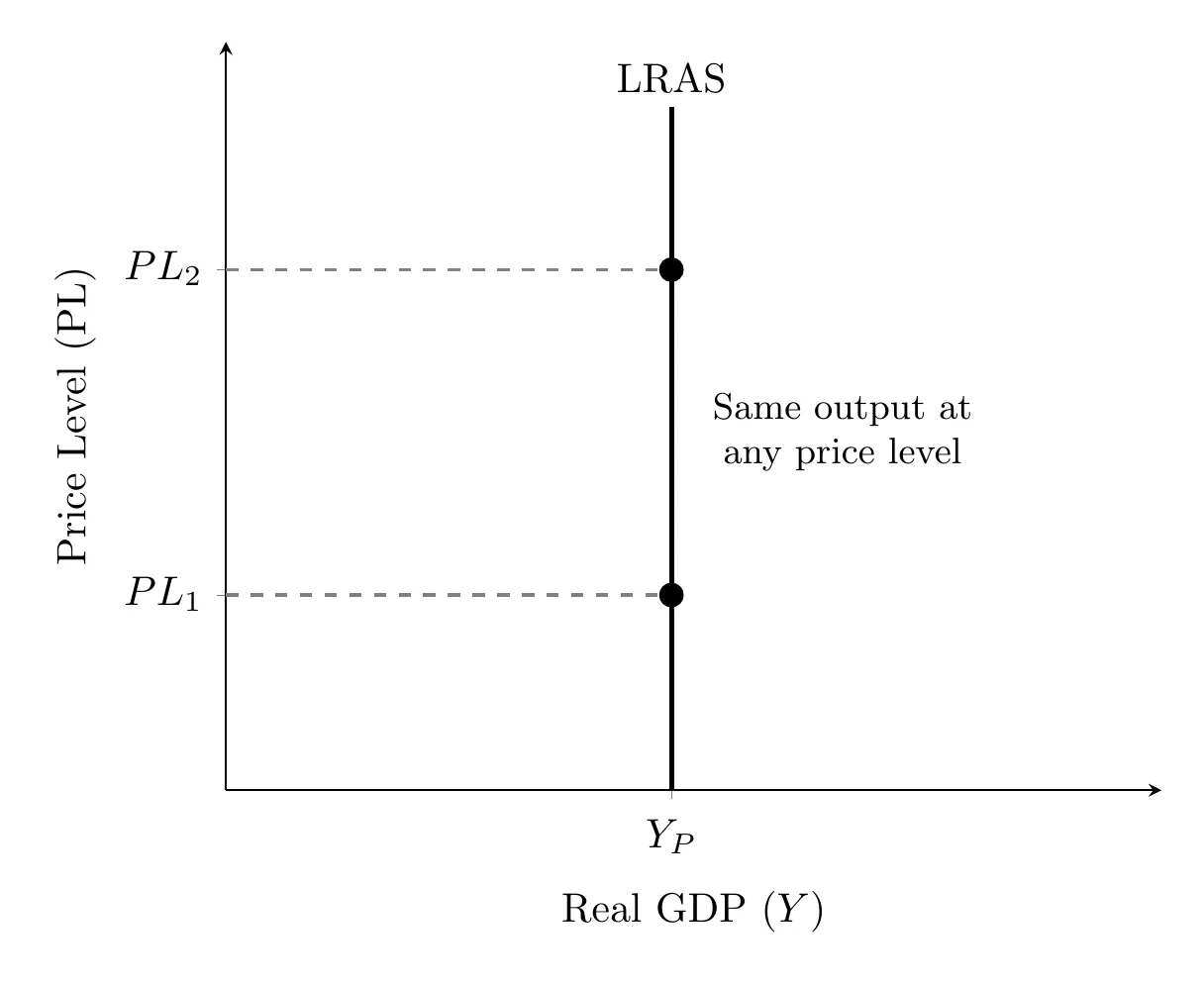
Defining the Long Run and the Vertical LRAS
The long run is when all prices and wages become fully flexible. The LRAS curve is vertical, meaning changes in the price level have no effect on output at all, so there’s no long-run trade-off between inflation and unemployment.
Unlike the short run, where fixed wages let firms hire more when prices rise, in the long run input prices and wages rise right along with the price level. Since costs rise as fast as revenue, firms have no incentive to increase output.
LRAS and Potential Output
LRAS represents the maximum sustainable output an economy can produce, similar to the PPC. This is potential output () or full employment output (), the output level when all resources are fully employed.
LRAS corresponds to the PPC because both show the economy's maximum sustainable capacity: the total output it will produce over a set period if all its resources are fully employed. Producing on the PPC is the same as producing at on the LRAS. Producing inside the PPC means some resources are sitting idle, which matches output to the left of LRAS (a recessionary gap, see 3.5).
Full employment doesn't mean zero unemployment. At , unemployment equals the natural rate (frictional plus structural unemployment), and there's no cyclical unemployment.
Shifters of the LRAS Curve
The same factors that shift the PPC outward shift LRAS to the right, representing economic growth:
- More land, labor, or capital
- More natural resources
- More machinery, better tools, or better technology
- A better educated workforce
Takeaway
In the long run, since wages and prices are fully flexible, firms lose the incentive to raise output when prices rise. That makes LRAS vertical at potential output, the economy’s max sustainable capacity, with no trade-off between inflation and unemployment. Only real changes to factors of production can shift LRAS and drive growth.