

3.6 - Changes in the AD-AS Model in the Short Run
Short-Run Equilibrium Shifts
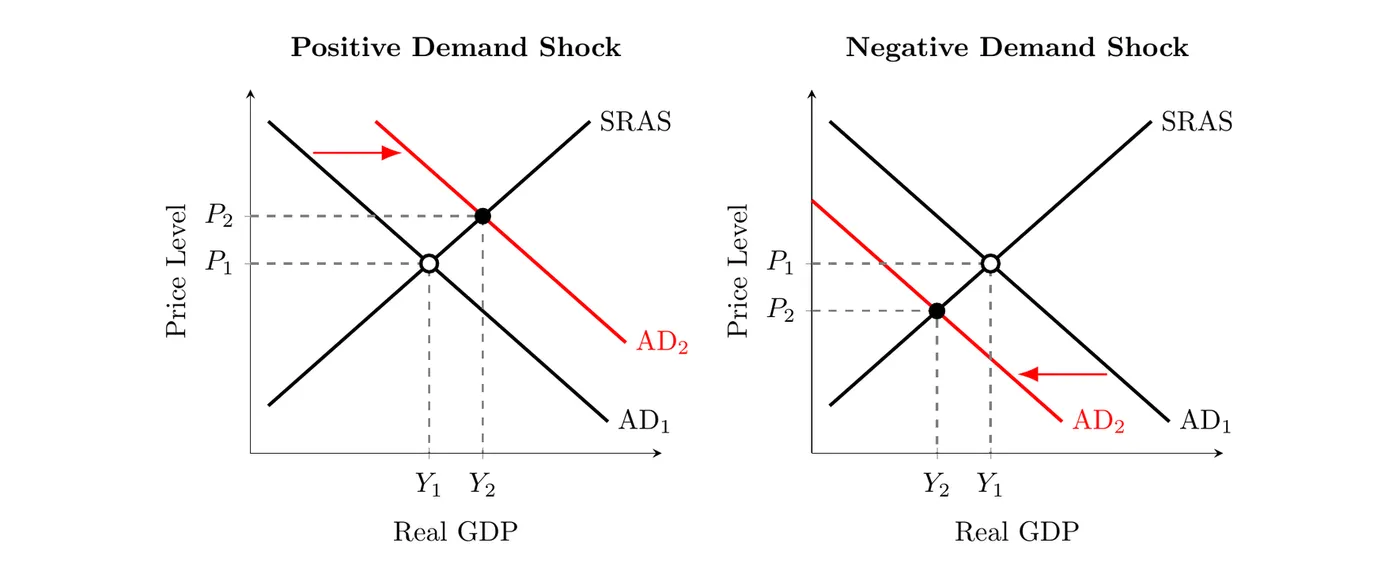
This analysis leaves out LRAS for simplicity, starting from an initial short-run equilibrium at price level and output .
Aggregate Demand Shifts (Demand Shocks)
AD shifts move price and output in the same direction.
Positive demand shock (AD shifts right): caused by an increase in C, I, G, or net exports.
- Price and output both rise.
- Unemployment falls, since more workers are needed.
- Nominal wages stay fixed in the short run.
- Real wages fall, since the fixed nominal wage now divides into a higher price level. More people have jobs, but their purchasing power has dropped.
Negative demand shock (AD shifts left): caused by a decrease in C, I, G, or net exports.
- Price and output both fall.
- Unemployment rises.
- Nominal wages stay unchanged.
- Real wages rise, since the fixed nominal wage divides into a lower price level. Fewer people have jobs, but those who do have more purchasing power.
SRAS Shifts (Supply Shocks)
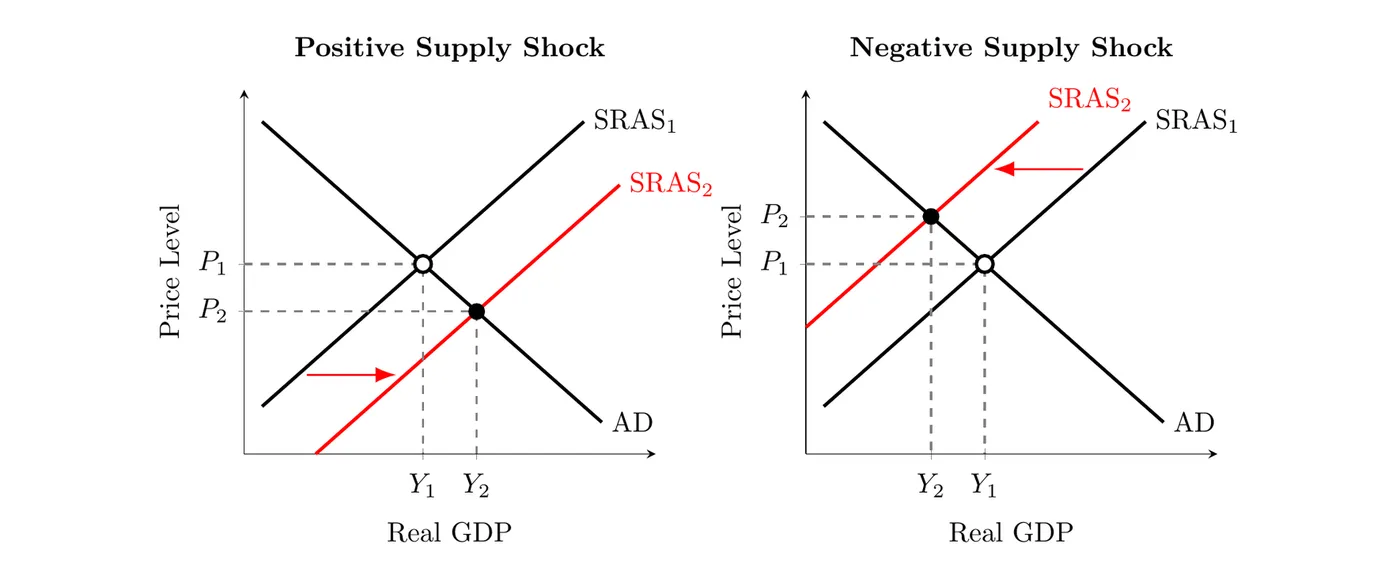
SRAS shifts move price and output in opposite directions.
Positive supply shock (SRAS shifts right): price falls and output rises. Causes include falling nominal wages, expectations of lower inflation, falling resource prices, lower business taxes or higher subsidies, or better productivity and technology.
- Employment rises and unemployment falls, since firms need more workers to produce the extra output.
Negative supply shock (SRAS shifts left): price rises and output falls, the worst combination since you get less output at a higher cost. This situation is called stagflation, when both unemployment and inflation are high (like the 1979 oil crisis).
- Employment falls and unemployment rises, since firms produce less and need fewer workers.
Causes of Inflation on the Model
- Demand-pull inflation: caused by a positive demand shock, driven by increased spending from households, businesses, or government.
- Example: a consumer spending boom or a big increase in government spending shifts AD right. Buyers want more output than firms can supply at current prices, so the price level gets pulled up.
- Cost-push inflation: caused by a negative supply shock.
- Example: a jump in oil prices raises costs for almost every firm. SRAS shifts left, so the price level rises even as output falls.
Takeaway
Demand shocks move price and output in the same direction, and since nominal wages are fixed in the short run, real wages move opposite to the price level. Supply shocks move price and output in opposite directions, and a negative shock creates the harmful stagflation scenario. Inflation can come from either demand-pull or cost-push causes depending on which curve shifted.