

3.7 - Long-Run Self-Adjustment
Short Run vs. Long Run Review
The key difference is sticky wages (short run) versus flexible wages (long run). In the short run, fixed costs let sellers profit and raise output when prices rise, giving SRAS its upward slope. In the long run, flexible wages mean there’s no relationship between price level and quantity supplied, giving LRAS its vertical shape.
Adjustment from an Inflationary Gap
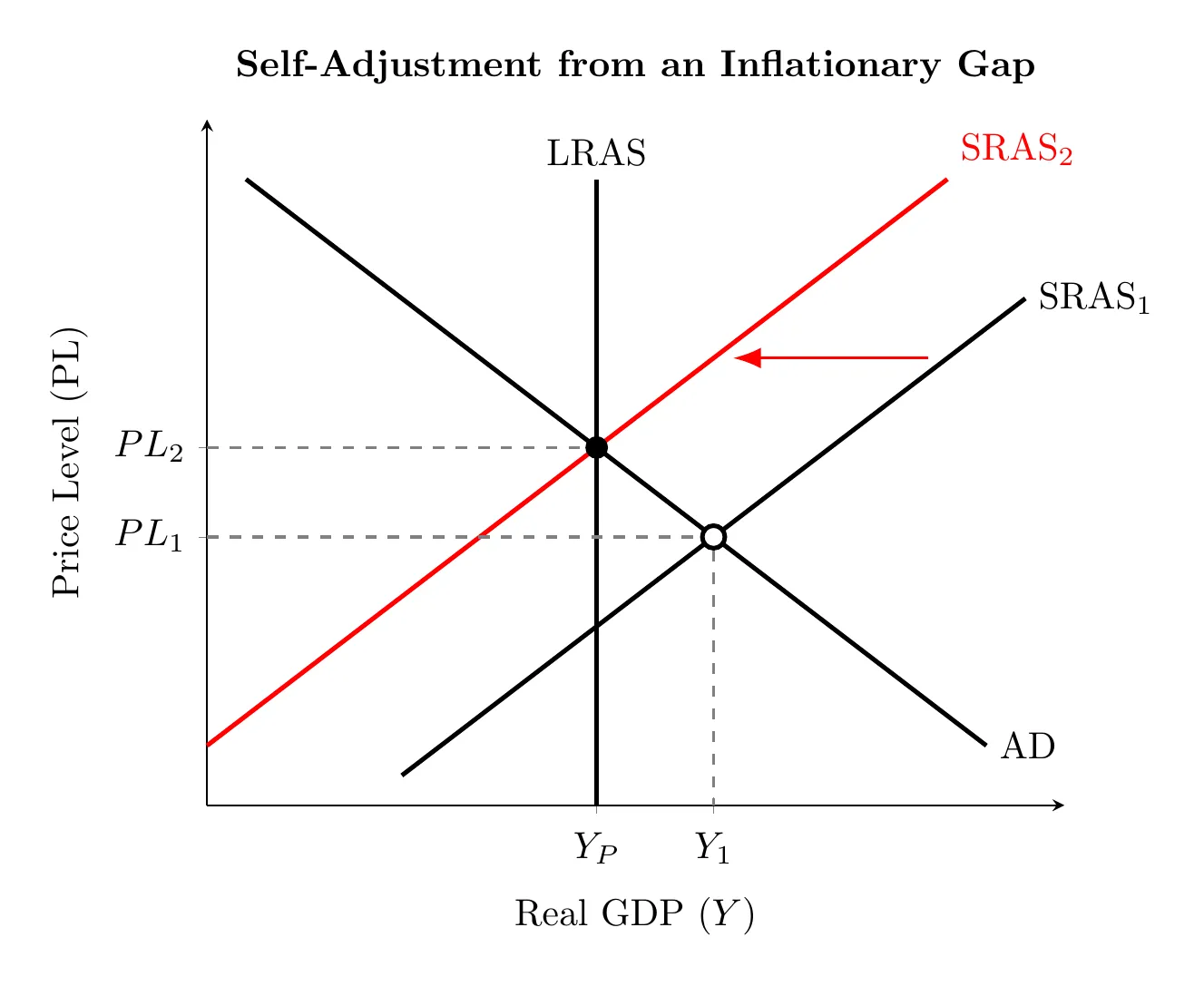
When actual output exceeds potential (), unemployment sits below the natural rate, but nominal wages are initially slow to rise.
Eventually, low unemployment creates competition for workers, pushing nominal wages up. Workers also notice rising prices and demand higher wages to recover their purchasing power, and businesses go along with it since they expect prices to keep rising too.
This wage increase raises production costs, shifting SRAS left. It keeps shifting until it meets AD and LRAS together, bringing the economy back to full employment. Nominal wages and prices end up higher than before, but real wages return to where they started.
Adjustment from a Recessionary Gap
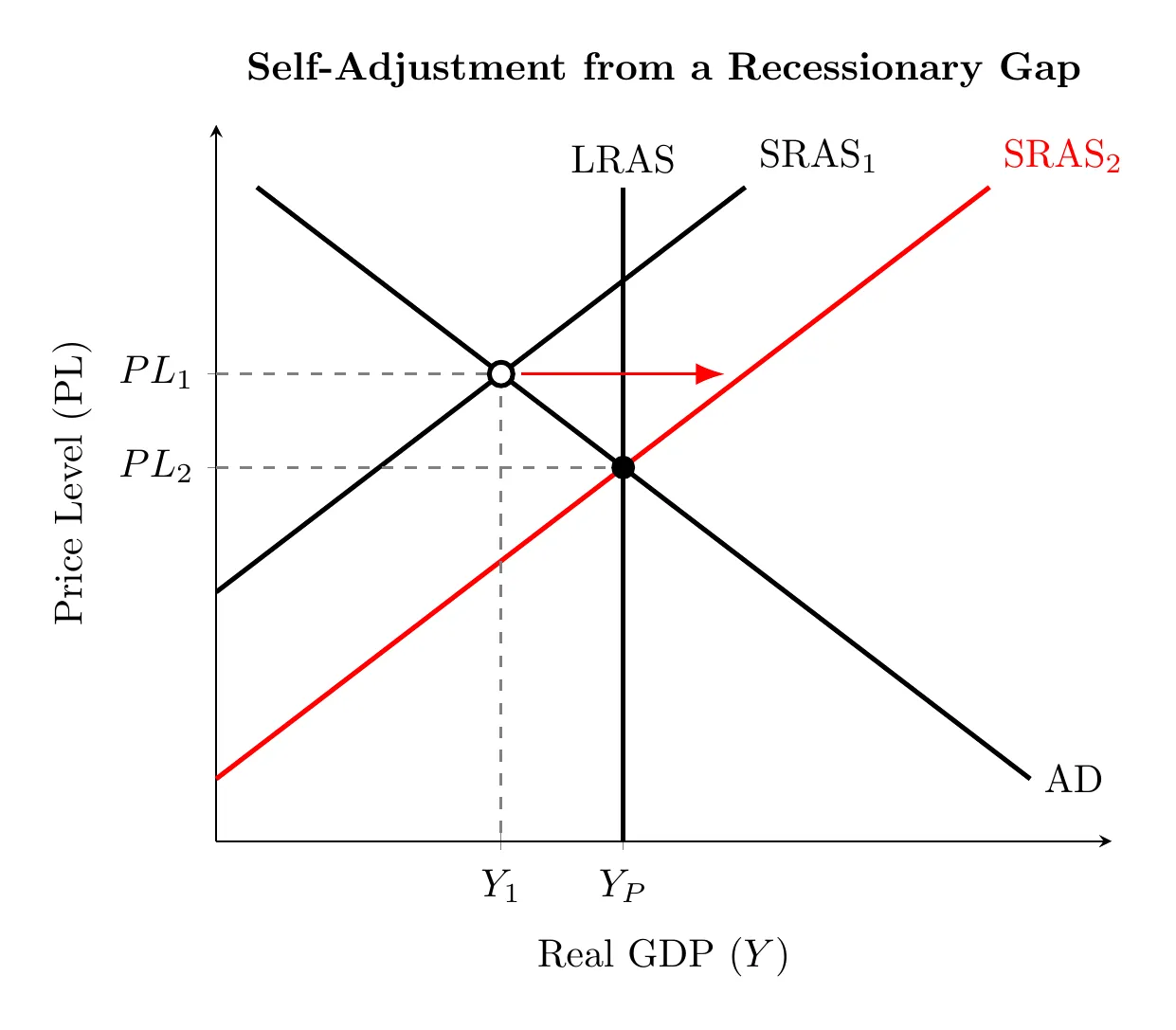
When actual output falls short of potential (), unemployment sits above the natural rate due to cyclical unemployment, while nominal wages stay unchanged at first.
Eventually, high unemployment pushes nominal wages down, lowering production costs and shifting SRAS right. The economy self-corrects back to long-run equilibrium, where unemployment returns to the natural rate and actual output matches potential output.
Nominal wages and the price level end up lower than before, but output is back at . This can take a long time, since workers resist pay cuts and nominal wages are especially slow to fall. Waiting it out can mean months or years of high unemployment, which is why policymakers often use fiscal policy (3.8) instead of waiting.
Adjustment after a Supply Shock
Self-adjustment works the same way after a shock to SRAS. Say oil prices spike and SRAS shifts left: the price level rises, output falls below , and unemployment rises (stagflation). With no government action, high unemployment eventually pushes nominal wages down, lowering production costs. SRAS shifts back right until the economy returns to , the natural rate of unemployment, and the original price level, since AD and LRAS never moved.
Shifts in LRAS
Self-adjustment always brings the economy back to , but itself can change. A rightward shift of LRAS means the full-employment level of output has increased, which is economic growth (from more resources, more capital, better technology, or a more educated workforce, see 3.4). A leftward shift means the economy's capacity has shrunk, for example when a war or natural disaster destroys capital.
Takeaway
The economy has a built-in self-correction mechanism based on wage flexibility in the long run. Left alone, it eventually returns to where AD, SRAS, and LRAS all meet, restoring potential output and the natural rate of unemployment, through wages rising (inflationary gaps) or falling (recessionary gaps) and shifting SRAS accordingly.