

3.5 - Equilibrium in the Aggregate Demand-Aggregate Supply (AD-AS) Model
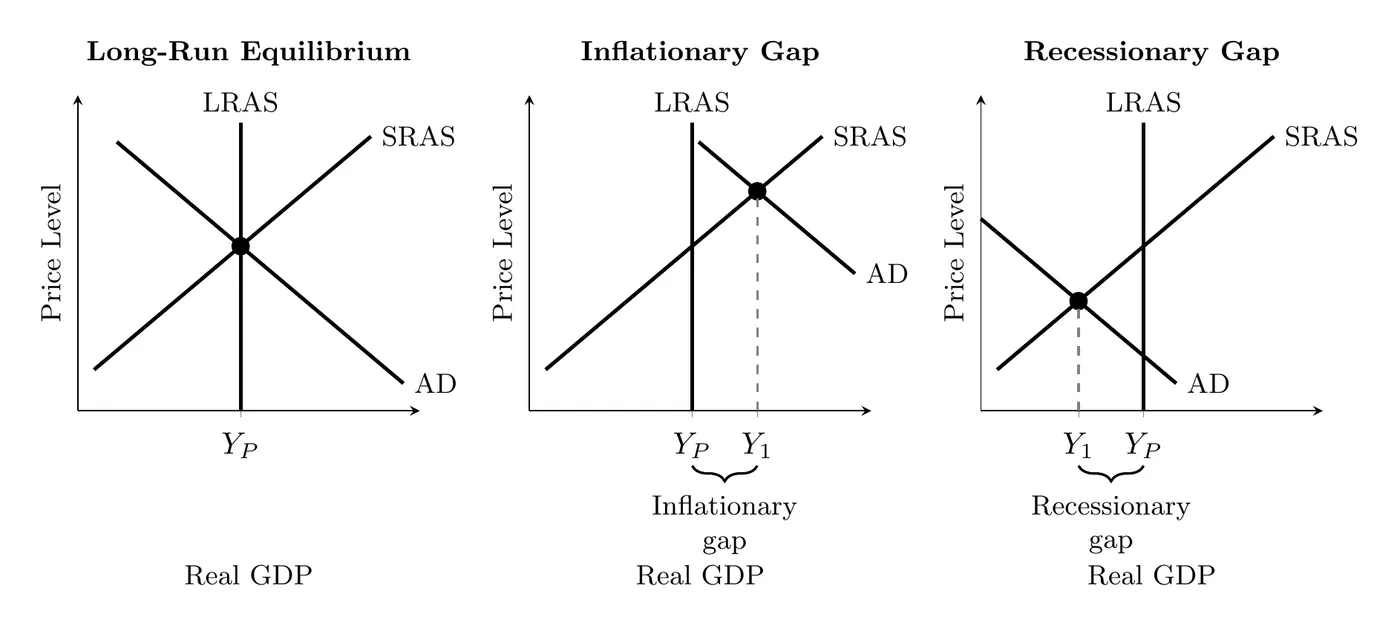
Defining Equilibrium
The AD-AS model combines total spending (AD) with total production (SRAS), making it arguably the most important model in AP Macro.
- Short-run equilibrium: where AD and SRAS intersect.
- This is where the aggregate quantity of output demanded equals the aggregate quantity supplied. If the price level were higher, firms would produce more than buyers want, unsold goods would pile up as inventory, and firms would cut prices and output. If it were lower, inventories would run down and firms would raise prices and output. Either way, the economy moves to the intersection.
- Long-run equilibrium (full employment): where AD, SRAS, and LRAS all intersect at once, at potential output (), meaning unemployment sits at the natural rate with no cyclical unemployment.
Short-Run Deviations (Gaps)
Inflationary gap (positive output gap): equilibrium sits to the right of LRAS, meaning actual output is greater than potential and unemployment is below the natural rate. This happens because wages and input prices are fixed in the short run, so businesses ramp up output when prices rise, temporarily exceeding potential.
Recessionary gap (negative output gap): equilibrium sits to the left of LRAS, meaning actual output is less than potential and unemployment is above the natural rate. This means cyclical unemployment exists, and the economy is in a recession, typically shown by falling GDP.
Measuring the gap: output gap = actual real GDP − potential real GDP. A positive number is an inflationary gap and a negative number is a recessionary gap. For example, if potential output is $20 trillion and actual output is $19 trillion, the output gap is −$1 trillion, a recessionary gap of $1 trillion.
Takeaway
Macroeconomic equilibrium can show up in three states. Long-run equilibrium means output sits at potential and unemployment sits at the natural rate. Short-run equilibrium to the right of LRAS is an inflationary gap (output above potential, unemployment below natural rate); to the left, it’s a recessionary gap (output below potential, unemployment above natural rate), meaning cyclical unemployment.