

3.8 - Fiscal Policy
Introduction to Fiscal Policy
The idea of using government policy to smooth out the business cycle is most associated with John Maynard Keynes. Fiscal policy refers to the government’s tax and spending decisions, aimed at macroeconomic stabilization, meaning smoothing the business cycle and bringing the economy back to long-run equilibrium.
Tools of Fiscal Policy
- Changes in taxes
- Changes in transfers (like welfare)
- Changes in government spending
Expansionary Fiscal Policy (Closing Recessionary Gaps)
Used when the economy faces a recessionary or negative output gap, aimed at boosting real GDP and cutting unemployment.
- Increase government spending
- Cut taxes
- Increase transfers
All of these shift AD right. Increasing government spending affects AD directly, since G is a component of AD. Tax cuts or transfer increases affect AD indirectly, by boosting disposable income, which then boosts consumption.
The expenditure multiplier (used for G) is larger than the tax multiplier (used for taxes and transfers). For example, closing a $1 trillion gap with an MPC of 0.75 and MPS of 0.25 needs $250 billion in new spending (multiplier of 4) but $333.33 billion in tax cuts or transfers (multiplier of 3).
Calculating the effect of a policy: if the government increases spending by $50 billion and the MPC is 0.9, the spending multiplier is 1 / 0.1 = 10, so AD (and real GDP) can rise by up to $500 billion. A $50 billion tax cut with the same MPC uses the tax multiplier of 0.9 / 0.1 = 9, so real GDP can rise by up to $450 billion.
Equal changes in G and taxes: because the spending multiplier is bigger, raising government spending and taxes by the same amount still increases AD. With an MPC of 0.75, raising both G and taxes by $100 billion adds up to $400 billion through spending and takes away up to $300 billion through taxes, a net increase of $100 billion. This is called the balanced budget multiplier, and it always equals 1.
Contractionary Fiscal Policy (Closing Inflationary Gaps)
Used to fight inflation during an inflationary or positive output gap, aimed at slowing GDP growth.
- Reduce government spending
- Raise taxes
- Reduce transfers
These shift AD left, bringing the economy back to long-run equilibrium. Expansionary policy raises both real GDP and the price level to reach full employment. That’s different from self-correction, which shifts SRAS right and reaches full employment at a lower price level. Contractionary policy lowers both real GDP and the price level to reach full employment.
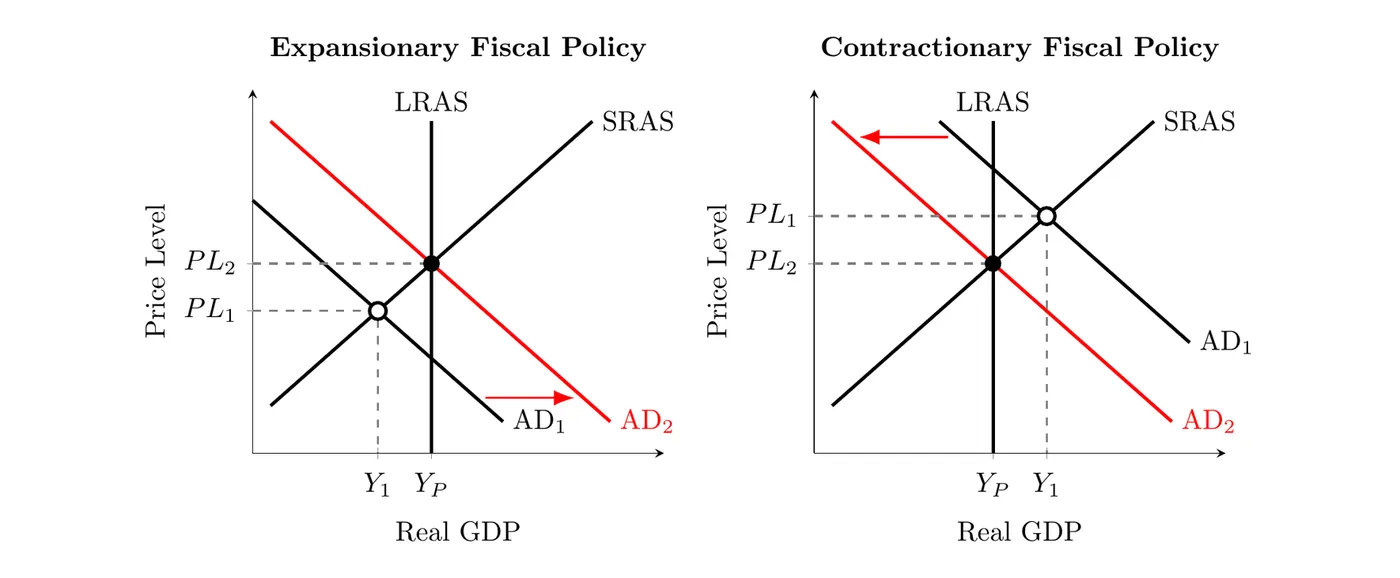
Example: to close a $200 billion inflationary gap when the MPC is 0.8, the spending multiplier is 5 and the tax multiplier is 4. The government could cut spending by $40 billion ($40 billion × 5 = $200 billion) or raise taxes by $50 billion ($50 billion × 4 = $200 billion).
Lags to Fiscal Policy
Fiscal policy suffers from lags that can weaken or even destabilize its effectiveness:
- Recognition lag: the time it takes to gather data and realize the economy is in trouble.
- Decision/legislative lag: the time Congress and the President take to agree on a plan.
- Implementation lag: the time it takes to actually spend the money once a law passes. Money from the 2009 American Recovery Act, for example, was still being spent as late as 2012.
Because of these lags, a stimulus passed during a recession might not reach the economy until it has already started recovering on its own. Then the extra spending pushes AD too far and can create an inflationary gap. That's how lags can destabilize the economy instead of smoothing it.
Takeaway
Fiscal policy, rooted in Keynesian thinking, uses spending, taxes, and transfers to stabilize the economy and close gaps. Expansionary policy (more G or tax cuts) targets recessions, while contractionary policy (less G or tax hikes) fights inflation. But recognition, decision, and implementation lags all limit how effective it can be.