

3.1 - Aggregate Demand (AD)
Introduction and Model Setup
The AD-AS model sits at the center of Unit 3 and most of AP Macro. “Aggregate” just means total. Aggregate Demand is the total demand across the economy for all final goods and services.
- Vertical axis (P): the aggregate price level, similar to the CPI.
- Horizontal axis (Y): real GDP, or aggregate output.
Output and unemployment move inversely: if output changes, unemployment moves the opposite way.
The AD Curve and Its Components
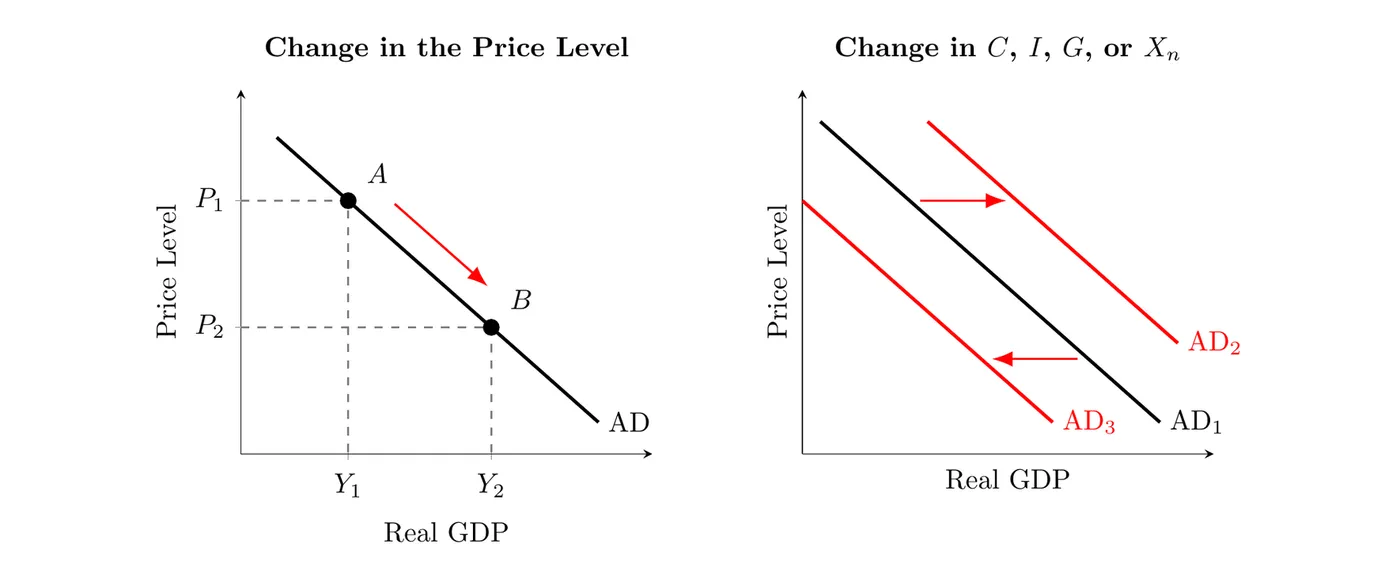
The AD curve slopes downward, showing a negative relationship between the price level and aggregate demand. It represents total spending in the economy:
This matches the GDP formula, since AD captures all spending from households, firms, governments, and foreign buyers.
Reasons for the Downward Slope
The substitution effect, which explains why a single product’s demand curve slopes down, doesn’t apply here since AD already covers demand for everything. Instead, three effects explain the downward slope:
- Real wealth effect: at a higher price level, people can’t afford as much, so demand falls; at a lower price level, they can buy more, so demand rises.
- This works through consumption (C): a higher price level shrinks the real value (purchasing power) of the money and savings people hold, so they feel poorer and buy less.
- Interest rate effect: a lower price level lets people save more, pushing interest rates down, which encourages more borrowing and spending.
- This works mainly through investment (I), plus consumer purchases made with loans: at a higher price level, people and firms need more money to buy the same things, so they borrow more and save less. Interest rates rise, and spending that depends on borrowing falls, like business investment and big purchases such as cars and houses.
- Exchange rate effect: a higher domestic price level makes American goods pricier for foreign buyers, which reduces exports and lowers aggregate demand. A lower price level does the opposite.
- This works through net exports (): Americans also switch toward imports, which are now relatively cheaper than U.S. goods, so net exports fall from both sides.
Shifters of Aggregate Demand
The shifters are the same four components: C, I, G, and .
- Increase (shift right): any of these components rises.
- Decrease (shift left): any of these components falls.
Movement along vs. shift: a change in the price level only moves the economy along the AD curve (that's the three effects above), changing the quantity of real output demanded. A change in C, I, G, or for any reason other than the price level shifts the whole curve.
Determinants of C and I:
- Wealth: rising stock markets or home values boost consumer spending; crashes or falling home prices reduce it.
- Expectations: optimism about the future boosts spending; pessimism reduces it.
- Interest rates: lower interest rates make borrowing cheaper, so firms invest more and households buy more on credit (cars, houses). Higher interest rates do the opposite.
Government policy:
- Fiscal policy (tax and spending decisions):
- Expansionary: increases AD (shift right) through more government spending, tax cuts, or more transfers.
- Contractionary: shifts AD left through spending cuts, tax hikes, or reduced transfers.
- Monetary policy also affects AD (expansionary increases it, contractionary reduces it), though this is mostly a Unit 4 topic.
Determinants of :
- Income abroad: when other countries' economies grow, they buy more U.S. exports, so rises and AD shifts right. A recession abroad does the opposite.
- Exchange rates: if the dollar depreciates, U.S. goods get cheaper for foreign buyers and imports get pricier for Americans, so rises and AD shifts right. An appreciation of the dollar does the opposite (more on this in Unit 6).
Takeaway
Aggregate Demand represents total spending in the economy (), graphed against the price level and real GDP. It slopes downward because of the real wealth, interest rate, and exchange rate effects. Any change in C, I, G, or , often driven by wealth, expectations, or fiscal policy, shifts the entire curve.