

2.9 - International Trade and Public Policy
The goal here is to understand how international trade and protectionist policies like tariffs and quotas affect domestic equilibrium, consumer and producer surplus, and overall efficiency.
Autarky: the closed economy
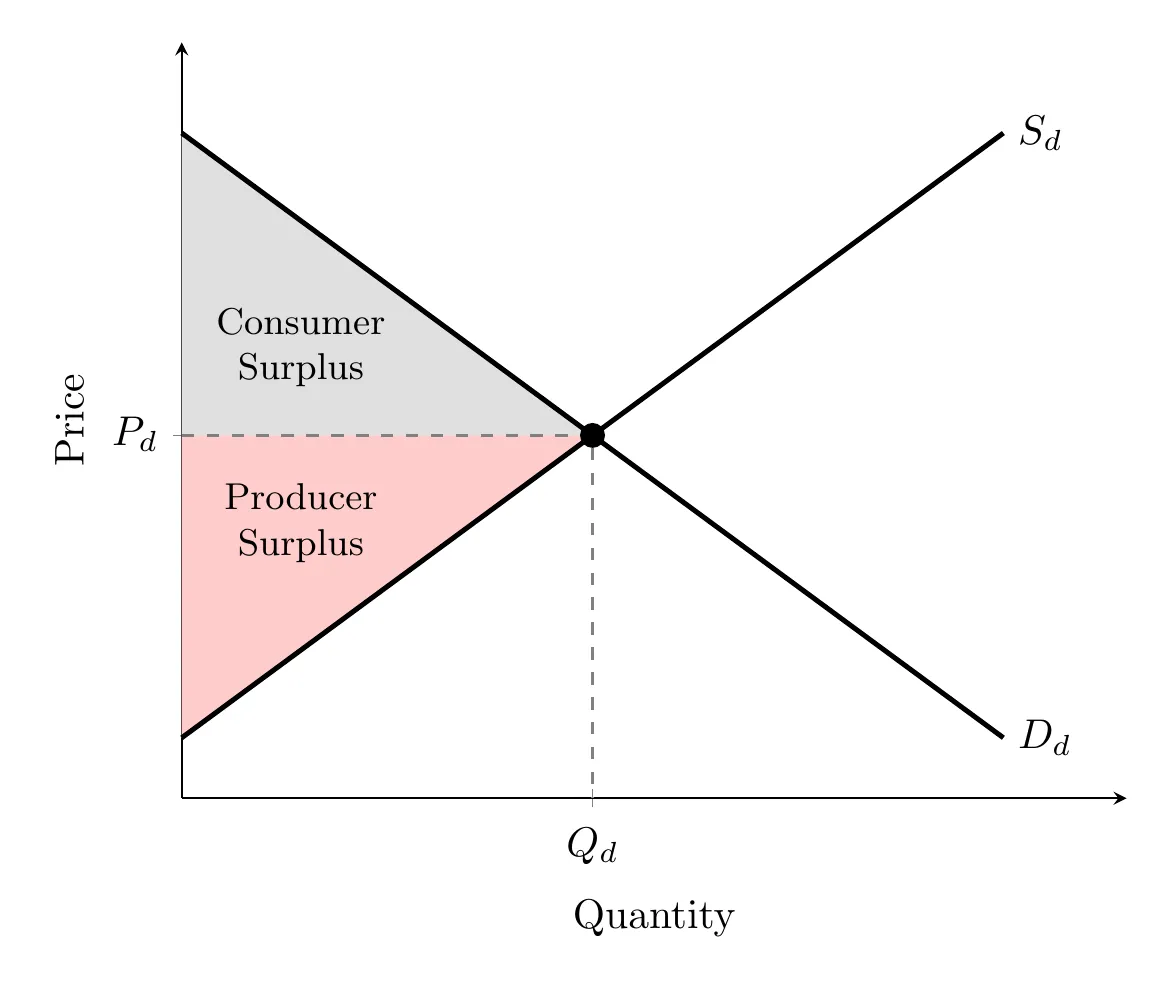
Before trading globally, a country can exist in autarky, meaning it’s fully self-sufficient and doesn’t trade. In that state, price and quantity are set purely by domestic supply and demand, and the market generates its own consumer and producer surplus, together forming total domestic economic surplus.
Opening up to trade
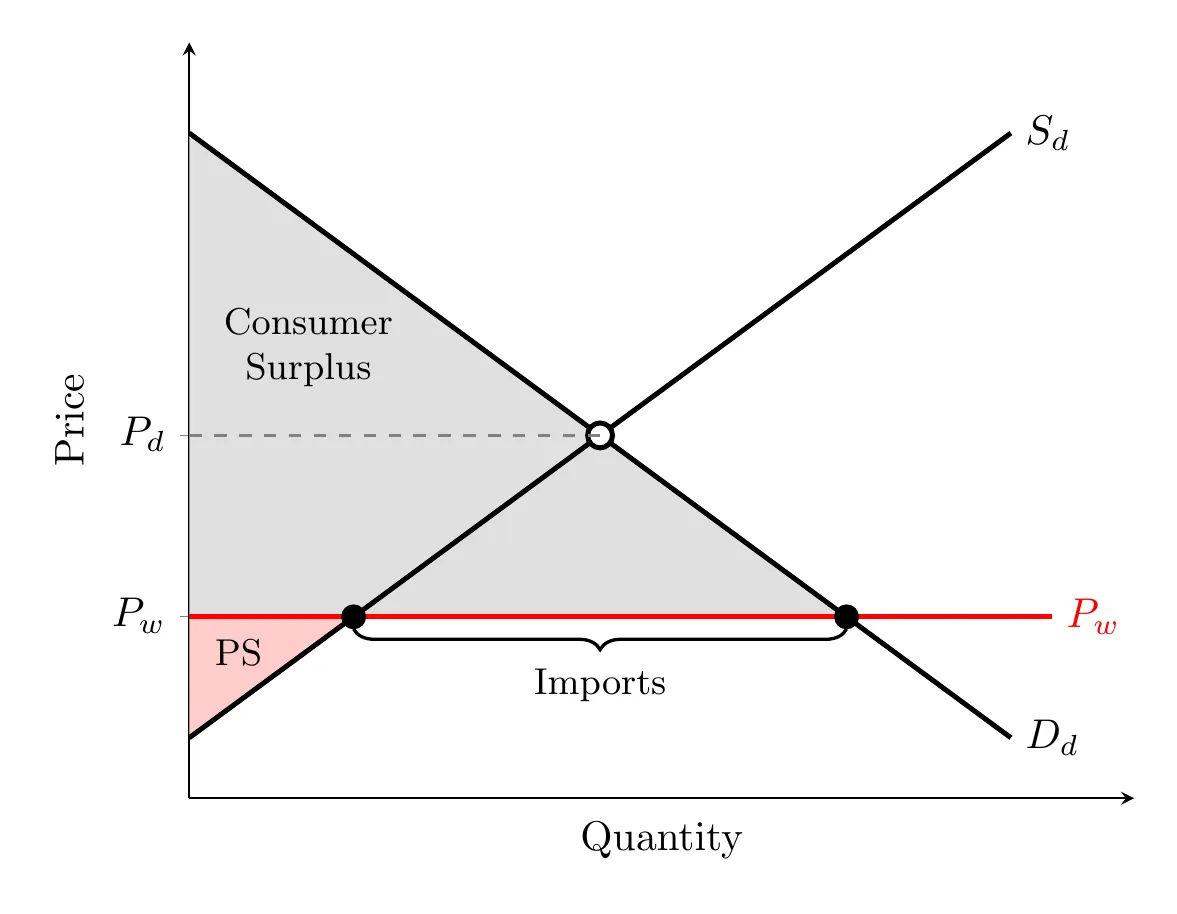
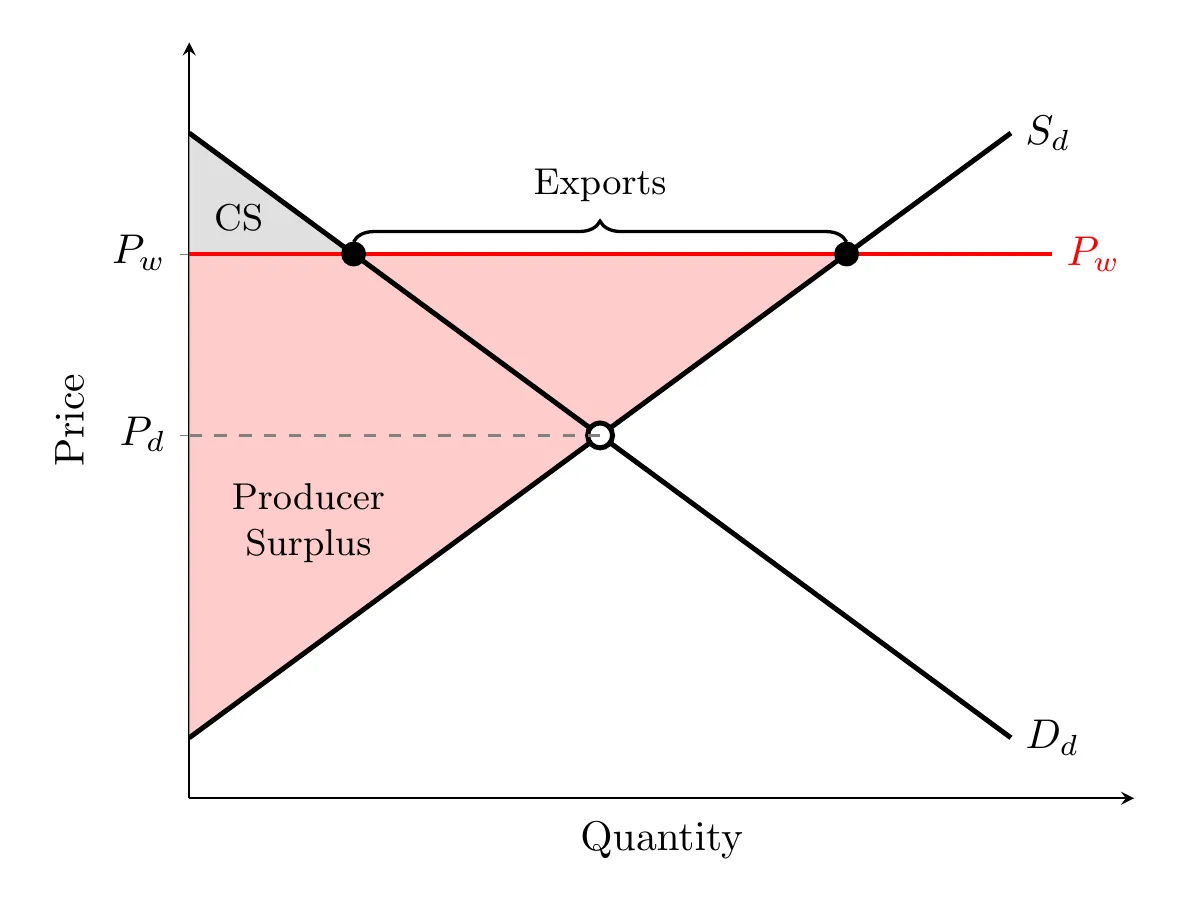
When a country starts trading, it has to reconcile its domestic price with the world price (). We assume a small country model, meaning it’s too small to influence global supply and demand, so it can buy or sell any amount at the world price.
Importing (world price is lower): domestic producers cut output to a lower quantity supplied while domestic consumers buy more. The gap between what consumers want and what local producers make gets filled by imports. Consumer surplus grows a lot, producer surplus shrinks, but total surplus increases overall.
Exporting (world price is higher): the higher price pushes producers to supply more while consumers buy less. The excess supply gets exported. Producer surplus grows a lot while consumer surplus shrinks, but total surplus still rises compared to autarky.
Protectionist policies
When domestic producers lose out to cheap imports, they often lobby for protection.
Import quotas: a legal cap on how much of a good can be imported. This raises the domestic price above the world price (though still below the original autarky price). It helps domestic producers but limits trade, shrinks total surplus, and creates deadweight loss.
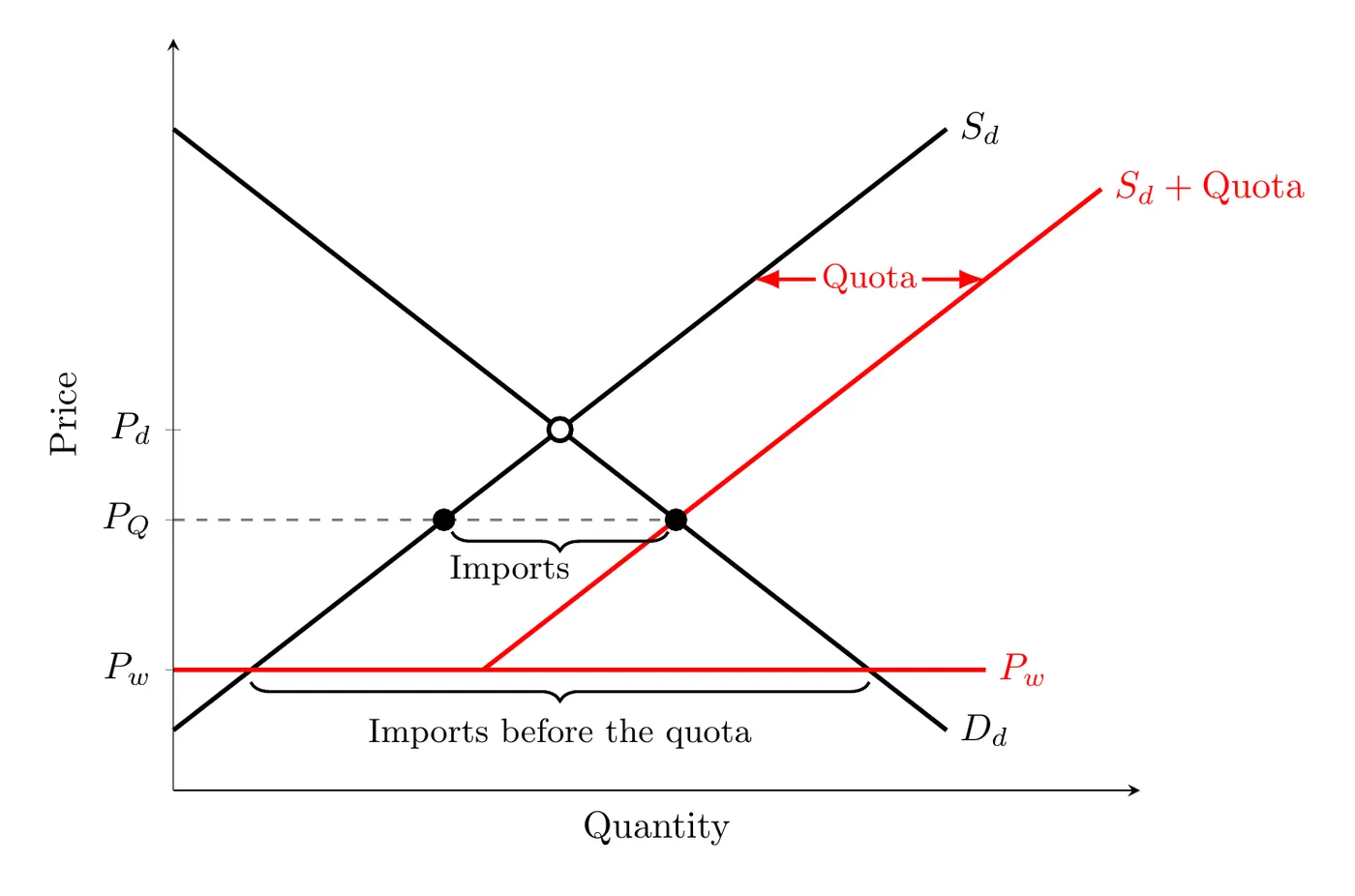
With a quota, imports fall to the quota amount, domestic producers make and sell more at the higher price, and domestic consumers buy less. Unlike a tariff, a quota raises no money for the government: the extra money from selling imports at the higher domestic price goes to whoever holds the import licenses. You won’t have to draw a quota graph on the AP Exam, but you do need to know how a quota changes quantities, price, consumer surplus, and total surplus.
Tariffs: a tax on imports specifically. It raises the effective price to World Price plus Tariff, increasing domestic production and decreasing domestic consumption, which shrinks imports. Consumer surplus falls, producer surplus rises, and the government collects tariff revenue (import quantity times the tariff). Tariffs create two separate deadweight loss triangles and, like quotas, reduce overall efficiency.
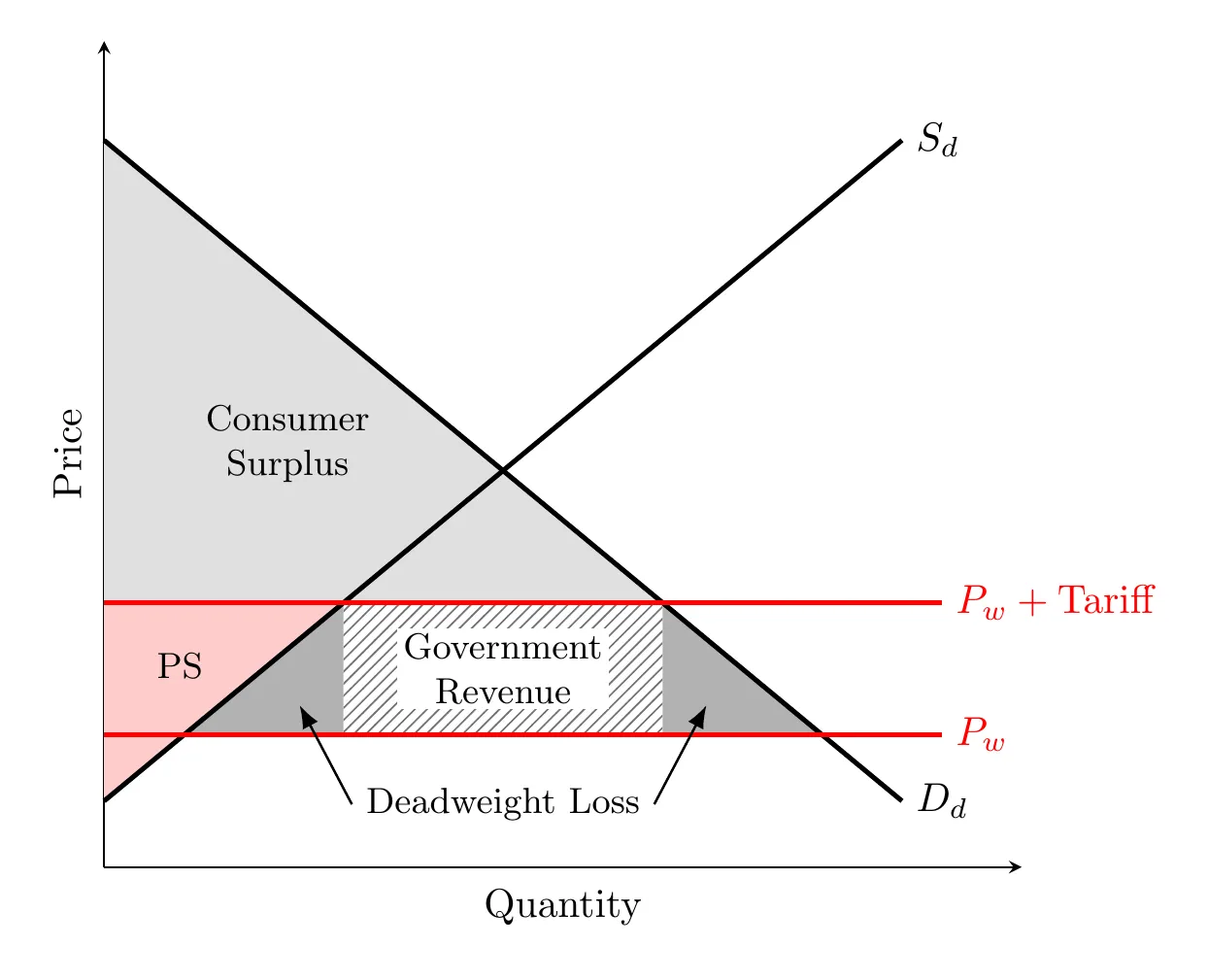
Worked example: the world price is $2, and the country adds a $2 tariff, raising the domestic price to $4.
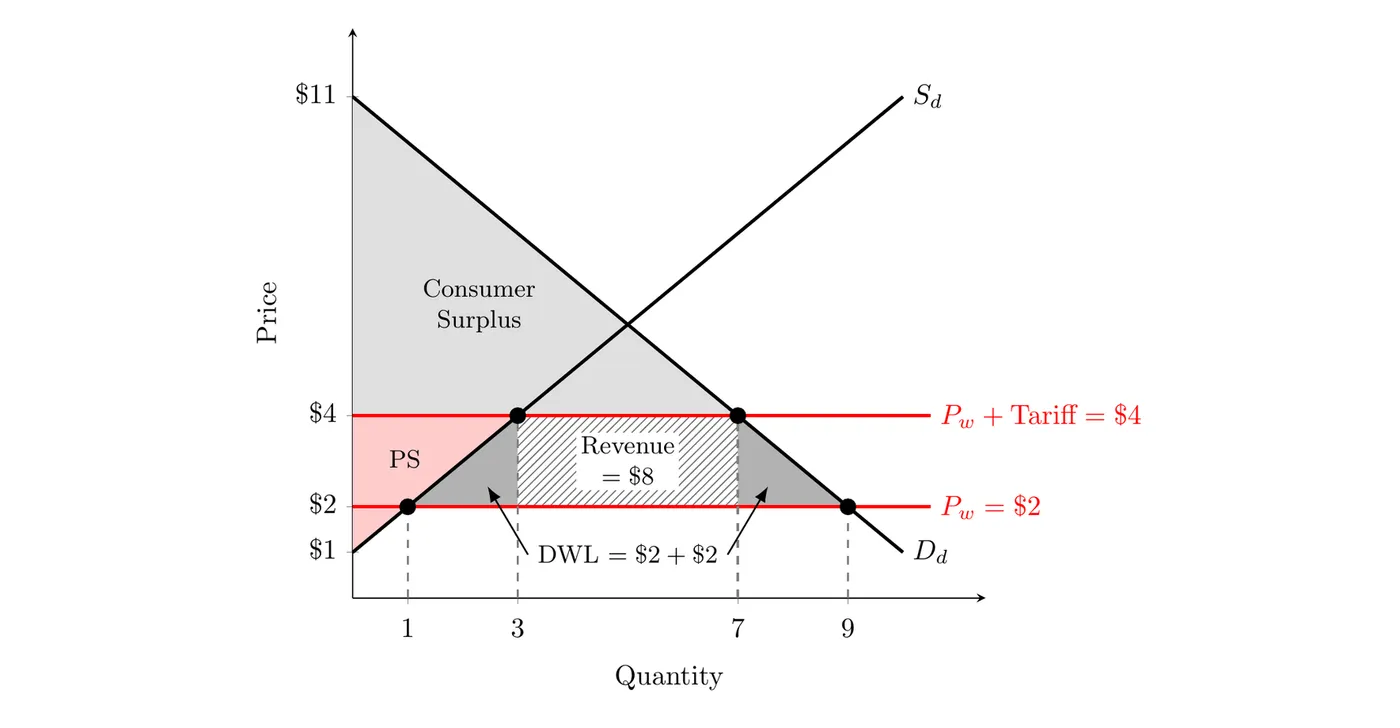
- Before the tariff (price $2): domestic producers make 1 unit and consumers buy 9, so the country imports 8.
- After the tariff (price $4): domestic producers make 3 and consumers buy 7, so imports fall to 4.
- Tariff revenue: $2 × 4 imports = $8.
- Consumer surplus falls by $16 (from $40.50 to $24.50), and producer surplus rises by $4 (from $0.50 to $4.50).
- Deadweight loss: two triangles, each , so $4 total. Check: the $16 consumers lose = $4 to producers + $8 to the government + $4 of deadweight loss.
Takeaway
International trade generally boosts a nation’s total economic surplus by letting it import cheaply or export at a premium. Trade creates winners and losers (consumers vs. producers), but the net gain to society is positive. Tariffs and quotas protect domestic producers from competition, but they come at the cost of shrinking total surplus and creating deadweight loss.
Analogy: picture a small town where the only baker sells bread for $5 a loaf. A bridge gets built to a city where bread costs $2, so townspeople start “importing” cheaper bread. The local baker loses money, but everyone else now has more money for other things, making the town wealthier overall. If the town slaps a “bridge toll” (tariff) on the city bread to protect the local baker, bread gets pricier for everyone, and some of the town’s total wealth just gets wasted.