

10.10 - Alternating Series Error Bound
Prerequisites
Important: the alternating series must converge for error bounds to mean anything. If the series diverges, error bound analysis is pointless.
Understanding Alternating Series Behavior
Before getting into error bounds, we need to see how alternating series converge.
Example: The Alternating Harmonic Series
Consider
This series converges by the Alternating Series Test.
Building a table of terms and partial sums:
Term | Decimal | Partial Sum | Decimal | |
1 | ||||
2 | ||||
3 | ||||
4 | ||||
5 | ||||
6 | ||||
7 | ||||
8 |
Key observation: the partial sums oscillate around the true sum.
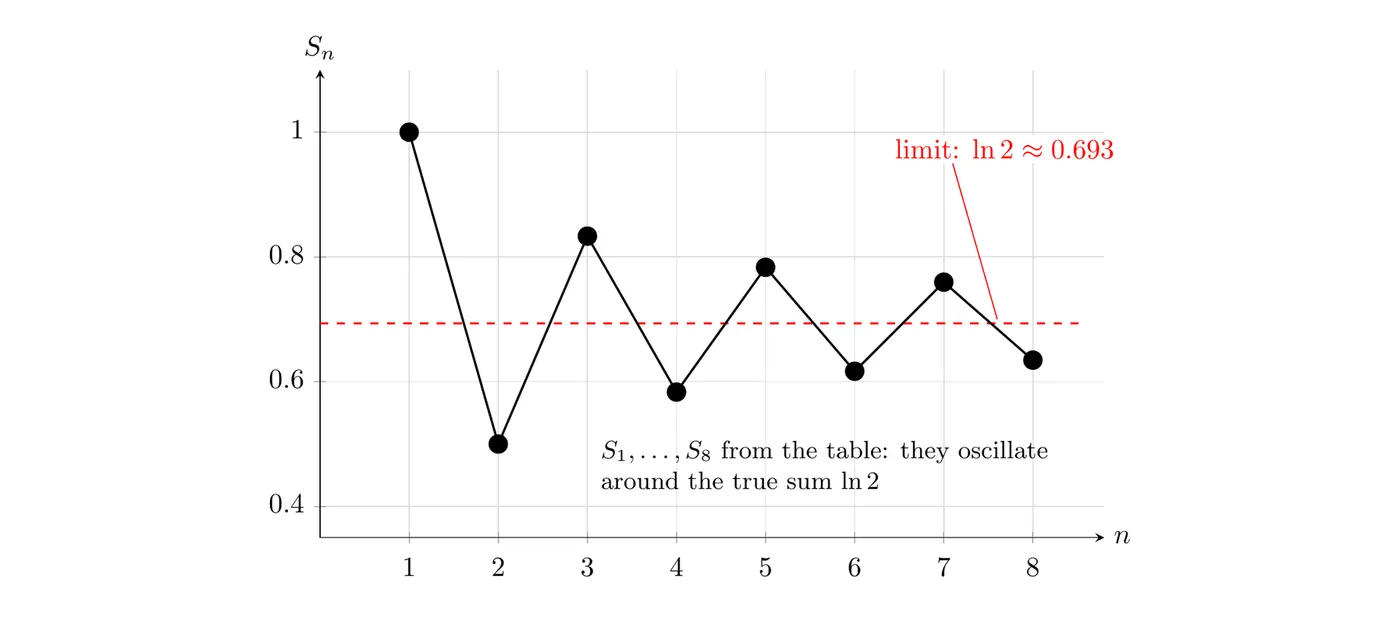
The true sum:
Calculating the Error (Remainder)
The error, also called the remainder, is the difference between the true sum and the partial sum.
where:
- is the true sum of the infinite series
- is the partial sum of the first terms
- is the remainder, or error, after terms
Computing Remainders
For the alternating harmonic series, with :
Error | ||
1 | ||
2 | ||
3 | ||
4 | ||
5 | ||
6 | ||
7 | ||
8 |
Notice: the errors shrink as grows.
The Alternating Series Error Bound Theorem
For an alternating series that passes the Alternating Series Test (, decreasing, and ):
In words: the error from approximating the sum with the first terms is no larger than the absolute value of the next term.
The Relationship Between Error and Error Bound
where is the actual error and is the error bound, meaning the maximum possible error.
The error bound is always the size of the very next term you didn’t include.
Overestimate or Underestimate?
The partial sums take turns landing above and below , so the true sum always sits between two partial sums in a row, and . That tells you which way the error goes:
- If the next term (the first one you left out) is negative, adding it would pull the total down, so is an overestimate: .
- If the next term is positive, is an underestimate: .
Check with the table: , and the next term is (negative). So is an overestimate, and sure enough, .
Verification with the Alternating Harmonic Series
Let’s confirm the theorem holds:
Error | Next term | Does ? | |
1 | Yes, | ||
2 | Yes, | ||
3 | Yes, | ||
4 | Yes, | ||
5 | Yes, |
The theorem holds every time.
Key Definitions
Term : an individual value in the sequence.
Partial sum : the sum of the first terms.
True sum : the limit of the partial sums.
Error (remainder) : the difference between the true sum and the partial sum.
Error bound: the absolute value of the next term.
Example 1: Finding How Many Terms You Need
How many terms of do you need so that the error is less than ?
We need .
Since , we have . Set up the inequality:
Answer: you need more than 999 terms, so at least 1000 terms to guarantee an error below .
Example 2: Finding the Error Bound for a Given Partial Sum
Find the error bound when you use the first 10 terms to approximate .
The error bound is the absolute value of the 11th term.
Answer: the error bound is .
Interpretation: using the first 10 terms gives an approximation that’s off by at most from the true sum.
Example 3: Approximating a Series with an Error Bound
Use the first 5 terms to approximate and find the error bound.
Step 1: Calculate with technology.
Using a calculator with summation notation:
sum((-1)^(n+1) * 4/n^2, n, 1, 5)
Result:
Step 2: Find the error bound, which is .
Step 3: Write the approximation with its error bound.
The true sum satisfies
Answer: the sum is about , with an error bound of , so the true sum lies between and .
Example 4: Proving an Approximation Meets an Error Requirement
Given
show that approximates with an error less than .
Step 1: Evaluate at .
Step 2: Identify the approximation.
This uses the first 2 terms, and .
Step 3: Find the error bound, which is .
Step 4: Compare to the required error.
We need the error to be less than , and
Conclusion: since , the approximation has an error less than .
Finding Intervals of Convergence with Error Bounds
For power series with a parameter , we can find where the approximations meet an error requirement.
Example 5: Error Bound with a Variable (Advanced)
The series converges for by the AST. For which of these values can you guarantee that the partial sum approximates the sum with an error less than ?
Step 1: Check the AST conditions. For , the terms are positive, they decrease (the numerator never grows and the denominator does), and they approach .
Step 2: Write and the first term left out.
Step 3: Make the error bound less than .
Answer: for , is guaranteed to be within of the true sum. Closer to the terms are bigger, so you’d need more terms.
Important Notes and Common Applications
When Can You Use the Error Bound Theorem?
Requirements:
- The series has to be alternating
- The series has to converge
- The terms have to be decreasing in absolute value
- The terms have to approach zero
These are the same requirements as the Alternating Series Test.
Why This Matters
Practical use: you can approximate infinite sums with finite calculations and still guarantee your accuracy.
On the AP exam: error bound problems show up regularly on BC free response questions.
Strategy for Error Bound Problems
Type 1: “How many terms do I need for error less than ?”
- Set up
- Solve for
- Answer with the smallest integer that satisfies the inequality
Type 2: “What’s the error bound using terms?”
- The error bound is
- Calculate the st term
- Take the absolute value
Type 3: “Approximate the sum with an error bound”
- Calculate with technology
- Find , the error bound
- Report
Type 4: “Prove the approximation meets the error requirement”
- Identify which partial sum is being used
- Calculate the next term, which is the error bound
- Compare it to the required error
- State your conclusion
Key Takeaways
- Error bound theorem: for an alternating series that passes the AST,
- The error bound is the next term, meaning the size of the very next term you left out
- It has to converge first. Error bounds only apply to convergent alternating series
- Partial sums oscillate, landing alternately above and below the true sum
- Errors shrink as grows
- It’s the next term, not the next partial sum. The bound is , not
- Absolute value matters. Take even when the term is negative
- Technology helps. Use your calculator’s summation notation
- Common AP problem. It shows up often on the BC exam
- Practical application: it lets you approximate with a guaranteed accuracy
- Four problem types: terms needed, find the bound, approximate with a bound, and prove a requirement
- Visual understanding: the graph shows oscillation around the true sum with shrinking amplitude