Dove's LibraryDove's Library

10.2 - Working with Geometric Series

Geometric Sequences

A geometric sequence is one where you get each term by multiplying the previous term by a constant called the common ratio rr.
General form: a,ar,ar2,ar3,ar4,…a, ar, ar^2, ar^3, ar^4, \ldots
where aa is the first term and rr is the common ratio.

Example 1: Identifying Geometric Sequences

5,15,45,135,…5, 15, 45, 135, \ldots
r=155=3r = \frac{15}{5} = 3
Check: 4515=3\frac{45}{15} = 3 and 13545=3\frac{135}{45} = 3. So r=3r = 3.
80,40,20,10,…80, 40, 20, 10, \ldots
r=4080=12r = \frac{40}{80} = \frac{1}{2}
So r=12r = \frac{1}{2}, meaning you halve each time.

Formula for the nnth Term

an=a1⋅rn−1a_n = a_1 \cdot r^{n-1}
Alternative forms. Starting from a “zeroth” term:
an=a0⋅rna_n = a_0 \cdot r^n
Starting from the kkth term:
an=ak⋅rn−ka_n = a_k \cdot r^{n-k}

Example 2: Finding a Formula

Given 2,6,18,54,…2, 6, 18, 54, \ldots, the common ratio is r=62=3r = \frac{6}{2} = 3.
Starting with a1=2a_1 = 2: an=2⋅3n−1a_n = 2 \cdot 3^{n-1}
Starting with a2=6a_2 = 6: an=6⋅3n−2a_n = 6 \cdot 3^{n-2}
Starting with a0a_0: work backwards, 2÷3=232 \div 3 = \frac{2}{3}, so an=23⋅3na_n = \frac{2}{3} \cdot 3^n
Verify they all agree at n=1n = 1:
  • 2⋅30=22 \cdot 3^0 = 2
  • 6⋅3−1=26 \cdot 3^{-1} = 2
  • 23⋅3=2\frac{2}{3} \cdot 3 = 2

Infinite Geometric Series

∑n=k∞arn=ark+ark+1+ark+2+⋯\sum_{n=k}^{\infty} ar^n = ar^k + ar^{k+1} + ar^{k+2} + \cdots
The most common version starts at n=0n = 0:
∑n=0∞arn=a+ar+ar2+ar3+⋯\sum_{n=0}^{\infty} ar^n = a + ar + ar^2 + ar^3 + \cdots

Convergence Test

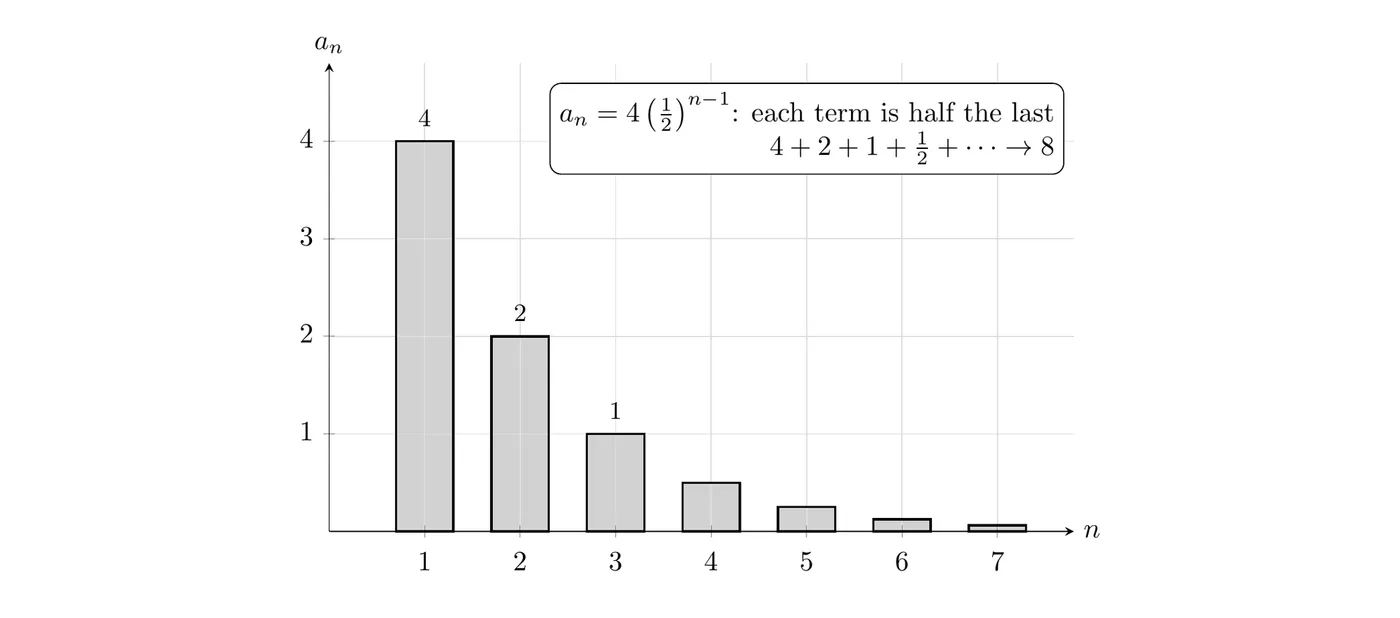
An infinite geometric series converges if and only if ∣r∣<1|r| < 1.
∣r∣<1  ⟹  CONVERGES|r| < 1 \implies \text{CONVERGES}∣r∣≥1  ⟹  DIVERGES|r| \geq 1 \implies \text{DIVERGES}
Why: when ∣r∣<1|r| < 1, each term is smaller than the last and they shrink toward zero. When ∣r∣≥1|r| \geq 1, the terms don’t shrink to zero, so the sum runs away.
10.2 - Working with Geometric Series

Sum Formula

When ∣r∣<1|r| < 1:
∑n=k∞arn=ark1−r\sum_{n=k}^{\infty} ar^n = \frac{ar^k}{1-r}
Note that arkar^k is just the first term of the series as written.
Most common form, starting at n=0n = 0:
∑n=0∞arn=a1−r\sum_{n=0}^{\infty} ar^n = \frac{a}{1-r}
Where the formula comes from. Use the multiply-and-subtract trick from 10.1 on the nnth partial sum, Sn=a+ar+ar2+⋯+arn−1S_n = a + ar + ar^2 + \cdots + ar^{n-1}:
Sn−rSn=a−arn⇒Sn=a(1−rn)1−r(r≠1)S_n - rS_n = a - ar^n \quad \Rightarrow \quad S_n = \frac{a(1 - r^n)}{1 - r} \quad (r \neq 1)
If ∣r∣<1|r| < 1, then rn→0r^n \to 0, so Sn→a1−rS_n \to \frac{a}{1-r}, and the limit of the partial sums is the sum of the series. If ∣r∣≥1|r| \geq 1 (and a≠0a \neq 0), the partial sums never settle on one number (for r=1r = 1, Sn=naS_n = na), so the series diverges. That’s why the cutoff is exactly ∣r∣<1|r| < 1.

Example 3: Finding the Sum

Find ∑n=0∞52n\sum_{n=0}^{\infty} \frac{5}{2^n}.
Step 1: Rewrite.
∑n=0∞5(12)n\sum_{n=0}^{\infty} 5 \left(\frac{1}{2}\right)^n
Step 2: Identify aa and rr. Plug in n=0n = 0 for the first term: a=5a = 5. And r=12r = \frac{1}{2}.
Step 3: Check convergence. ∣r∣=12<1|r| = \frac{1}{2} < 1, so it converges.
Step 4: Apply the formula.
51−12=512=10\frac{5}{1 - \frac{1}{2}} = \frac{5}{\frac{1}{2}} = 10
The series converges to 10.

Example 4: More Complex Terms

Find ∑n=3∞4n+15n\sum_{n=3}^{\infty} \frac{4^{n+1}}{5^n}.
Step 1: Rewrite.
4n+15n=4n⋅45n=4(45)n\frac{4^{n+1}}{5^n} = \frac{4^n \cdot 4}{5^n} = 4 \left(\frac{4}{5}\right)^n
So the series is ∑n=3∞4(45)n\sum_{n=3}^{\infty} 4 \left(\frac{4}{5}\right)^n.
Step 2: Identify. r=45r = \frac{4}{5}. The first term (plug in n=3n = 3) is
4(45)3=4⋅64125=2561254 \left(\frac{4}{5}\right)^3 = 4 \cdot \frac{64}{125} = \frac{256}{125}
Step 3: Check convergence. ∣r∣=0.8<1|r| = 0.8 < 1, converges.
Step 4: Apply the formula.
256/1251−45=256/1251/5=256125⋅5=25625=10.24\frac{256/125}{1 - \frac{4}{5}} = \frac{256/125}{1/5} = \frac{256}{125} \cdot 5 = \frac{256}{25} = 10.24

Example 5: A Divergent Series

Does ∑n=1∞3⋅2n\sum_{n=1}^{\infty} 3 \cdot 2^n converge?
Here r=2r = 2, so ∣r∣=2>1|r| = 2 > 1. The series diverges. No sum exists.

Working Backwards: Finding rr from the Sum

Example 6

A geometric series starting at n=0n = 0 has first term 1212 and sum 1818. Find rr.
a1−r=18⇒121−r=18\frac{a}{1-r} = 18 \quad \Rightarrow \quad \frac{12}{1-r} = 1812=18−18r⇒18r=6⇒r=1312 = 18 - 18r \quad \Rightarrow \quad 18r = 6 \quad \Rightarrow \quad r = \frac{1}{3}
Check: ∣r∣=13<1|r| = \frac{1}{3} < 1, so the convergence condition holds.

Using Technology for Messy Series

Example 7: Trig Functions

Find ∑n=4∞[sin⁡2(52)]n\sum_{n=4}^{\infty} \left[\sin^2\left(\frac{5}{2}\right)\right]^n.
Step 1: Identify the structure. This is geometric with r=sin⁡2(52)r = \sin^2\left(\frac{5}{2}\right).
Step 2: Calculate rr (in radians, and store it, don’t round).

r=sin⁡2(2.5)≈0.3582r = \sin^2(2.5) \approx 0.3582
Step 3: Check convergence. ∣r∣≈0.3582<1|r| \approx 0.3582 < 1, converges.
Step 4: Find the first term at k=4k = 4.
r4=[sin⁡2(2.5)]4≈0.01646r^4 = \left[\sin^2(2.5)\right]^4 \approx 0.01646
Step 5: Apply the formula.
0.016461−0.3582≈0.016460.6418≈0.0256\frac{0.01646}{1 - 0.3582} \approx \frac{0.01646}{0.6418} \approx 0.0256
Important: store the intermediate values in calculator memory. Don’t round until the very end.

Step-by-Step Strategy

  1. Rewrite in the form ∑arn\sum ar^n
  1. Identify the common ratio rr
  1. Check convergence: is ∣r∣<1|r| < 1? If not, stop, it diverges
  1. Find the first term arkar^k by plugging in the starting value of nn
  1. Apply the formula: ark1−r\frac{ar^k}{1-r}
  1. Simplify

Common Pitfalls

  • Forgetting the absolute value in the convergence test. ∑3(−12)n\sum 3\left(-\frac{1}{2}\right)^n converges because ∣−12∣=12<1\left|-\frac{1}{2}\right| = \frac{1}{2} < 1.
  • Getting the first term wrong. If the series starts at n=2n = 2, the first term is ar2ar^2, not aa.
  • Rounding intermediate values. Store them; round only the final answer.
  • Confusing ana_n with SnS_n. One is a term, the other is a sum.
  • Using the sum formula when ∣r∣≥1|r| \geq 1. Always check convergence first.
10.2 - Working with Geometric Series

Key Takeaways

  • Geometric sequence: multiply by the constant rr to get the next term
  • Common ratio: r=an+1anr = \frac{a_{n+1}}{a_n}, any term divided by the previous one
  • nnth term: an=a1⋅rn−1a_n = a_1 \cdot r^{n-1}
  • Converges if and only if ∣r∣<1|r| < 1 (absolute value matters)
  • ∣r∣≥1|r| \geq 1 means it diverges, so no sum
  • Sum formula: ∑n=k∞arn=ark1−r\sum_{n=k}^{\infty} ar^n = \frac{ar^k}{1-r} when ∣r∣<1|r| < 1
  • Most common form: ∑n=0∞arn=a1−r\sum_{n=0}^{\infty} ar^n = \frac{a}{1-r}
  • Identify the first term based on the starting index
  • Store calculator values, don’t round early
  • Always check convergence before applying the sum formula
  • You can solve for rr backwards if you’re given the sum and first term

AP® is a registered trademark of the College Board, which is not affiliated with Dove's Library and was not involved in the production of, and does not endorse, this website.

Providing free, high-quality AP notes to help students succeed, earn college credit, and reach their educational goals, ensuring everyone has access to the resources they need.

© 2026 Standard Learning Group, Inc., which operates Dove's Library. All rights reserved.