

10.7 - Alternating Series Test for Convergence
Definition of an Alternating Series
An alternating series is one whose terms flip sign: positive, negative, positive, negative, and so on.
where for all .
The difference between the two:
- : the first term is negative (when )
- : the first term is positive (when )
Structurally, the or creates the sign pattern, and is the positive magnitude of each term.
The Alternating Series Test (AST)
For or , where :
The series CONVERGES if both conditions hold.
Condition 1: the terms approach zero
Condition 2: the terms are decreasing
Equivalently,
If either condition fails, the test is inconclusive. (And if Condition 1 fails, the series actually diverges by the nth term test.)
Checking if the Terms Are Decreasing
Three ways:
Method 1: take the derivative (least recommended). Treat as a function and show past some point. It works, but it’s usually tedious.
Method 2: plug in values (most intuitive). Compute and see that each term is smaller than the last. Usually it’s obvious.
Method 3: algebraic manipulation (most rigorous). Show that . Or, often easier, show that:
If the ratio is less than 1, then .
Example 1: The Alternating Harmonic Series
Does converge or diverge?
Step 1: identify it as alternating. It has the form with .
Written out:
Step 2: check Condition 1
Step 3: check Condition 2. The terms are , and clearly:
Both conditions hold, so the series converges by the Alternating Series Test.
Worth pausing on: the regular harmonic series diverges, but the alternating harmonic series converges. That’s how much of a difference alternation makes.
Example 2: Rational Function with Alternating Sign
Does converge or diverge?
Step 1: identify
Step 2: check Condition 1. The denominator has degree 2 and the numerator degree 1, so:
Step 3: check Condition 2 using the ratio method. We need .
Form the ratio:
Expand the numerator:
Expand the denominator:
Now compare. The denominator is exactly the numerator plus , which is positive for all :
Since the denominator is bigger than the numerator:
Both conditions hold, so the series converges by AST.
Example 3: When Condition 1 Fails
Does converge or diverge?
Step 1: identify
Step 2: check Condition 1
Since the limit is , Condition 1 fails.
The series diverges.
You can stop right here. By the nth term test for divergence, if , the series has to diverge, alternating or not. No need to check whether the terms are decreasing.
Alternating Series Without an Explicit
Sometimes the alternation is hiding in a trig function.
Example 4: cosine creating alternation
Does converge or diverge?
Step 1: recognize the pattern. Evaluate :
So , which means:
That’s the alternating harmonic series in disguise.
Step 2: apply AST with
- Condition 1: ✓
- Condition 2: is decreasing ✓
The series converges by AST.
When a Series Is NOT Alternating
Careful. Not every series with a in it actually alternates.
Example 5: double alternation cancels out
Is alternating?
Step 1: analyze the sign pattern. There are two alternating factors:
- : alternates
- : also alternates
Step 2: multiply them
- : (positive)
- : (positive)
- : (positive)
The product is always positive.
This is not an alternating series. The two alternating factors cancel each other out, leaving every term positive. You’d need a different test.
Strategy for Alternating Series Problems
Step 1: confirm it’s actually alternating.
- Look for or
- Or check whether a trig function is creating the alternation
- Watch for double alternation that cancels out
Step 2: apply Condition 1.
- Compute
- Limit isn’t 0 → stop, the series diverges by the nth term test
- Limit is 0 → continue
Step 3: apply Condition 2.
- Show the terms are decreasing
- Easiest: plug in values, or show
Step 4: conclude.
- Both conditions met → converges by AST
- Either fails → the test is inconclusive (or it diverges, if Condition 1 failed)
Alternating vs. Non-Alternating
Series | Type | Result |
Harmonic (not alternating) | Diverges | |
Alternating harmonic | Converges | |
p-series, | Converges | |
Alternating p-series | Converges |
Alternation can turn a divergent series into a convergent one. But it doesn’t always change anything.
Common Mistakes to Avoid
- Forgetting to check Condition 1. Always verify first
- Including the in . is the positive magnitude only. Wrong: . Right:
- Checking the wrong thing for Condition 2. You need decreasing, not
- Not recognizing cancellation. Check whether multiple alternating factors cancel
- Stopping at Condition 1. Both conditions are required
Visual Understanding
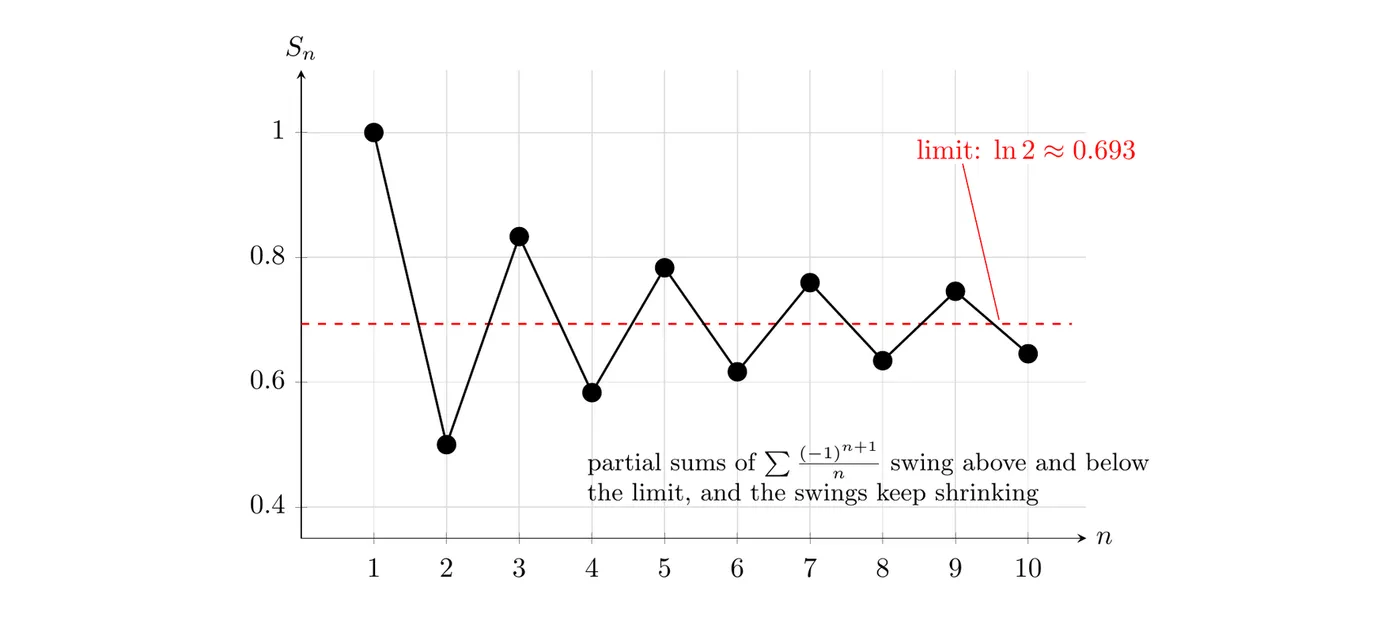
The partial sums oscillate above and below the limit, with the swings shrinking each time, eventually closing in on the value.
Key Takeaways
- Alternating series: terms flip sign, usually via or
- Two conditions for convergence:
- is decreasing ()
- Both are required. If either fails, AST doesn’t guarantee convergence
- Condition 1 failing means the series diverges by the nth term test
- Three ways to check decreasing: derivative (hard), plugging in values (intuitive), or the ratio (rigorous)
- The alternating harmonic series converges, even though the regular harmonic series diverges
- Alternation can change behavior: some divergent series converge once you alternate them
- vs. : the only difference is the starting sign
- Watch for hidden alternation: , while (not alternating at all)
- Double alternation cancels: is always positive
- is the magnitude. Don’t include the when you identify it